ST. PETERSBURG, Fla.–The effects of the recent federal stimulus payments continue to be seen in the most recent card spending data released by PSCU.
PSCU’s Advisors Plus and Data & Analytics teams has released its latest year-over-year weekly performance trends, comparing the fourth week of the year (ending Jan. 24) with the ending Jan. 26, 2020.
“Spending remained strong in Week 4, with debit growth across the goods, service and grocery merchant categories remaining elevated from the recent federal stimulus payments,” said Glynn Frechette, SVP, Advisors Plus at PSCU. “In this week’s deeper dive, we look back at contactless activity and the strong adoption of card present 'tap-and-go' transactions throughout the pandemic. Increased adoption of contactless has driven continued growth, with contactless debit outperforming credit. The average purchase amount for contactless debit transactions is almost half the average purchase amount for debit transactions overall, a strong indicator of the ongoing shift away from cash traditionally used for smaller-spend purchases.”
According to PSCU, spending remained strong for credit and debit in the fourth week of January 2021, with growth in debit purchases in the goods, service and grocery sectors continuing to be aided by the second round of COVID-19 relief funding.
Among the data points:
- Debit card spend was up 23.4% in Week 4 and debit transactions finished up 7.2%. Debit purchases were lower than the previous four-week average of +25.1% and transactions were also lower than the previous four-week average of +8.3%.
- Credit card spend in Week 4 finished up 3.8%, just below the previous four-week average of 4%. Transactions finished down 3.1%, lower than the previous four-week average of 1.3%.
Digital Payments
PSCU said consumers continue to show strong adoption of digital payments, including contactless, mobile wallets and Card Not Present (CNP) alternatives, while using less cash.
Among the findings:
- Contactless “tap-and-go” transactions via dual interface cards continue to show strong consumer acceptance, with debit showing notable strength. Debit contactless transactions as a percent of card present activity on contactless debit cards have more than doubled from around 8.4% in January 2020 to 18% in Week 4 of 2021.
Contactless credit transactions have also more than doubled, growing from 6.5% to 13.4% of card present activity on contactless credit cards in the same timeframe. “We continue to view these results as conservative, as the ratio considers the proportion of contactless activity to all card present transactions, not just those able to be tapped,” PSCU said.
- Mobile wallet (i.e. “Pays”) transactions and purchases for both credit and debit cards continue to show good growth with card present activity. Debit mobile wallet purchases finished Week 4 up 67.6% year over year, lower than the previous four-week average of +72.9%. Credit mobile wallet purchases are up 47.5% year over year, in line with the previous four-week average of +47.1%. PSCU said the results represent six supported mobile wallets: Apple Pay, Fitbit Pay, Garmin Pay, Google Pay, LG Pay and Samsung Pay.
- “We continue to see more volume conducted via Card Not Present (CNP) transactions,” said PSCU. “For credit, 55.2% of purchase volume and 45% of transactions are CNP. For debit, 43.7% of purchase volume and 30.9% of transactions are CNP. Purchase mix has held steady and is up 7.1 percentage points year over year for credit and seven percentage points for debit. Transaction mix also remains steady, up 10 percentage points for credit and 7.6 percentage points for debit year over year.”
- Cash withdrawal transactions at the ATM were down year over year. For the most recent week, the number of cash withdrawals was down 15.6%, below the previous four-week average of -13.4%.
Merchant Categories
From a merchant category perspective, the start of 2021 continues to show strong results in Goods, Utilities, Services, Grocery Stores and Restaurants, while year-over-year performance for Travel and Gasoline remains depressed, according to PSCU.
The CUSO reported:
- Purchases in the Goods sector remained strong, up 24.4% year over year for credit and 44.4% for debit, despite a weekly change of -3.1 and -7.4 percentage points, respectively.
- Utilities spend was up 25% year over year for debit and up 16.9% for credit; Service spend was up 26.1% year over year for debit and up 9.7% for credit; Grocery spend was up 13.2% for debit and up 15.4% for credit; Restaurants were up 9.2% for debit and down 18.2% for credit.
- Travel was down 19.2% year over year for debit and down 55.6% for credit; Gasoline was up 2.4% for debit and down 12.8% for credit.
Regional Analysis
With its regional analysis of spend based on the segmentation used by the U.S. Bureau of Economic Analysis (BEA), PSCU reported:
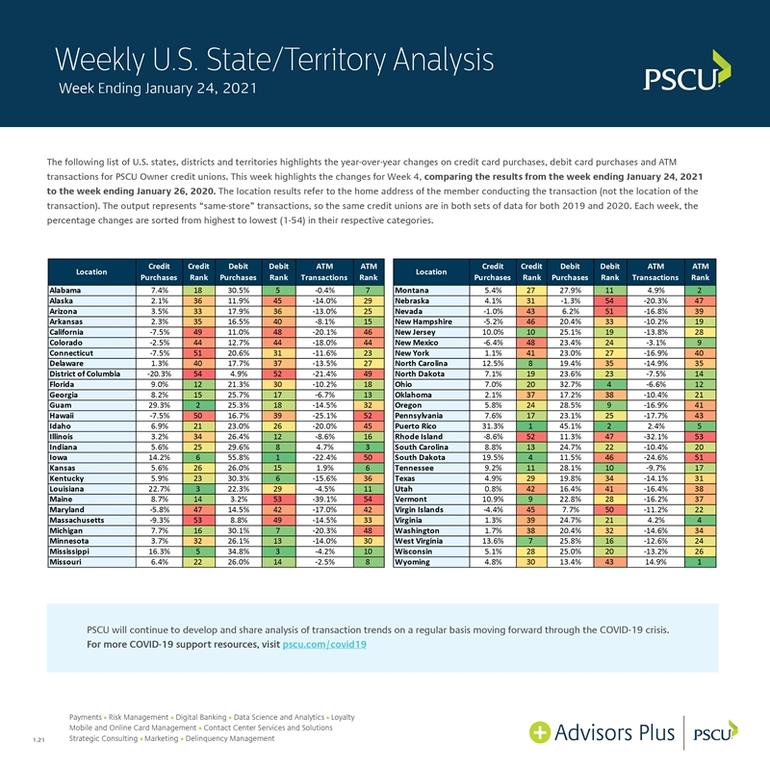
- Overall U.S. spend was up 3.8% for credit purchases. The Great Lakes (+5.4%) and Southeast (+8.1%) finished as the strongest regions for Week 4. Hawaii (-7.5%) and the New England region (-5.3%) had the lowest credit purchase performance.
- Overall U.S. spend was up 23.4% for debit purchases. The Great Lakes (+29.0%) and Plains (+27.0) regions finished as the strongest regions for Week 4. Hawaii (+16.7%) and the Far West (+14.4%) region had the lowest debit purchase performance.
- PSCU noted its Weekly U.S. State/Territory Analysis is available at www.PSCU.com/COVID19, and ranks U.S. states and territories by year-over-year performance for debit purchases, credit purchases and ATM transactions.
The Deeper Dive
This week’s PSCU deeper dive revisits Contactless “Tap-and-Go” Activity.
“Throughout the course of the pandemic, we have seen the strong adoption of Card Present ‘tap-and-go’ transactions and continue to see growth driven by a combination of increased member use and merchant adoption,” PSCU said. “We have observed that contactless debit is performing better than contactless credit.”
PSCU said the data below reflect the most notable sectors and their Week 4 results. The percentages represent Card Present contactless tap-and-go purchase transactions as a subset of all contactless card purchase transactions.
- Restaurants: 21% of debit transactions and 16.7% of credit transactions are tap-and-go. For 2020 Week 4, the results were 10% of debit transactions and 14% of credit transactions. Within the Restaurant sector, Fast Food Restaurants have a higher level of contactless activity than dine-in restaurants and bars/taverns. For Week 4, their contactless transactions are broken out below.
- Fast Food Restaurants: 26% of debit transactions and 21% of credit transactions. For 2020 Week 4, the results were 16% of debit transactions and 9% of credit transactions.
- Dine-In Restaurants: 9% of debit transactions and 11% of credit transactions. For 2020 Week 4, the results were 5% of debit transactions and 5% of credit transactions.
- Bars/Taverns: 8% of debit transactions and 9% of credit transactions. For 2020 Week 4, the results were 4% of debit transactions and 6% of credit transactions.
- Goods: 17% of debit transactions and 12% of credit transactions are tap-and-go. For 2020 Week 4, the results were 8% of debit transactions and 6% of credit transactions.
- Grocery Stores: 18% of debit transactions and 14% of credit transactions are tap-and-go. For 2020 Week 4, the results were 7% of debit transactions and 6% of credit transactions.
- Drug Stores: 37% of debit transactions and 18% of credit transactions are tap-and-go. For 2020 Week 4, the results were 22% of debit transactions and 8% of credit transactions.
- One of the expectations of contactless is the shift of small-dollar “everyday spend” purchases that most often take place with cash, PSCU stated. Accordingly, the average purchase amount for tap-and-go is lower than non-contactless transactions. For Week 4, the average purchase amount for contactless debit is $21.84, lower than the overall average purchase amount for debit of $42.11 by 48%. The average purchase amount for contactless credit is $43.26, lower than the overall average purchase amount for credit of $67.36 by 36%.