

LAWRENCEVILLE, Ga.—After years of volatility that upended auto lending assumptions, Black Book says 2026 will mark a long-awaited return to stability in vehicle values—but not a return to simplicity.
For credit union lenders, the outlook suggests more predictable depreciation and residuals on paper, paired with growing fragmentation beneath the surface that will demand sharper underwriting and portfolio segmentation.
Black Book projects total light-vehicle sales of 15.7 million units in 2026, with retail sales holding near 13 million. Used vehicle values are expected to remain elevated, with the Used Vehicle Retention Index ending the year at 139—essentially flat from where it began. For lenders, that signals steadier collateral performance after years of swings that complicated loan-to-value calculations, pricing, and risk modeling. Depreciation for 2–6-year-old vehicles is forecast at 11.9%, close to historical norms and a welcome shift for credit unions managing longer-term auto portfolios.
K-Shaped Market
That stability, however, masks widening divergence across vehicle segments and borrower profiles. Black Book points to a “K-shaped” market in which affordability pressures are pushing many consumers toward older, higher-mileage vehicles, while more affluent buyers continue to absorb higher prices and richer trims on the new side. For lenders, this means risk is no longer evenly distributed: similar loan terms may behave very differently depending on vehicle age, fuel type, and borrower income.
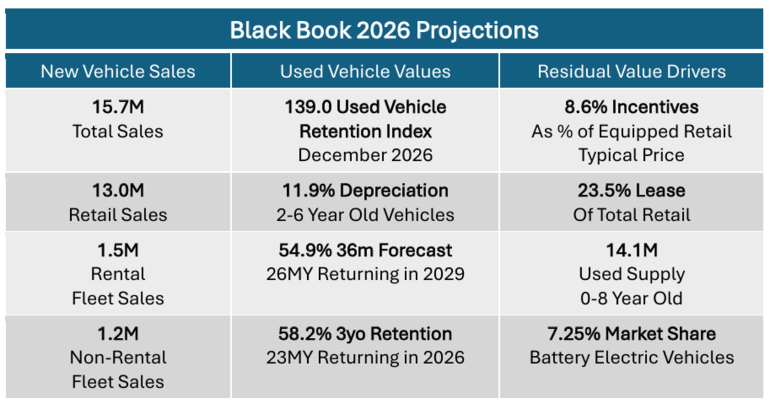
Residual values remain structurally higher than pre-pandemic levels, particularly for late-model vehicles. Three-year-old vehicles returning to market in 2026 are expected to retain 58.2% of original MSRP—down modestly from 2025 but still well above historical averages. One-year-old vehicles show even stronger retention, supporting fleet economics and helping replenish late-model used supply. For credit unions, elevated residuals reduce negative equity risk but may also compress affordability as vehicle prices remain high relative to incomes.
Fleet Behavior
Fleet behavior continues to reshape used supply dynamics. Rental companies are holding vehicles longer to offset higher acquisition costs, limiting near-term supply but increasing mileage tolerance among buyers. Non-rental fleet sales, meanwhile, are expected to decline in 2026 after several years of catch-up buying following the supply-chain crisis. Black Book forecasts used supply of 14.1 million vehicles aged 0–8 years—growth, but still below what the market would typically need to ease pricing pressure meaningfully.
Tariffs emerge as a delayed but material factor for lenders to watch closely. While new trade policies introduced in 2025 had limited immediate impact, Black Book expects pricing effects to show up more clearly in 2026 through higher MSRPs, content packaging changes, and destination fees. Those increases are likely to surface directly in monthly payments, testing borrower elasticity and potentially dampening demand—especially for payment-sensitive credit union members.
Electric vehicles represent the clearest area of reset. Black Book expects used EV prices to decline in 2026, typically by $1,500 to $2,500, driven by a wave of off-lease returns and softer demand following the loss of federal tax credits. EV market share is projected to fall to 7.25% of total light-vehicle sales, prompting automakers to scale back production plans. For credit unions, the data reinforces the need for cautious EV residual assumptions and tighter monitoring of collateral performance as the segment reprices.
The bottom line for credit union auto lenders: 2026 offers relief from headline volatility, but not from complexity. Stable averages may make forecasting easier, yet widening gaps between vehicle segments, fuel types, and borrower cohorts will require more granular credit strategies. In Black Book’s “new normal,” disciplined pricing, targeted underwriting, and close attention to shifting supply channels will matter more than ever.