

WASHINGTON—A third of small business owners say inflation remains the single most important problem in operating their business, although their concern over rising costs in the National Federation of Independent Business survey is actually five points lower than what the same survey found in July, which was its highest reading since the fourth quarter of 1979.
Overall, the Small Business Optimism Index rose 0.6 points in November to 91.9. November’s reading is the 11th consecutive month below the 49-year average of 98, according to the NFIB.
“Going into the holiday season, small business owners are seeing a slight ease in inflation pressures, but prices remain high,” NFIB Chief Economist Bill Dunkelberg said in a statement. “The small business economy is recovering as owners manage an ongoing labor shortage, supply chain disruptions, and historic inflation.”
Key Findings
According to the NFIB, key findings from the most recent survey include:
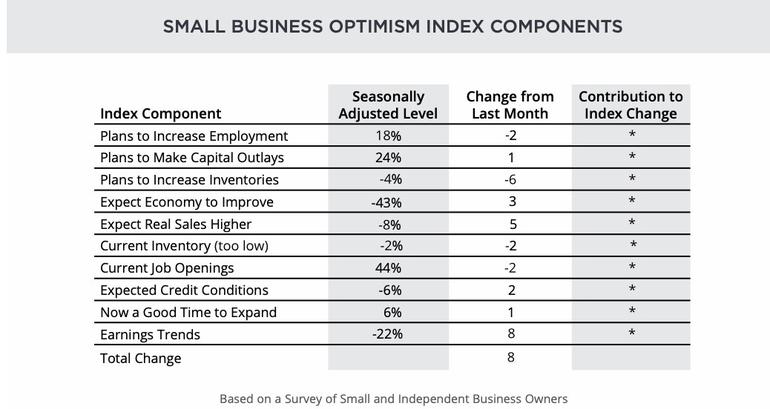
- The organization noted 44% of all owners reported job openings they could not fill in the current period. “The difficulty in filling open positions is particularly acute in the transportation, wholesale, and construction sectors,” the NFIB said. “Owners’ plans to fill open positions remain elevated, with a net 18% (seasonally adjusted) planning to create new jobs in the next three months.”
- 55% of owners reported capital outlays in the last six months, up one point from October. Of those making expenditures, 39% of owners reported spending on new equipment, 19% acquired vehicles, and 12% improved or expanded facilities. Eleven percent spent money for new fixtures and furniture and 5% acquired new buildings or land for expansion. Up one point from October, 24% plan capital outlays in the next few months, according to the NFIB. Overall, capital spending remains too weak to improve productivity.
- A net negative 7% of all owners (seasonally adjusted) reported higher nominal sales in the past three months. The net percentage of owners expecting higher real sales volumes improved five points to a net negative 8%, a “weak reading,” according to the NFIB.
- The net percentage of owners reporting inventory increases rose six points to a net 5%. Nineteen percent reported increases in stocks and 14% reported reductions.
- 29% of owners recently reported that supply chain disruptions have had a significant impact on their business. Another 34% report a moderate impact and 26% report a mild impact. Only 11% report no impact from recent supply chain disruptions, the NFIB said.
- A net negative 2% of owners viewed current inventory stocks as “too low” in November, down two points. By industry, shortages were the most frequent in wholesale (18%), manufacturing (14%), transportation (12%), and retail (11%), according to the NFIB. Shortages in construction (9%) have been reduced because of home sales and new construction have slowed. Down six points from October, a net negative 4% of owners plan inventory investment in the coming months. Overall. Inventories are starting to build, but only modestly to date.
- The net percentage of owners raising average selling prices increased one point from October to a net 51% seasonally adjusted. Unadjusted, 8% of owners reported lower average selling prices and 56% reported higher average prices. Price hikes were the most frequent in wholesale (73% higher, 0% lower), retail (69% higher, 7% lower), construction (66% higher, 5% lower), and manufacturing (63% higher, 5% lower). Seasonally adjusted, a net 34% plan price hikes.
- Seasonally adjusted, a net 40% reported raising compensation, down four points from October, the NFIB said. A net 28% of owners plan to raise compensation in the next three months, down four points from October’s reading. Nine percent of owners cited labor costs at their top business problem and 21% said that labor quality was their top business problem.
- 2% of owners reported that all their borrowing needs were not satisfied. Twenty-two percent reported all credit needs were met and 62% said they were not interested in a loan. Three percent reported that financing was their top business problem, up two points and the highest since December 2018.
Just in Time for the Holidays, CUToday’s Free Morning Headline Email is Now Double-Free!
Don’t forget to check your Spam/Junk email folder if you haven’t been receiving your free, popular and daily CUToday.info news headlines.
And if you haven’t yet signed up for the new email solution on which CUToday.info has partnered with ResponseGenius, you can do so here. Signing up requires less than one minute of your time.
CUToday.info has received very positive response from readers following the move to an improved provider of the daily headlines, but many also noted they did need to go to their Spam/Junk folder and mark it as safe.
The new email solution has not only improved every reader’s delivery experience, but it also features a fresh, new format that is easy to read, especially on mobile devices.
Please note and/or make your IT department or email administrator aware the emails will be coming from the domains CUTodayinfo.com and CUTodayinfoReply.com.