

NEW YORK–September’s initially strong economic numbers have gone “up in smoke,” according to new analysis, driven by a big decline in U.S. manufacturing activity.
“Last week, the major equity indexes ushered in October with a vicious downdraft not seen since late August,” stated E*Trade in its analysis of recent economic activity. “Beginning on October 1, the Dow Jones Industrial Average tumbled more than 800 points over the course of two days. By the time the dust settled, both the Dow and S&P 500 had fallen below their 100-day moving averages and given back all the previous month’s gains.”
The sell-off came on the heels of what E*Trade called a “resilient” September that overcame a host of economic challenges.
“It served as another reminder that the long-running economic expansion is fragile,” said E*Trade.
The Volatility
What’s creating the volatility?
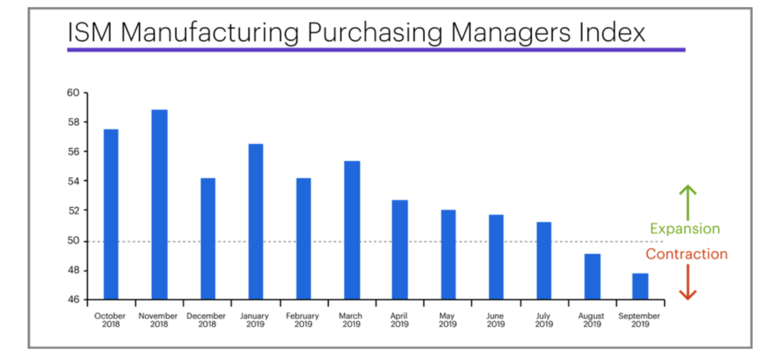
According to E*Trade, the immediate impetus for the volatility was a decline in U.S. manufacturing activity. The ISM Manufacturing Purchasing Managers Index (PMI) came in at a tepid 47.8 in September—down 1.3% from the previous month’s reading. (Anything below 50 generally indicates that manufacturing activity is contracting. E*Trade’s analysis noted it was the PMI’s lowest reading since June 2009 and represented the sixth consecutive decline in industrial output.
“But manufacturing activity is only part of the story. Inventories are also telling,” said E*Trade. “The Federal Reserve Bank of St. Louis tracks the national business inventories-to-sales ratio, which is typically inversely correlated to industrial output. A rising ratio indicates that unsold business inventories as a percentage of sales are increasing—hinting at weak demand. Although it has leveled off recently, the inventories-to-sales ratio has been on a steady upward climb since June of last year—yet another indicator of manufacturing softness.”
What It All Means
What does all of that mean for credit unions eager to know what lies ahead?
“In aggregate, the numbers don’t necessarily point to recession, but they could be an indicator of a slowing economy,” said E*Trade’s analysis. “GDP growth of 1.5% would mark a sharp fall-off for an economy that has consistently expanded by at least 2% on an annualized basis over the past two years, and it could help prompt another Fed rate cut later this month.”
The E*Trade analysis went on to add, “In some ways, the current conundrum can be viewed as a manufacturing recession that’s occurring even as the economy is adding jobs and unemployment has fallen to a 50-year low.”
Explaining the Conflict
How can these two conflicting forces be at work?
“For starters, some of the biggest job gains in the latest employment report were in non-manufacturing service industries that employ lower-paid workers,” explained the E*Trade analysis. “This also showed up in average hourly earnings, which edged lower in September—even as the unemployment rate declined.”
E*Trade added the ongoing trade war continues to take a toll on both the economy and the markets, and not just in the U.S. and China, but globally.