

MADISON, Wis.–Lending at credit unions slowed in November, the savings-per-member ratio appears to have bottomed out, loan quality will decrease this year, and CU membership grew at its slowest pace since 2020, according to the new Trends Report from TruStage.
The report is based on data through November of 2023. Here's a look at credit union performance by category:
Total Credit Union Lending
Credit union loan balances rose 0.4% in November, below the 1.0% pace reported in November 2022, according to the Trends Report.
“Driving overall loan growth was strong growth in credit card loans (1.7%), home equity lending (1.5%), and adjustable-rate mortgages (1.4%),” wrote TruStage’s chief economist, Steve Rick. “November seasonal factors typically subtract 0.22 percentage points from the underlying trend loan growth as winter weather slows auto and home purchases.”
The report notes that over the past 12 months, total credit union loan balances rose a strong 9.0%, above the 7.2% long-run average.
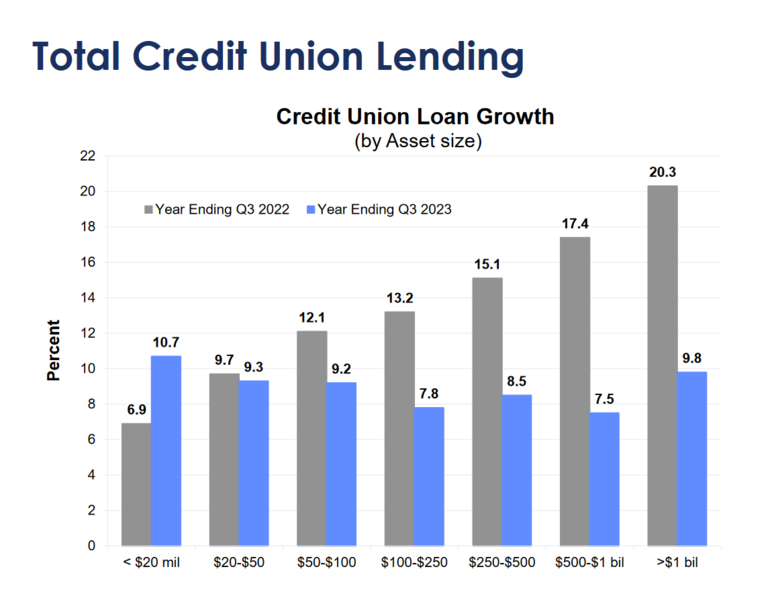
“However, industry growth rates mask big disparities between large and small credit unions,” the Trends report states. “For the first time in many years, small credit unions reported faster loan growth than larger credit unions due to lower loan-to-savings ratios providing them greater liquidity for lending. “
According to the Trends Report, in the year ending in the third quarter of 2023, credit unions with assets greater than $1 billion reported a 9.8% increase in loan balances, which was down significantly from a similar period one year earlier.
“During the same period, credit unions with assets less than $20 million reported loan growth of 10.7%, which is above the 6.9% pace set a year earlier,” the Trends Report says. “We expect overall credit union loan growth to slow to 5.0% in 2024 due to tight credit union liquidity, high interest rates and satiated consumer demand for durable goods.”
Consumer Installment Credit
Credit union consumer installment credit balances (auto, credit card and other unsecured loans) rose 0.7% in November, below the 0.9% rise set in November 2022, as consumer spending ebbed in the fourth quarter of 2023, the Trends Report states.
Credit union consumer installment credit grew 7.4% over the last year, which is above its 30-year average of 6.3%, but slower than the 8.4% rise in total real estate loans, the report adds.
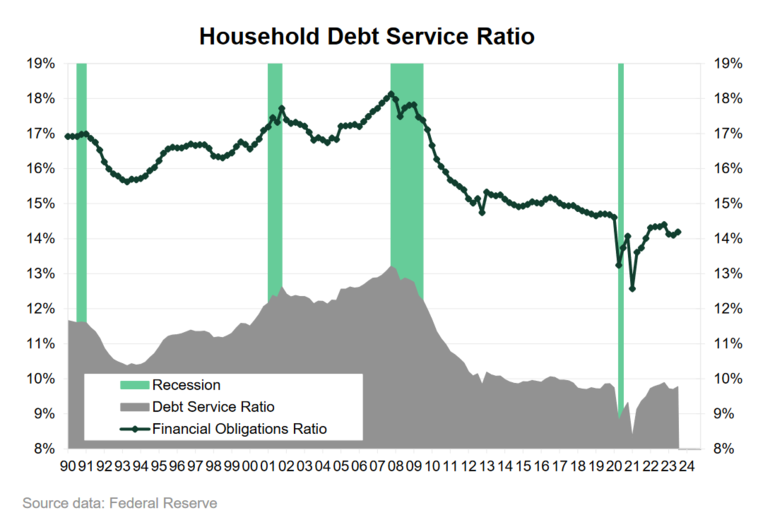
“The household debt service ratio (mortgage and consumer debt payments required to remain current on that debt as a percent of disposable income) rose to 9.78% in the third quarter, from the 9.69% reported in the second quarter, and above the record low of 8.31% reported in the first quarter of 2021, according to the Federal Reserve,” wrote Rick.
He noted the 2021 record-low debt service ratio was caused by record-low interest rates and government stimulus checks, which were used to pay off debt.
Looking Ahead
“The Financial Obligations Ratio, which adds to debt payments and other obligations like rent payments, auto lease payments, homeowners' insurance and property tax payments, rose slightly to 14.2% in the third quarter of 2023, but significantly below the 18.1% record high set back in the 4th quarter of 2007,” according to the report.
Looking into 2024, Rick is projecting that high interest rates and the repricing of adjustable-rate credit will mean higher spending on servicing debt, which will increase the debt service ratio.
“This will reduce household disposable income for spending on goods and services or will decrease the national savings rates,” the report states.
Vehicle Loans
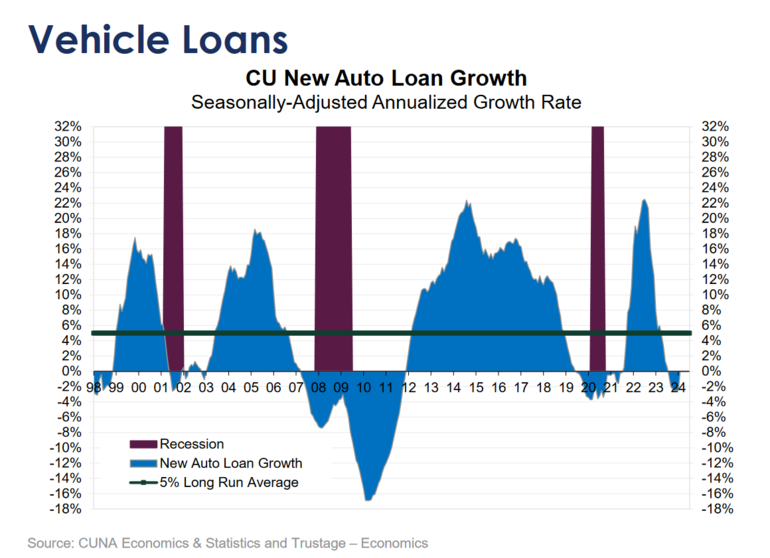
The new Trends Report shows credit union new-auto loan balances fell at a -2.5% seasonally-adjusted annual rate in November, significantly below the 14.2% pace set in November 2022 (see figure above), due to high lending interest rates, tight liquidity pressures causing some credit unions to pull back from lending, increased vehicle incentives by manufactures, and tighter lending standards reducing the availability of credit.
“November is typically one of the slower months of the year for credit union new-auto loan originations as seasonal factors subtract 0.35 percentage points from the underlying trend growth rate due to normally weak new auto sales,” the report states.
Real Estate Information
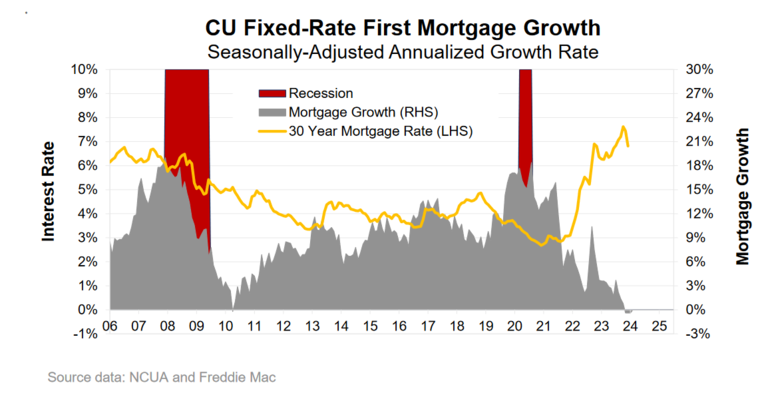
Credit union fixed-rate first mortgage loan balances fell 0.1% in November, below the 0.2% gain set in November 2022, according to the Trends Report analysis.
The report shows existing home sales rose 0.8% in November from October to a seasonally adjusted annual rate of 3.82 million, the first monthly gain in six months.
“But sales are still down 7.3% on a year-ago basis due to high interest rates and poor affordability,” the report shares. “Fixed-rate mortgage loan balances are currently falling at a -0.4% seasonally-adjusted annualized growth rate as credit union members have switched to more adjustable-rate mortgage products which typically have lower interest rates.
“With the Federal Reserve expected to lower short-term interest rates 100-150 basis points in 2024, and the 10-year treasury interest rate expected to remain around 4.0%, expect the 30-year mortgage interest rate to fall to the low 6% range in the second half of 2024,” the report forecasts. “Following two years of double-digit growth, the housing market remains overvalued so expect home prices to level off or decline 3-5% during the next two years.”
The report further predicts mortgage originations will rise 15% in 2024 as the economy continues its expansion and mortgage interest rates fall approximately one percentage point throughout 2024.
Savings & Assets
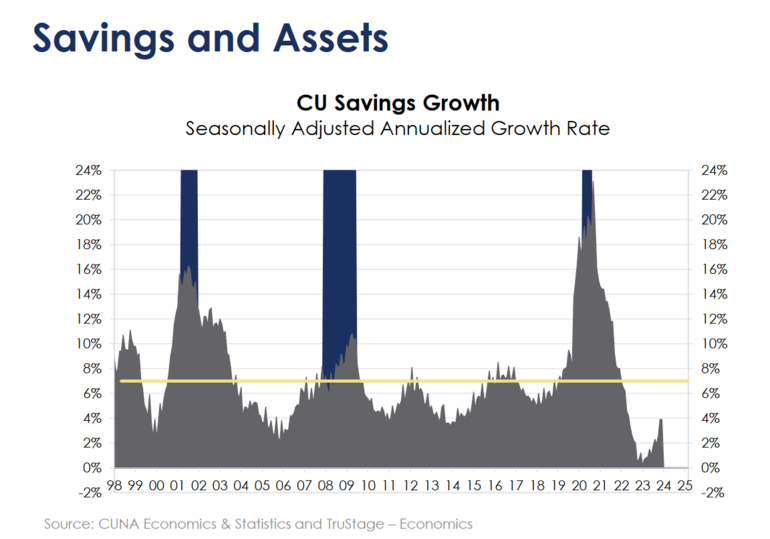
The new report shows credit union savings balances rose 0.3% in November, better than the -0.3% decline reported in November 2022, as credit unions raised their deposit interest rates to retain and attract additional deposits. November’s seasonal factors typically subtract 0.2% percentage points from the underlying savings trend growth.
Savings balances are currently growing at a 4.0% seasonally-adjusted annualized growth rate, which is below the 7% long-run average, the Trends Report states.
“Members are saving less than normal due to the increased spending on leisure and hospitality after the COVID-19 pandemic and still higher than normal inflation,” the report adds.
According to the new Trends Report, the average credit union member was sitting on $13,394 in deposits in November 2023, down $232 from the $13,626 set back in November 2022.
“This is a 1.7% drop in the dollar amount of deposits per member,” wrote Rick. “But it appears the savings-per-member ratio has bottomed out and will begin to rise soon and eventually approach its long run 4.5% annual growth rate over the next two years.
“We expect credit union savings balances to rise 4% in 2024, below the 7% long run average but better than the 1% reported in 2023 due to rising real incomes, a rise in the personal savings rate (personal savings as a percentage of disposable personal income), and higher credit union deposit interest rates,” the forecast continues. “Additional liquidity will be welcomed by many credit unions facing tight liquidity conditions in 2023.”
Equity and Other Key Measures
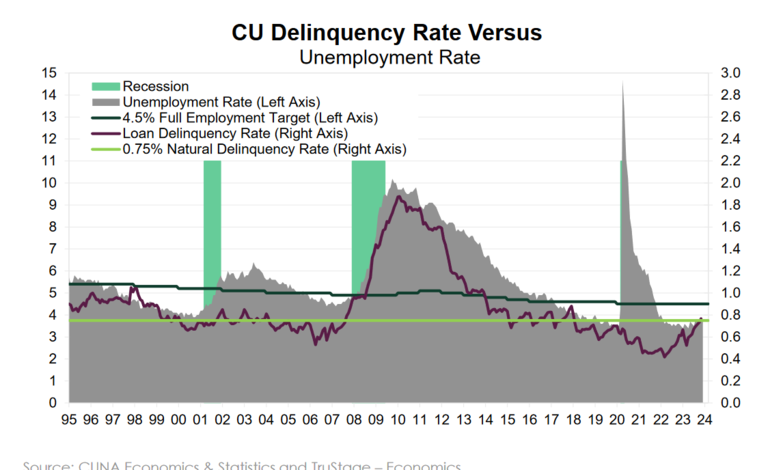
The Trends Report shows the credit union loan delinquency rate (loans two or more months delinquent as a percent of total loans outstanding) rose to 0.77% in November from 0.52% in March, which is in line with the traditional seasonal pattern.
“Delinquency rates typically reach their nadir in any year’s first quarter as members use their tax refunds and bonus checks to catch up on any late loan payments,” the Trends Report states. “As the year progresses, delinquency rates slowly rise and reach their apex late in the fourth quarter.
Credit union loan delinquency rates are now approximately equal to the 0.75% long-run natural delinquency rate, after six years of below trend numbers.”
According to the Trends Report, five factors explain the low loan delinquency numbers of the past few years:
- Low unemployment rates
- Stimulus checks
- Enhanced unemployment benefits
- Loan forbearance programs
- A rather large denominator effect due to loan balances rising faster than the dollar amount of delinquent loans.
“Expect loan quality measures to deteriorate during 2024 due to higher interest rates causing repricing of adjustable-rate loans and higher loan repayments, a slowing economy leading to rising unemployment rates, the resumption of student loan payments and slower loan growth,” the Trends Report is forecasting. “Since the delinquency rate is a ratio its important to compare the growth rates of the numerator (dollar amount of delinquency loans) and the denominator (total loans). During the last year, the numerator increased 33.6% while the denominator rose only 7.5%. This increased the delinquency ratio 24%, from 0.62% in November 2022 to 0.77% today. The 24% growth rate can be approximated by subtracting the denominator growth rate from the numerator growth rate, (33.6% - 7.5% = 26.1%).”
Credit Unions & Members
The new Trends Report shows credit union memberships grew 256,000 in November, or 0.18%, which is above the 120,000 new members, or 0.09%, that were added in November 2022.
Year-to-date, credit unions added 4.084 million new members, slower than the 5.280 million members added during a similar period in 2022, the Trends Report shows.
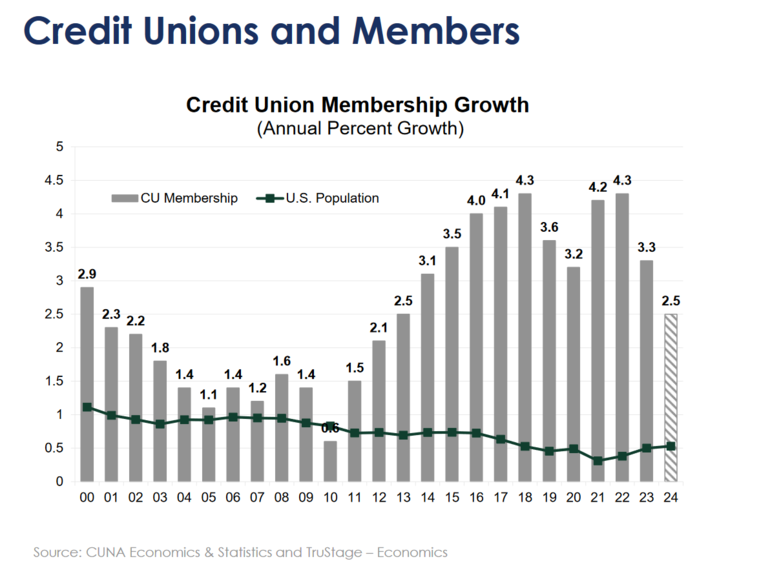
During the last 12 months, credit union memberships rose 3.3%, the slowest pace since 2020, according to the report.
“Credit union membership growth of 3.3% is outpacing the 0.50% growth rate of the U.S. population, indicating credit unions are increasing their market share of the financial services marketplace,” the report states.
Total credit union memberships reached 141.8 million in November, 4.5 million more than November 2022.
Two Major Factors
“Strong credit card and home equity lending and strong job hirings are two major factors driving the rise in credit union memberships,” the report states. “Job growth is a major factor determining credit union membership growth. The U.S. economy added 2.7 million jobs during 2023, according to the Bureau of Labor Statistics. For 2024, expect only 1.5 million new jobs to be created as the economy slows and the labor market reaches equilibrium.
“Slower job growth will weigh on membership growth while new-auto indirect lending will be a major factor supporting membership growth,” the analysis continues. “We expect the pace of membership growth to fall slightly to 2.5% in 2024 while the U.S. population growth increases slightly to 0.53%.”