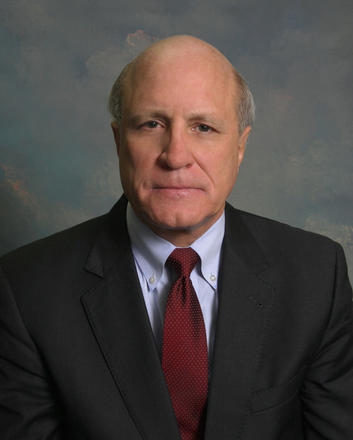
Jim Blaine, SECU
RALEIGH, N.C.–North Carolina State Employees’ Credit Union has published both its Capital Plan and internal “Stress Test” results on its website.
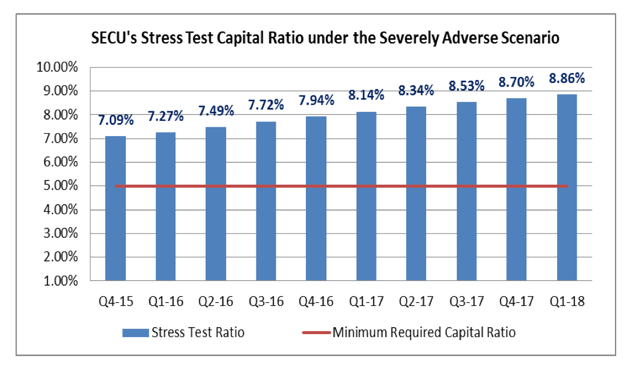
SECU said results show it is strongly capitalized and able to well withstand even the “severely adverse” economic conditions.
Although credit unions are not required to publish internally developed stress test results, SECU said it believes full disclosure and transparency speaks well to its audience of two-million members. According to the $33-billion SECU, the move provides its members with access to reviews of its capital adequacy under hypothetical national economic stress scenarios. SECU said its internal stress test results gauge its ability to maintain sufficient capital while operating in “adverse” and “severely adverse” economic environments.
SECU noted that the Comprehensive Capital Analysis and Review (CCAR) is an annual exercise required by the Federal Reserve to ensure that the largest banks (greater than $50 billion) have “robust,” forward-looking capital planning processes that account for their unique risks and that adequate capital remains under three stressed economic environments. Dodd-Frank Annual Stress Testing (DFAST) is an analytical tool designed to evaluate whether banks between $10 billion and $50 billion retain sufficient capital under these same adverse economic circumstances. Tests are hypothetical and are to reflect the potential impacts on capital when the economy has high unemployment, low housing prices and unfavorable interest rates—as found in mild to severe recessions.
SECU said its internal tests used Federal Reserve Bank stress-test macro-economic model assumptions published in January of 2016 as a guide to measure the effects of challenging environments on its capital.
“Moody’s Analytics, an international economic modeling expert, created six unique ‘credit loss models’ for SECU, which calculated and correlated the stressed economic environments to potential changes in loan losses, earnings and capital at SECU,” the credit union said in a statement. “Results of these stress tests show that SECU is strongly capitalized and able to well withstand even the ‘severely adverse’ economic environment imposed in the Federal Reserve stress test assumptions. Additionally, KPMG, a global accounting advisory firm, performed an extensive analysis to validate and confirm the results of the Moody’s credit loss model projections. KPMG found those model results to be sound and reasonable.”
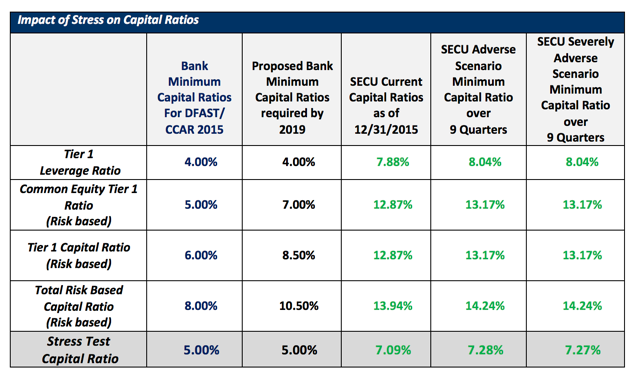
“Results of applying large bank ‘stress test’ assumptions to the SECU balance sheets again reflect that our capital levels exceed the capital requirements imposed on large banks,” said SECU CEO Jim Blaine. “The voluntary publication of our internal stress test results provides assurance to the member-owners of SECU of our ability to withstand severe economic conditions similar to those experienced over the past seven years. We have completed capital level comparisons using the FDIC and BASEL standards applied to U.S. banks which reflect strong results. Additionally, as the illustration shows, SECU currently exceeds the proposed capital requirements credit unions will be required to meet by 2019. A strong capital and liquidity foundation are key elements of a safe and sound financial institution. We are pleased with the positive results from our internal capital analyses.”