

WASHINGTON–Additional details continue to be revealed around where the more than $500 billion in Paycheck Protection Program loans are going, while separately, the first charges have been brought against people for attempting to defraud the PPP.
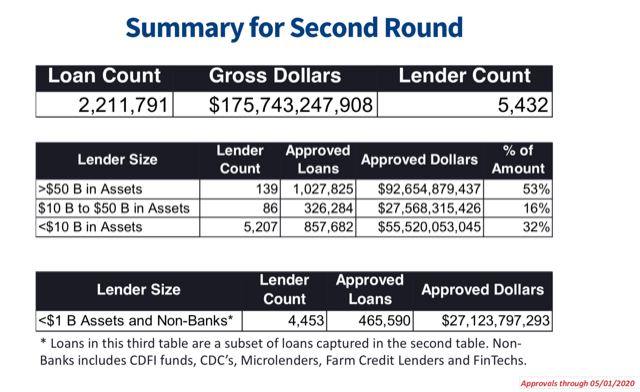
The Small Business Administration has released a report on PPP activity through May 1, which shows $175.7 billion in loans had been approved just five days into the program's second round of funding. That's on top of the $349 billion loaned out in just 13 days during the program's first round.
“The data suggest that this time around, the loans may be going to smaller businesses, and demand remains high,” noted National Public Radio in its analysis. “However, there are still big questions about how well the loans are reaching the businesses that need them most.”
Among some of the data points:
Average Loan Size Has Gone Down
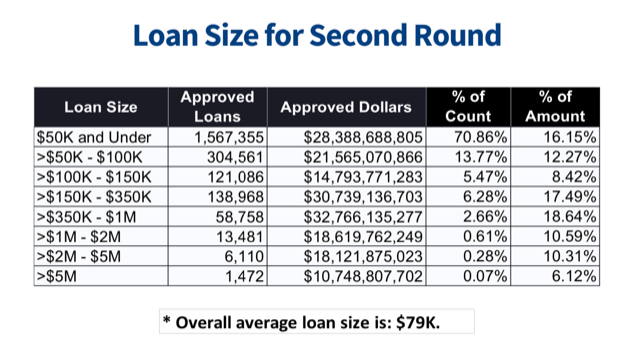
The average PPP loan in this second round of funding was $79,000 as May 1, substantially lower than at the end of the first round, when the average loan was around $206,000.
As CUToday.info has reported, the second round of funding includes $30 billion for lending institutions with less than $10 billion in assets, and SBA also set aside one eight-hour period last week during which the agency only allowed small lenders to access the system.
The smaller lenders have also tended to give out smaller loans. SBA data show that the average PPP loan at banks with over $50 billion in assets is just over $90,000 this round. At banks with less than $1 billion, that average is around $58,000.
Large Loans Have Used Up a Large Chunk of Money
In the first round of PPP funding, loans of more than $2 million accounted for around 1.5% of total loans, but around one-quarter of the total pool of money, according to the SBA. This time, those loans are 0.35% of all loans, but they account for just over 16% of the total pool of second-round money.
As CUToday.info has also reported, those largest loans will be getting extra scrutiny as the SBA announced it will be auditing all loan applications for over $2 million. There were more than 25,000 such loans in the first round, and just over 7,500 thus far in the second round.
In light of the limited funds, there have been calls to simply better limit the maximum loan size, currently set at $10 million, NPR reported.
"Had Congress set a maximum limit of $1 million it would have freed up over $150 billion — enough money to more than double the number of truly small businesses that received aid," Brookings Institution Fellow in Economic Studies Aaron Klein told Politico.
Still Short on Funds
The SBA has announced nearly $176 billion in loan approvals in the first five day of the second round — an even faster clip than the first round's $349 billion in 13 days, as NPR reported.
“And there's good reason to think that plenty of small businesses could be in need of funds after this round runs out. After the first round, a survey from the National Federation of Independent Business found that three-quarters of small businesses had applied for the first-round PPP loans, but only 20% had gotten the money,” NPR reported.
PPP Funds Don't Appear to Have Gone to Places Needing it Most
NPR reported economists at the University of Chicago and MIT have taken a first stab at figuring out how well the program might be boosting local economies. In a new working paper, they compared employment data to PPP data as of April 15 — just before the first round of funding ran out.
"Fifteen percent of establishments in the regions most affected by declines in hours worked and business shutdowns received PPP funding; in contrast, thirty percent of all establishments received PPP funding in the least affected regions," the authors wrote, according to NPR.
Two People Charged With Attempted PPP Fraud
Meanwhile, in U.S. District Court for the District of Rhode Island, David A. Staveley, aka Kurt D. Sanborn, 52, of Andover, Mass., and David Butziger, 51, of Warwick, R.I., have been charged with conspiring to seek obtain the forgivable loans guaranteed by the SBA, claiming to have dozens of employees earning wages at four different business entities when, in fact, there were no employees working for any of the businesses, according to the Justice Department.
As CUToday.info has reported, there has been concern expressed since the launch of the program over its potential for fraud given the more than $600 billion allotted to the program and the disbursal of the funds in such a short time period.
Staveley and Butziger are charged by way of a federal criminal complaint with conspiracy to make false statement to influence the SBA and conspiracy to commit bank fraud, according to the DoJ. Additionally, Staveley is charged with aggravated identity theft. Butziger is charged with bank fraud.
At the Expense of Small Business
“Every dollar stolen from the Paycheck Protection Program comes at the expense of employees and small business owners who are working hard to make it through these difficult times,” said Assistant Attorney General Brian A. Benczkowski of the Justice Department’s Criminal Division, in a statement. “The Criminal Division is committed to working with our law enforcement partners to root out abuse of the important relief programs established under the CARES Act.”
U.S. Attorney Aaron L. Weisman for the District of Rhode Island added, “Attorney General Barr has directed all U.S. Attorneys to prioritize the investigation and prosecution of crimes related to coronavirus and COVID-19, and we are doing just that.”
FBI Special Agent Joseph R. Bonavolonta said Stavely and Butziger alleged conspired to fraudulently obtain more than half a million dollars in the PPP loans.
“Thankfully we were able to stop them before taxpayers were defrauded, but today’s arrests should serve as a warning to others that the FBI and our law enforcement partners will aggressively go after bad actors like them who are utilizing the COVID-19 pandemic as an opportunity to commit fraud,” said Butziger.
Businesses Not Operating
According to court documents, the fraudulent loan requests were to pay employees of businesses that were not operating prior to the start of the COVID-19 pandemic and had no salaried employees, or, as in one instance, to pay employees at a business the loan applicant did not own.
The documents allege Staveley and Butziger discussed via email the creation of fraudulent loan applications and supporting documentations to seek loans guaranteed by the SBA for COVID-19 relief through the Paycheck Protection Program (PPP). It is alleged that Staveley posed as his brother in real estate transactions.
“It is alleged that Staveley claimed in loan applications requesting more than $438,500 that he had dozens of employees at three restaurants he owned, two in Warwick, Rhode Island, and one in Berlin, Massachusetts,” the court documents state. “An investigation determined that one of the Rhode Island restaurants, the former Remington House, and the Massachusetts restaurant, On The Trax, were not open for business prior to the start of the COVID-19 pandemic, at the time the loan applications were submitted, or at any time thereafter. Moreover, Staveley did not own or have any role in the second Rhode Island restaurant, Top of the Bay, for which he was seeking financial relief.”
Misused Identity
According to court documents, Staveley’s Massachusetts restaurant was closed by March 10, 2020, when the town of Berlin revoked the business’ liquor license for numerous reasons, including that “Sanborn” allegedly misrepresented that his brother owned the restaurant. Investigators obtained information that Staveley/Sanborn allegedly used his brother’s personal identifying information in other real estate transactions as well.
According to court documents, it is alleged that on April 6, 2020, Butziger filed an application seeking a $105,381 SBA loan under the PPP as owner of an unincorporated entity named Dock Wireless. Butziger claimed in documentation filed with the bank and in a telephone call with an FBI undercover agent posing as a bank compliance officer that he had seven full-time employees on Dock Wireless’ payroll, including himself.
The Justice Department said Butziger falsely represented to the agent that he brought the employees on full-time on Jan. 1, 2020, and laid them off at the end of March. Butziger claimed the employees continued to work without being paid through April 2020, and that he would use SBA PPP funds to pay them.