WASHINGTON–While credit unions are scrambling to push back against proposed federal legislation that would expand the interchange process by creating a new credit card routing mandate, the nation’s retailers have responded with praise for the bill.
As CUToday.info reported, Sens. Richard Durbin (D-IL) and Roger Marshall (R-KS) have introduced the Credit Card Competition Act of 2022, which seeks to expand upon the “Durbin Amendment” that was enacted in 2010 as part of the Dodd-Frank Act.
‘Giant Step Forward’
“Processing credit card transactions should not be limited to two companies when there are a dozen that can do the job just as well,” NRF Vice President for Government Relations, Banking and Financial Services Leon Buck said. “Routing choice has saved retailers and their customers billions in the debit card market and can do even more in the much-larger credit card market. This is a giant step forward in bringing about the transparency and competition retailers have sought for years.
“Credit card swipe fees have been driving up prices paid by American consumers for decades but are particularly burdensome amid the near-record inflation families face today,” Buck continued. “These fees are a percentage of the transaction, so they take even more out of retailers’ and consumers’ pockets as prices go up. They are a significant factor in inflation, but one that could be minimized if the card industry would compete the same as other businesses.”
Fintechs Should be an Option
As the NRF noted, at present, purchases made on Visa and Mastercard credit cards are only processed over the two companies’ respective networks.
“Under the bill, banks that issue the two brands of credit cards – the most dominant in the multitrillion-dollar payments market – would be required to allow transactions to be processed over at least two unaffiliated payment networks,” the retailers said. “One network could continue to be Visa or Mastercard but the other could be either a competing credit card network or one of several independent networks like Star, NYCE or Shazam that offer equal security but lower fees. New fintech processors could also be used.”
Under the proposed legislation, Visa and Mastercard would not be allowed to process each other’s transactions, and the debit networks they own – Visa’s Interlink and Mastercard’s Maestro – could not be the second network.
According to the retailers adding competition to the processing of credit card transactions, retailers and their customers could ultimately save $11 billion a year or more, according to payments consulting firm CMSPI.
Credit Union Response
Both CUNA and NAFCU have expressed strong opposition to the bill.
Proponents of the legislation, including the National Retail Federation, have been stressing that the bill applies only to financial institutions with $100 billion or more in assets and would have no effect on community banks or small credit unions. Navy FCU is the only CU above that asset threshold.
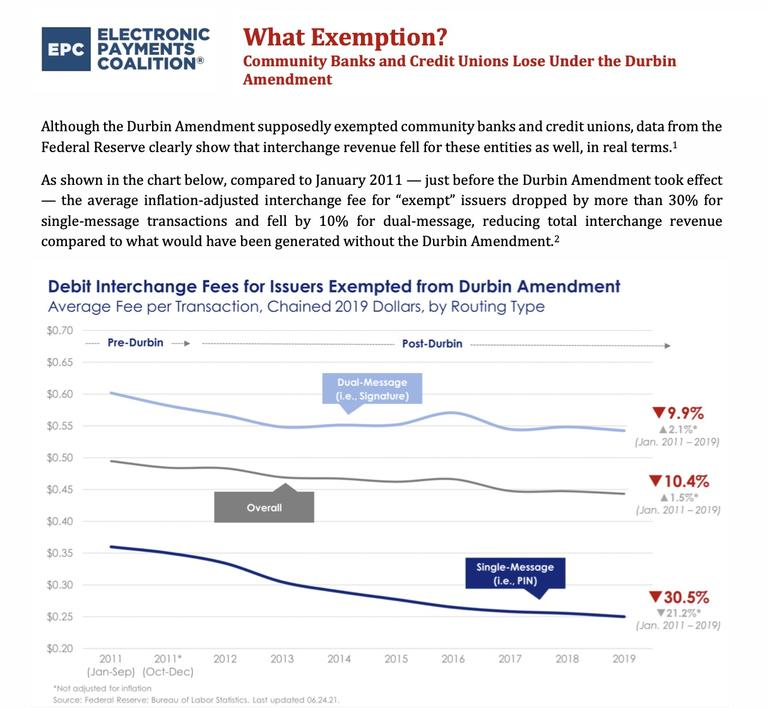
But NAFCU said the legislation “essentially imposes a back-door price control on credit card interchange fees. While the bill limits these requirements to only institutions over $100 billion in assets, the history of the failed exemption in the Durbin Amendment has shown that these price controls will negatively impact all institutions,” the association said.
NAFCU further cited Fed data that indicates the Durbin amendment has taken away $6-$8 billion a year from the revenue that banks and credit unions use to “serve their customers and members.”
The Electronic Payments Association also created this infographic, below.