

WASHINGTON—A trade association representing retailers has issued a statement that claims the “Credit Union National Association Fears Improved Economy” and that credit unions’ claims of losses due to data breaches are overblown and groundless.
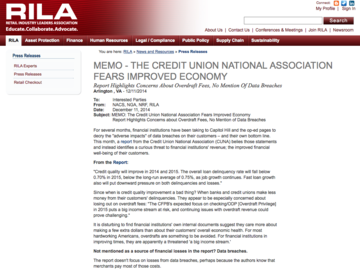
The RILA website.
The claims, made in a “memo” posted online by the Retail Industry Leadership Leaders Association (RILA), were issued in response to a CUNA economic forecast for credit unions that shows positive numbers, with RILA using those numbers to say it’s clear evidence that data breaches are not causing any damage to credit unions.
CUNA’s response: “Seriously?”
In its statement, RILA said “financial institutions have been taking to Capitol Hill and the op-ed pages to decry the ‘adverse impacts’ of data breaches on their customers – and their own bottom line. This month, a report from the Credit Union National Association (CUNA) belies those statements and instead identifies a curious threat to financial institutions' revenue; the improved financial well-being of their customers.”
CUNA CEO Jim Nussle issued a statement pointing to analysis that suggests credit unions help members realize $6 billion in financial benefits annually and that “an improved economy is good for members, credit unions and for CUNA. This ‘memo[ from RILA is, in that sense, just bizarre.”
“In the first place, the memo indicates a disturbing lack of understanding of the role delinquent loans and loan losses play in credit union operations – which typically indicate trouble for credit union members,” said Nussle.
In its analysis of the industry forecast made by CUNA, RILA cites figures showing a decrease in delinquencies at credit unions, and then asks, “Since when is credit quality improvement a bad thing? When banks and credit unions make less money from their customers' delinquencies. They appear to be especially concerned about losing out on overdraft fees.” RILA cited the CFPB’s attention to overdraft protection programs, which it said “puts a big income stream at risk, and continuing issues with overdraft revenue could prove challenging."
“It is disturbing to find financial institutions' own internal documents suggest they care more about making a few extra dollars than about their customers' overall economic health,” said RILA. “For most hardworking Americans, overdrafts are something to be avoided. For financial institutions in improving times, they are apparently a threatened ‘big income stream.'”
That statement drew this response from CUNA.
““Credit unions welcome lower delinquency and net charge-off rates – they directly reflect stronger financial health for their members,” said Nussle. “Secondly, in the current low-interest rate environment, revenue for all financial institutions has been squeezed. Programs such as overdraft protection and ‘courtesy pay’ can ease the squeeze a bit, but, more importantly, ensure credit union members can cover their checks without incurring an embarrassing bounced check. It just happens sometimes.”
After citing the improved bottom lines at credit unions nationally, RILA suggested one issue is noticeable in its absence.
“Not mentioned as a source of financial losses in the report? Data breaches,” said RILA. “The report doesn't focus on losses from data breaches, perhaps because the authors know that merchants pay most of those costs.”
But CUNA said data breaches are a very real cost to credit unions, saying its research has found at least $90-million in breach-related costs to CUs to date in 2014.

Jim Nussle, CEO, CUNA.
“Credit unions have yet to see any reimbursements from that retailer as a result of the violation,” said Nussle. “Maybe RILA thinks $90 million is no big deal – but, for credit unions, that expense may mean members realize lower returns on their savings and maybe even higher loan rates.”
In its statement, RILA said “the real facts on data breach fraud” are these:
• Merchants And Financial Institutions Split The Cost Of Fraud. A 2013 study by the Federal Reserve looked at fraud instances associated with use of debit cards and found that retailers do share the costs incurred as a result of card fraud. In fact, costs were shown to be borne almost equally among retailers and card-issuing institutions.
• Merchants Cover Fraud Costs Under Agreements With Card Networks. Merchants are required to compensate card issuers for any fraud that occurs as a result of a breach based upon an agreed upon formula that the card issuer has negotiated with MasterCard and Visa.
• Merchants Pay For Replacement Of Compromised Cards. By contract, card issuers are reimbursed for fraud losses and card reissuance costs based upon a formula agreed to by the card issuer and card networks even if no fraudulent activity has actually occurred on the card.
• More Secure Payment Technologies Like Chip-And-PIN Reduce Fraud Dramatically. Unfortunately, credit unions and their brethren don't want PIN numbers with new chip cards even though that is the formula that has proved successful in other countries around the world.
• PINs Make Transactions 700 Percent More Secure, according to the Federal Reserve.
• Chip-And-PIN Could Reduce US Fraud Losses By 40 Percent. "If the use of [chip-and-PIN] payment cards in the United States leads to a fraud loss pattern similar to the patterns seen in France, the Netherlands, and the UK, then U.S. fraud losses could fall by as much as 40 percent."
• Credit Unions Are Lagging Behind On The Chip-And-PIN Transition. "More than half of credit unions will miss a key October 2015 deadline that requires credit cards to be equipped with EMV chips, according to executives with major payment processing organizations."
“The RILA memo is a perverse and misguided interpretation of CUNA’s economic forecast, cobbled together to support the NACS, NGA, NRF, RILA agenda – which seeks to help merchants dodge responsibility for the losses they cause when they fail to secure consumer’s private data,” said Nussle. “The claims made in the memo are not supported by our forecast commentary. The leaps made in the document are, to us, a curious threat to any perception of reality.”