

MADISON, Wis.—Credit unions are gaining market share as other lenders tighten lending standards, pushing the movement’s share of consumer credit to 13.2% in June 2023, up from 12.8% in June 2022, TruStage reported.
In its August Trends Report, which includes data through June, TruStage also forecast that credit union delinquency rates will rise to more “normal” levels in 2024—likely to 0.75%--as members draw down on their extra savings amassed during the pandemic.
The company’s economists are also predicting net interest margins will continue to climb this year and into 2024, as will the loan-to-share ratio, while the number of credit unions continues to shrink.
Here’s a look at how credit unions performed by category, according to the new Trends Report:
Total Credit Union Lending
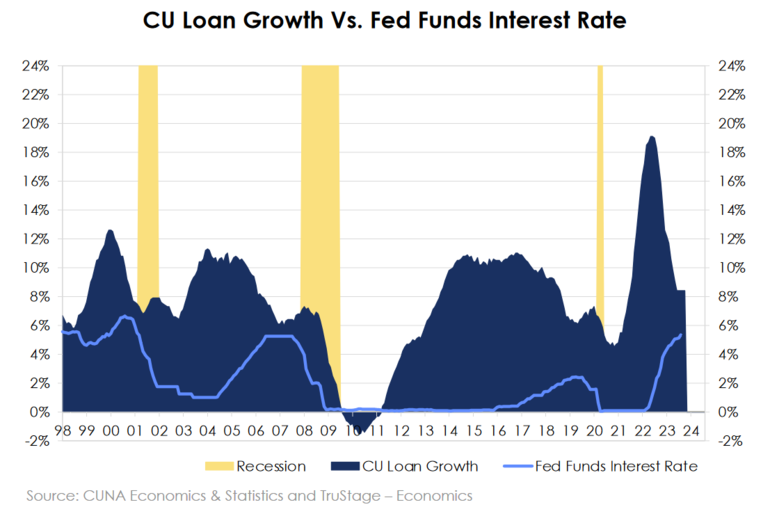
Credit union loan balances rose 0.7% in June, which is much slower than the 2.3% pace reported in June 2022, due to higher interest rate reducing members’ incentive to borrow, TruStage noted.
“June typically records the fastest loan growth of the year, with seasonal factors adding 0.4 percentage points to the underlying trend growth,” stated TruStage Senior Economist Steve Rick, who authored the report.
According to the report, credit union loan balances grew at an 8.4% seasonally-adjusted, annualized growth rate in June, significantly lower than the 19.1% high-water mark set in June 2022 due to the Fed Funds interest rate rising more than five percentage points over the last 15 months.
‘The Long Run’
“Over the long run credit union loan balances typically rise 7% per annum,” the report states. “The credit union average loan-to-asset ratios reached 70.1% in June, above the 65% recorded in June 2022 and the highest since January 2020 before the COVID-19 pandemic. History shows recessions typically occur 6-12 months after credit union loan-to-asset ratios rise above 69%.”
According to TruStage, the above-trend growth rate in credit union lending is a function of multiple factors: banks tightening lending standards, homeowners tapping into their home equity after years of rapid home price appreciation, higher than normal inflation increasing the prices of cars and other durable goods, members spending to release some pandemic pent-up demand, and a surge in leisure spending.
Consumer Installment Credit
Credit union consumer installment credit loan balances (auto, credit card and other unsecured loans) rose 0.8% in June, below the 2.4% reported in June 2022 as higher interest rates slowed new and used auto lending, according to the Trends Report.
Credit union consumer installment credit rose 12.1% during the 12 months ending in June, above the 7.81% pace reported by all other lenders, the report added.
“Credit unions are gaining market share as other lenders tighten lending standards,” the report states. “According to the most recent Senior Loan Officer Survey, roughly one in three banks plans to tighten lending standards for credit cards in the third quarter, a continuation from the second quarter. This has pushed credit union market share of consumer credit to 13.2% in June 2023, up from 12.8% in June 2022.”
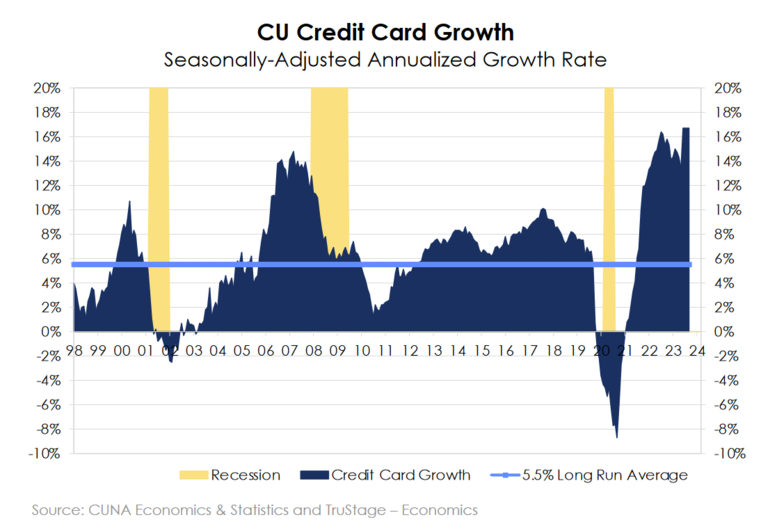
The data show credit union credit card growth rose at the fastest pace in recorded history in June, rising at a 16.7% seasonally-adjusted annualized growth rate. In addition, balances are rising as members spend on leisure and hospitality after the COVID pandemic but also due to the pressure from rising prices of food and gas, the report explains.
“June’s credit card seasonal factors usually add 0.55 percentage points to the underlying trend growth rate. Rising gas prices, consumers venturing out again and spending on services will keep credit card loan growth in high positive territory for the remainder of the year,” TruStage said.
Vehicle Loans
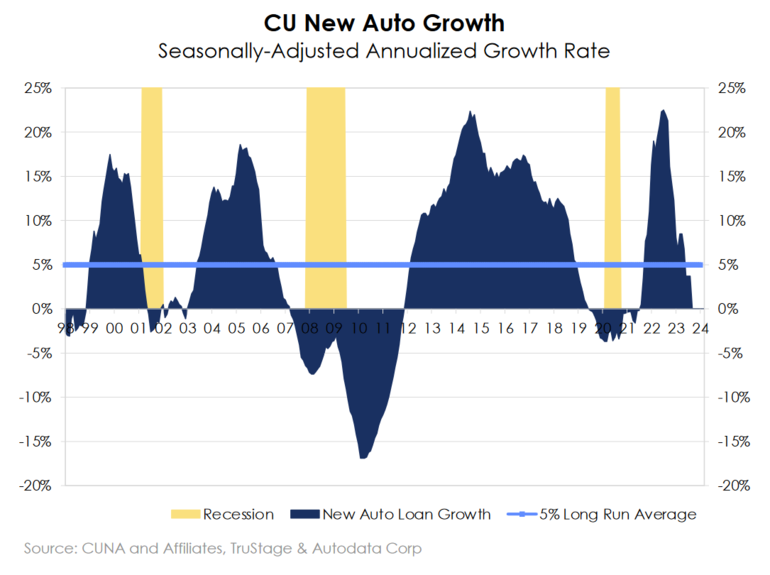
Credit union new-auto loan balances rose at a slow 3.7% seasonally-adjusted, annualized growth rate in June, below the long run average of 5% and below the 22% reported last year, according to the report, which noted higher interest rates and elevated auto prices are reducing demand for new vehicles.
“June’s seasonal factors usually add 0.5 percentage points to the underlying trend growth rate and June typically has the second largest seasonal factor of the year. May through October is considered the new-auto buying and lending season,” Rick stated.
On a month-over-month basis, new-auto loan balances increased 0.2% in June, a worse result compared to the 1.8% jump reported in June 2022 when auto inventories started to increase, the Trends Report states.
“Credit union new-auto loans currently make up 35% of total auto loans, with used-auto loans making up the other 65%,” the report notes. “Used-auto loan balances rose 0.7% in June, below the 2.5% pace reported in June 2022. Used auto prices are down 10% over the last year but remain considerably above the pre-pandemic average. With new vehicle prices still elevated, consumers have made use of their used vehicles for trade-ins to help lower transaction prices.”
“A typical used-auto loan is originated at roughly half the dollar amount of a new-auto loan,” Rick added.
Real Estate Information
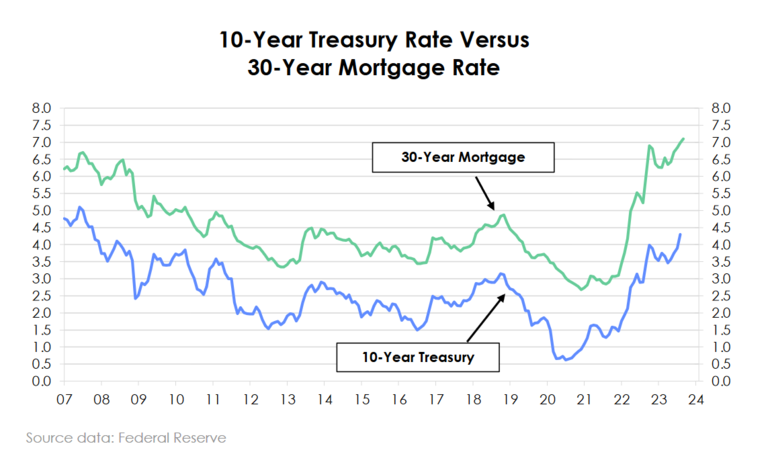
Credit union fixed-rate first mortgage loan balances grew 0.3% in June, which was slower than the 1.1% reported in June 2022 due to higher interest rates.
According to the Trends Report, a year-to-date growth comparison shows a 0.2% growth rate during the first half of 2023, which was up when compared to the -2.4% in the first six months of 2022.
Credit unions now hold $572 billion of first mortgages on their books, which is 32% of their total loan portfolio. Moreover, credit unions now hold 4.2% of the entire mortgage market, according to the Report.
“Home prices rose 0.7% in June from May, according to the Core Logic Home Price Index, but fell 0.5% year-over-year. Key to the recent increase in prices has been the limited supply of homes for sale even though higher home financing costs have weighed on housing demand as prospective homebuyers face greater monthly mortgage payments,” the report states. “The biggest hurdle to greater supply of homes is the spread between the average rate on all outstanding mortgages (the effective mortgage rate) and the current mortgage rate. The spread is currently 200 basis points as 82% of all outstanding mortgages have an interest rate below 5%.”
Rick is forecasting that as the Federal Reserve continues to tighten monetary policy in the coming months, mortgage rates will remain elevated and curb house price growth in the coming months and years.
Savings and Assets
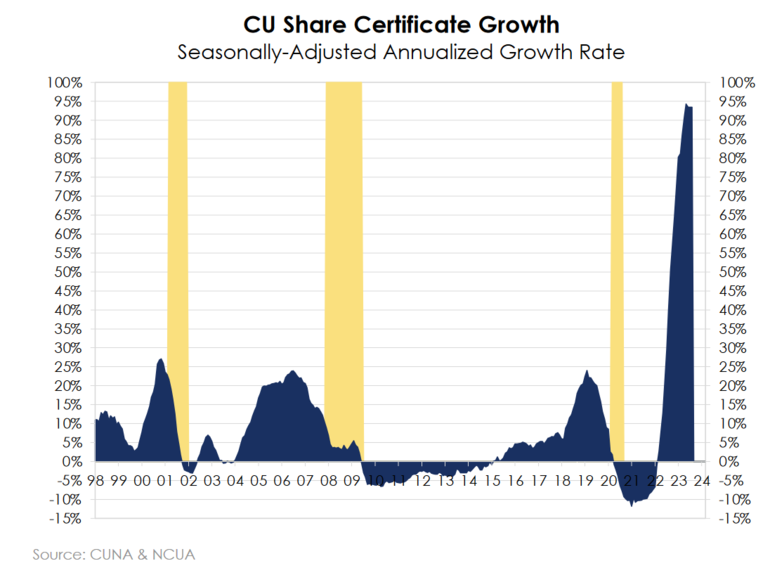
Credit union share certificate deposit accounts grew at a 93.5% seasonally-adjusted annualized growth rate in June, the fastest in credit union history “as members took advantage of significantly higher certificate of deposit interest rates,” the Trends report states.
“Many credit unions are now offering rates on CDs more than 5% which for many credit union members is a significant psychological threshold and incentivized them to move funds from more liquid deposit products,” Rick added.
The Trends Report data show that on a monthly growth rate basis, CDs increased 4.2% in June, while money market accounts fell 1.8% and regular share deposits fell 1.6%.
Certificate Mix
“Certificate of deposits now make up 21.9% of all credit union deposits, up from 12.9% in June of 2022. This shift in the mix of deposits has increased significantly credit union of cost of funds this year, putting downward pressure on net interest margins,” the report said.
Credit union total savings balances rose 0.7% in June, twice the 0.35% 10-year average, due to the month ending on a payroll Friday and checking account balances rising 3.5%.
“This temporary surge in deposits is expected to reverse this summer as members keep spending their excess savings accumulated during the pandemic and other members moving funds out of credit unions altogether to take advantage of alternate savings products paying higher interest rates,” the Report said.
Capital and Other Key Measures
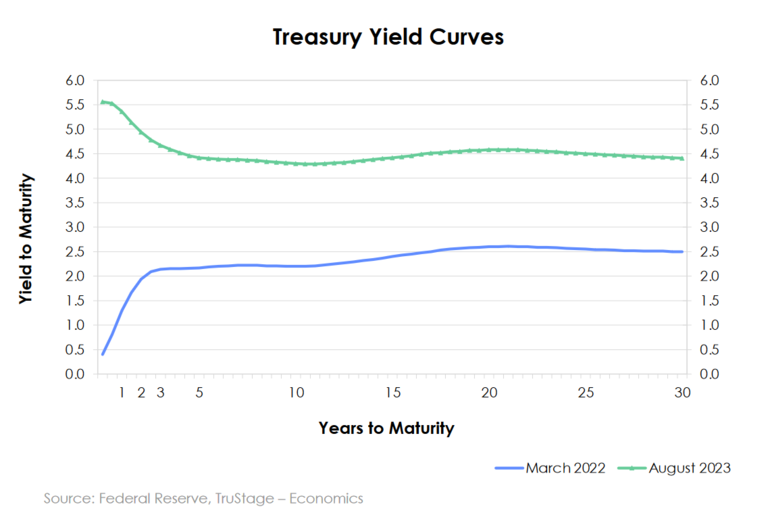
“The Treasury yield curve shifted up dramatically over the last 18 months, especially the short-to-medium-term portion of the yield curve,” the report states. “Interest rates on the 10-year Treasury note rose 210 basis points to 4.3%, while the one-year Treasury note interest rate rose 406 basis points to 5.36%. With short-term interest rates rising faster than longer-term interest rates, the yield curve inverted with short-term interest rates higher than longer-term interest rates.”
Added Rick, “Historically an inverted yield curve is a harbinger of a coming recession in the next nine to 15 months. Normally an inverted yield curve would put downward pressure on credit unions’ net interest margins as the business of buying money short term and selling money long term becomes less lucrative as credit union cost of funds rises faster than asset yields. However, the recent rise in short-term interest rates has boosted the yields on investments and therefore boosted asset yields faster than deposit costs. So net interest margins are expected to rise for the remainder of this year and into 2024 for many credit unions.”
‘Highest Since January 2020’
The report further notes credit union loan-to-share ratios rose to 83.2% in June, the highest since January 2020 before the pandemic, and up from 74.9% in June 2022. The recent cyclical low of 68.6% occurred during April 2021, the lowest since April 2013, the analysis notes.
“Expect loan-to-share ratios to continue to rise for the rest of the year as loan growth outpaces savings growth as members continue to draw down excess savings balances,” the Report forecasts.
Credit Unions and Members
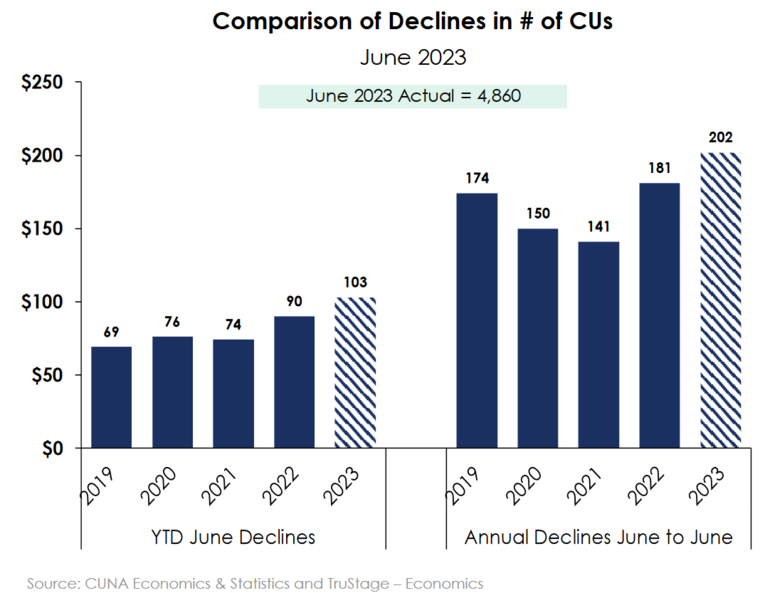
As of June 2023, CUNA estimates 4,860 credit unions were in operation, five fewer than May and 202 fewer than June 2022. During the first half of 2023, approximately 103 credit unions ceased to exist because of mergers, purchases, and assumptions or liquidation.
“During a typical year, 46% of the total decline in the number of credit unions takes place in the first half of the year, which means that we can estimate the 2023 full-year decline in the number of credit unions to be 224, above the 189 reported in 2022,” Rick stated. “The recent rise in interest rates and its corresponding liquidity risk ramifications have accelerated the pace of credit union mergers. The average asset size of a credit union now stands at $464.4 million, up 8.5% from a year ago, while the median asset size is $55.4 million, up 7.2% over the last year.
‘Likely to Accelerate’
“The trend towards industry consolidation and bigger credit unions is only likely to accelerate due to the benefits of greater economies of scale, higher productivity and larger earnings that are all achieved with a larger asset base. Larger, more efficient credit unions will also raise the barrier to entry for new, small credit unions,” Rick added.
Are You Being Gouged for Bank-Like Subscription Fees for Old News? Here’s a CU-Like Way to Fix That
The biggest, best and freshest news reporting in credit unions remains free! Each morning CUToday.info delivers its daily Fresh Today news update offering the latest headlines and breaking news right to your email, with the easy-to-read headlines format allowing you to click on the stories that interest you most in order to learn more. So stop paying those bank-fee-like subscription prices from other so-called “news”” publications!
If you haven’t yet signed up for the new email solution on which CUToday.info has partnered with ResponseGenius, you can do so here. Signing up requires less than one minute of your time—and it’s free!
Please note that after signing up you may need to go to your Spam/Junk folder and mark the morning headlines email as safe. CUToday.info does not provide its list of readers and emails to outside parties, and we will not be contacting you to sell you an extended warranty or sending you any links so you may cash in on an inheritance you didn’t know was coming.
And did we mention it’s free?