

MADISON, Wis.—Credit unions have been relaxing lending standards as they perhaps brace for a tougher lending environment in 2020, if the latest CUNA Mutual Trends Report data is any indication of what’s coming.
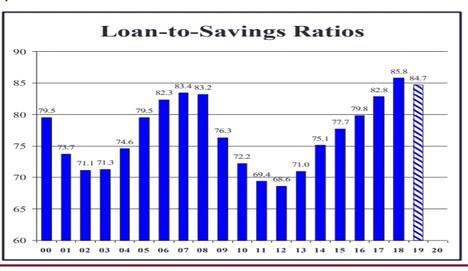
The latest Trends Report shows lending growth continues to slide from 2018’s pace—particularly auto lending—and deposits are building at the same time. There is also concern growing of another home price “bubble,” while membership growth at CUs has slowed considerably since 2018.
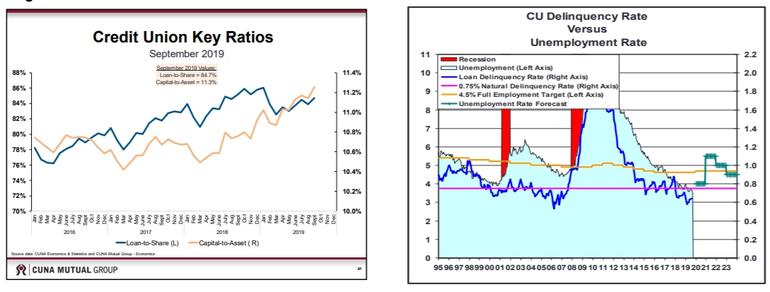
Data show credit union loan balances rose 0.7% in September, but slower than the 0.8% pace reported in September 2018. The credit union average loan-to-savings ratio fell to 84.7% in September, down from 85.2% in September 2018 due to deposit growth exceeding loan growth.
“It appears the credit cycle has turned and will decline in 2020,” CUNA Mutual Group stated.
Loan-to-savings ratios peak right before recessions and may contribute to the economic slowdown that follows due to tight liquidity from credit unions reducing their pace of lending and high levels of members’ debt reducing their demand for loans. Based on current trends, credit union lending growth could slow to 5.5% in 2020, while savings balances increase 9%. This will drop the average loan-to-savings ratio to 82% at year’s end 2020, CUNA Mutual Group said.
Here’s a look at how credit unions performed by category during and through September:
Credit Union Consumer Installment Credit
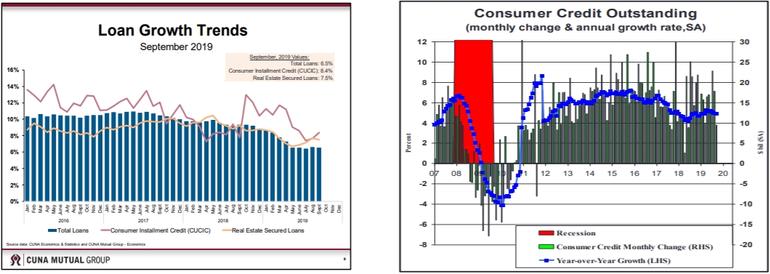
Credit union consumer installment credit loan balances (auto, credit card and other unsecured loans) rose 0.3% in September, faster than the -0.4% decline set in September 2018. During the last 12 months, credit union consumer installment credit grew 8.4%. According to the Federal Reserve, outstanding consumer credit rose a modest $9.5 billion for all lenders in September, with balances up 4.9% over the last year.
“We expect consumer credit growth to slow over the next few years due to less demand from borrowers and less supply by lenders as they tighten lending standards,” the report stated.
Vehicle Loans
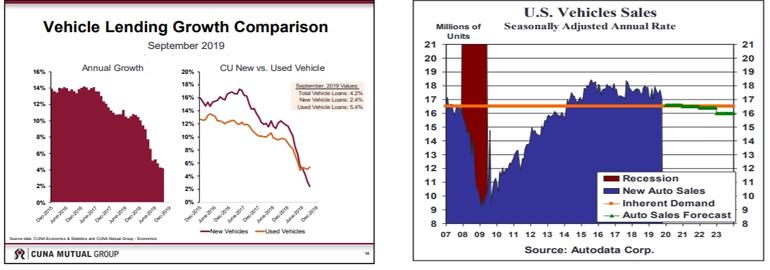
Credit union new-auto loan balances rose 0.4% in September, significantly below the 1.1% pace set in September 2018. New-auto loan balances rose only 2.4% during the last 12 months, significantly below the 12.5% increase set in the year ending in September 2018. Recently credit unions lost 2 percentage points of the new vehicle loan origination market to the banking sector. Large banks have turned to the auto lending market as commercial lending volume tapers off. Total auto loan balances have risen 4.2% since September 2018, which is slower than overall loan growth, and in turn has led to auto loans making up only 34.3% of the credit union loan portfolio, down from 35.1% last year.
Vehicle sales rose to a 17.2 million unit seasonally-adjusted annualized sales rate in September, up from 17.1 million in August.
The Slow Lane
“We expect auto sales to slow in 2020 to the 16.5 million annual sales pace considered by economists to be the ‘inherent demand’ for the U.S. auto sector,” the Trends Report states. “Five factors will slow auto sales in 2020; the elimination of pent up demand for new vehicles, new car prices increasing faster than inflation and wages, slowing U.S. economic growth, and auto manufactures pulling back production, leaving less need to push car sales through increased incentives and fleet sales.”
New car sales as a percent of all vehicle sales fell to a record low 27%, as truck and SUV sales continue to dominate the U.S. market. To put this into perspective, as recently as 2013 more than half of all new vehicles sold in the U.S. were cars.
Real Estate Secured Lending – First Mortgages and Other Real Estate
According to the Trends Report, credit union fixed-rate first mortgage loan balances grew only 1.1% in September, below the 2% pace set in September 2018 due to existing-home sales rising 1.3% from August. Adjustable-rate mortgage loan balances rose 1.3% in September, above the 0.4% pace recorded in September 2018.
Home equity lending balances were unchanged in September, which is better than the 0.8% drop reported in September 2018. Home equity seasonal factors typically shave 0.21 percentage points from the underlying monthly trend growth rate in September, so this September’s unchanged balances indicate that credit union members were willing and able to tap into their home equity to satisfy some of their borrowing and spending needs, CUNA Mutual said.
The contract interest rate on a 30-year, fixed-rate conventional home mortgage fell to 3.61% in September from 4.63% in August, and below the 4.63% reported in September 2018. During the last three months, the mortgage loan risk premium, which is the spread between the 30-year mortgage interest rate and the 10-year Treasury interest rate, rose to 200 basis points, which is above the 170 basis point historical average.
“We expect the 10-year Treasury interest rate to remain in the 1.75% to 2.25% range in 2020. Therefore, we can expect the 30-year mortgage interest rate to hover in the 3.5% to 4% range over the next year. Interest rates this low would not be that unusual. During the last nine years, mortgage interest rates have been below four percent 52% of the time,” CUNA Mutual said in its analysis.
Another Bubble?
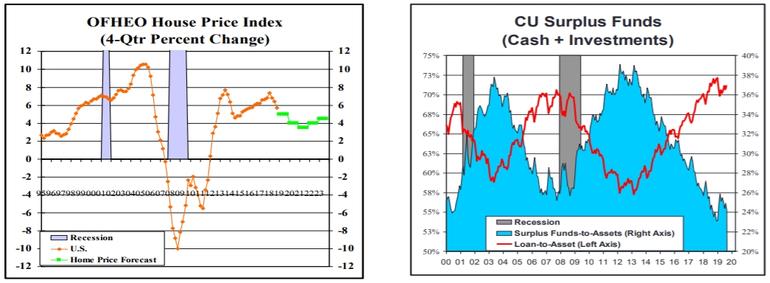
CUNA Mutual’s economists noted home prices rose 0.4% in September from August, according to the Core Logic Home Price Index, and 3.5% year-over-year. The OFHEO House Price Index rose 5.5% over the last year ending in the second quarter.
“Some people are wondering if home prices are becoming overvalued again, and therefore are creating another home price bubble,” the report’s analysis suggests. “One way to measure overvaluation is to compare today’s home price-to-income ratio and home price-to-rent ratio to their historical averages. Historically, a house in the U.S. cost around 3 to 3.5 times the median annual income. During the housing bubble of 2004-2005, the median price for a single-family home cost more than 5.1 times the median annual household income in November 2005. Today, that ratio stands at 4.4. This ratio is heavily influenced by interest rates, and when interest rates go down, the affordability of a house goes up, so people spend more money on a house.”
Surplus Funds (Cash + Investments)
Not surprising, given the trend lines, credit union liquidity appears to be on the rise in 2019 as loan growth fell below asset growth. Credit union surplus funds as a percent of assets rose to 24.2% in September, slightly higher than one year earlier due to surplus funds growth (7%) outpacing asset growth (6.9%). Credit union borrowings fell 6.7% over the last year ($4 billion) due to loan demand being weaker than saving supply, CUNA Mutual reported.
Credit union borrowings as a percent of assets stands at 3.6%, below the 4.9% set back in the first quarter of 2009. Loans fell to 71.2% of assets in September, below the 71.5% set one year ago, and only slightly below the 72.1% set back in January of this year, which was the highest since July 1980, the Trends report stated.
Currently, 52% of credit union surplus funds have a maturity of less than one year, up from 46.7% in September 2018.
“The large holding of shorter maturity investments was due to the Federal Reserve raising short-term interest rates over the last three years,” the Trends report analysis states. “The shift to shorter-maturity investments reduced credit unions’ exposure to falling investment values as interest rates increased, but this interest rate risk reduction comes at a cost, specifically an opportunity cost, or what is given up. Historically, thee-year Treasury notes yielded roughly 66 basis points above overnight money. This opportunity cost is, in effect, an interest rate risk insurance premium. This summer, however, the difference between 3-year Treasury notes and overnight money fell to -60 basis points, encouraging the placement of surplus funds into short-term investments.”
Savings and Assets
Credit union savings balances fell 0.3% in September, less than the 0.1% gain reported in September 2018 due to August ending on a payday Friday.
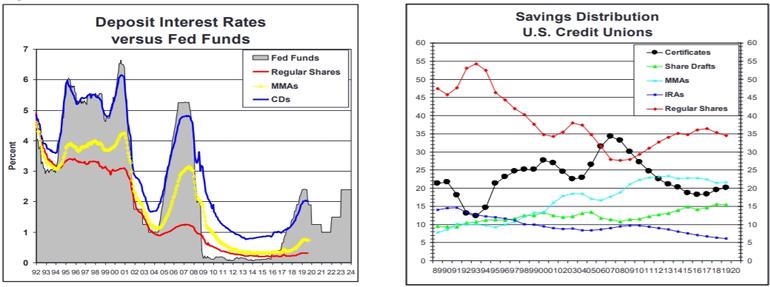
CUNA Mutual reported savings balances rose a strong 7.1% during the last 12 months due to falling gas prices, tax cuts, rising incomes, aging demographics and fears of recession. The company’s analysts are projecting credit union cost of funds will fall 10 basis points in 2020 due to the Federal Reserve lowering the Fed Funds interest rate 0.75% over the last few months and possibly further if the economy stumbles in 2020.
“Credit unions will follow suit and lower interest rates on share certificates and money market accounts, similar to what they did in 1998, 2001 and 2008. Members’ behavior will also contribute to lower funding costs as they move deposits from higher-cost share certificates to low-cost regular shares. This is known as the ‘mix effect,’” CUNA Mutual Group said.
Capital and Other Key Measures
The credit union system’s capital-to-asset ratio rose to 11.3% in September, up from 11.1% in August due to a drop in deposits and assets. The capital ratio is up 0.5% from what was reported in September 2018 due to capital growth of 11.9% outpacing asset growth of 6.9%.
The credit union loan-to-share ratio, however, is down 0.5% over the last year to 84.7% from 85.2% due to loan growth falling short of savings deposits growth. On-time payment performance of loans is improving in tandem with the labor market. The loan delinquency rate (loans two or more months delinquent as a percent of total loans outstanding) fell to 0.64% in September, down from 0.67% in September 2018 as the unemployment rate falls below what economists now believe is the “full employment rate” of 4.5%.
According to the Trends Report, all of this is leading to credit unions relaxing lending standards by going further down the credit spectrum.
Number of Credit Unions
As of September 2019, CUNA estimates 5,476 credit unions were in operation, down 186 from September 2018. Year-to-date, the number of credit unions fell by 127, slightly less than the 138 reported in the first nine months of 2018.
CUNA Mutual noted NCUA’s Insurance Report of Activity showed 50 mergers were approved in the third quarter, with an average asset size of $26.5 million. The average asset size of the continuing credit union was $950 million. Forty-three of the mergers were due to credit unions wanting expanded services, five were due to poor financial conditions and two were due to inability to obtain officials.
“The pace of consolidation continues in both the credit union and banking industries. The number of FDIC-insured banks fell by 239 during the last 12 months ending in June 2019,” CUNA Mutual stated. “This leaves a grand total of 5,303 banks in operation, 173 fewer than the total number of credit unions. This consolidation is eliminating the excess capacity in the financial services space, cutting duplication of operating costs, culling layers of overlapping management and allowing for scale to squeeze better deals from suppliers. This consolidation trend will lead to larger and more efficient depository institutions with lower operating expense ratios and a more competitive financial services industry.”
Membership
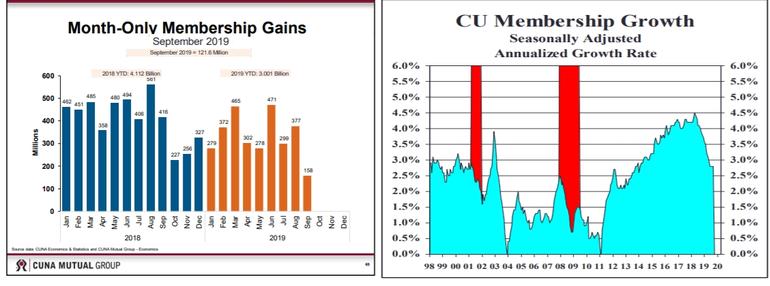
Credit unions added more than three-million memberships in the first nine months of 2019, significantly below the 4.1 million added in the similar time period of 2018. Slowing demand for credit was the major driver for the slowdown in memberships, CUNA Mutual said, noting CU loan balances increased $51.2 billion in the first nine months of this year, below the $69.5 billion for the similar time period in 2018.
Also driving the slowdown in memberships was the slowdown in job creation in the U.S. During the first nine months of 2018, the economy added approximately two-million jobs, compared to only 1.5 million jobs added so far this year. Credit union memberships grew at a 2.8% seasonally-adjusted annualized growth rate in September – the slowest pace since the spring of 2015 (Figure 15).
“We expect membership growth to slow in 2020 to a more sustainable pace of 2.5%,” said CUNA Mutual.