

WASHINGTON–Four financial regulators, including NCUA, were pressed by members of the Senate Banking Committee during a hearing to address a range of issues, including how much debt the Fed is taking on, how TDRs are being treated, and whether a planned overhaul of CRA rules will actually hurt low-income communities.
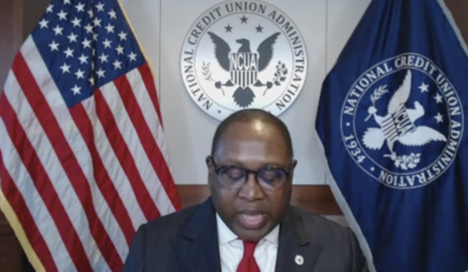
Rodney Hood
As is often the case when other banking regulators are included among the witnesses along with NCUA, few questions were directed toward the credit union regulator. The hearing included Federal Reserve Vice Chairman for Supervision Randal Quarles, OCC Comptroller Joseph Otting, and FDIC Chairman Jelena McWilliams, along with NCUA Chairman Rodney Hood.
The hearing was conducted virtually, with both senators and witnesses taking part via video, with a few glitches along the way.
Credit Unions ‘Vital’
In his remarks to the committee, Hood said credit unions are “vital” to American households and with average industry net worth of more than 11% said CUs are in a strong position.
Hood addressed recent changes approved by the NCUA board to the Central Liquidity Facility, saying “liquidity is a pillar of strength” in credit unions, and added the agency must anticipate the CLF may again prove “critical” moving forward.
Hood further told the committee credit unions have been active in working with the SBA on Paycheck Protection Loans, saying he spoke with one CEO of a small CU that had made 150 PPP loans representing $8 million, and to another CDFI CU in Mississippi that had made more than 1,000 PPP loans, including one loan to a historically black university.
Later, Hood was asked what was the highest interest rate at which a credit union could make a loan. Hood told the committee the NCUA board has raised the APR cap to 18% for 18 months, while PAL loans can go up to 28%. Hood said those APRs are still “far lower than pernicious payday lenders.”
‘Positive Actions’
In addition, in response from Sen. Jerry Moran (R-KS) regarding loan modifications and how NCUA is treating troubled debt restructurings, Hood said, “We are reminding examiners when it comes to doing loan modifications these are to be treated as positive actions.”
Both Hood and the FDIC’s McWilliams said their agencies had met with FASB about not negatively accounting for the TDRs.
In response to a separate question from Sen. Catherine Cortez Masto (D-NV) regarding how TDRs might affect credit unions, Hood said NCUA expects “modest liquidity impact and perhaps some lost servicing income.”
Banks Let ‘Off the Hook’
The strongest comments were made by Sen. Sherrod Brown (D-OH) who used his time on several occasions to argue the poorest communities in the country are being hit hardest by the economic downturn while receiving the least amount of assistance from the government.
Brown further said the Office of the Comptroller of the Currency and the FDIC are gutting the Community Reinvestment Act (CRA).
Brown said the proposed revisions to CRA would let banks “off the hook.” Brown was joined by several other Democrats on the committee in criticizing the proposed overhaul of CRA rules.
“Black, brown and low-income communities are again getting hit the worst,” said Brown. “Instead of pitching in to help, the FDIC and OCC want to gut one of the few rules we have to provide any help to communities.”
The CRA proposals, suggested Brown are invitations to payday lenders to enter those communities.
Brown’s ire wasn’t focused on just the OCC and FDIC, with the senator adding NCUA has also reduced or delayed rules aimed at protecting borrowers and ensuring CUs can lend in their communities. Pressed for time, Brown did not go into details on where he thought NCUA was acting in ways he did not approve.
Brown said he’s been hearing from mayors and other community representatives in his home state of Ohio who say lower-income communities are struggling and the proposed CRA changes would only add to the struggle.
“You are proposing to overhaul a rule that’s central to making sure these areas are not left behind,” Brown commented. “Why are you plowing ahead?”
The FDIC’s McWilliams and the OCC’s Otting both said they disagreed with the suggestion the CRA overhaul would be harmful, with Otting saying that getting more dollars into low-income communities is a “priority.”
What About Wrongdoing?
Brown also said he is worried that without strong consumer protections and while regulators are dealing with the financial crisis, Wall Street banks and other financial institutions will skirt the law and “squeeze every penny out of their customers,” while never facing any penalties.
Brown asked all four witnesses if they would impose strong penalties and strong enforcement against any financial institution or FI executive for wrongdoing. All four said yes, they would “enforce the law.”
Later, in response to a question from Sen. John Kennedy of Louisiana, Quarles said the Fed balance sheet has grown from $4.2 trillion on Feb. 1 to between $6.5 trillion and $7 trillion today.