

WASHINGTON–Three banking regulators were grilled by members of Congress during a hearing here over the recent failures of several large banks, with several asking why no one was fired by the regulators for what one congressman called “incompetence.”
NCUA Chairman Todd Harper was among the regulators appearing before Congress, but he fielded only a few questions given the focus on what took place at the failed Silicon Valley Bank, Signature Bank and elsewhere.
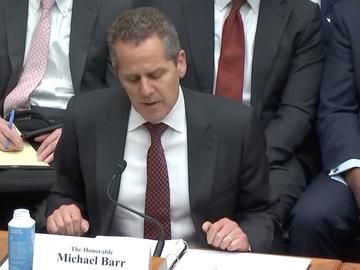
In addition to Harper, those testifying before the Subcommittees on Financial Institutions and Monetary Policy, Oversight and Investigations, and Housing and Insurance included:
- Michael Barr, vice chairman for supervision for the Federal Reserve
- Marin Gruenberg, chairman of the FCIC
- Michael Hsu, acting Comptroller of the Currency
Many of the questions asked reflected the partisan divide in Congress, with Republicans suggesting spending by the Biden Administration drove up inflation and interest rates that contributed to the banks’ failures, and Democrats suggesting it was instead a rollback of banking rules under the Trump Administration that led to the failures.
All three banking regulators said the banking system remains strong and depositors should remain confident. But Barr said his review of the failure of SVB revealed weaknesses in regulation and oversight.
Report Findings
Barr re-shared the findings of the recent report by the Federal Reserve on the failure of the $200-billlion Silicon Valley Bank. As CUToday.info reported here, the key takeaways from that report are:
- Silicon Valley Bank's board of directors and management failed to manage their risks
- Federal Reserve supervisors did not fully appreciate the extent of the vulnerabilities as Silicon Valley Bank grew in size and complexity
- When supervisors did identify vulnerabilities, they did not take sufficient steps to ensure that Silicon Valley Bank fixed those problems quickly enough
- The Federal Reserve’s tailoring approach in response to the Economic Growth, Regulatory Relief, and Consumer Protection Act and a shift in the stance of supervisory policy impeded effective supervision by reducing standards, increasing complexity, and promoting a less assertive supervisory approach
Barr called for stronger capital standards and reconsideration of some prudential requirements, including how available-for-sale securities are treated, along with other issues. He also said a culture change is needed that would allow supervisory authorities to act quickly.
Additional Testimony
The FDIC’s Gruenberg outlined during his prepared testimony the assessment the regulator has recently announced related to covering the costs from the failure to the insurance fund. CUToday.info has coverage of that plan here.
Like Barr, Gruenberg cited failures by the management and boards of the failed institutions and by regulators as contributing to the failures.
The OCC’s Hsu called for an “update” to insurance coverages for depositors.
Chairman Patrick McHenry (R-NC) pressed Barr over his statement on a cultural change, and he asked if examiners felt impeded about reporting up the chain of command?
“The report found that supervisors were more reluctant than they had been to elevate issues,” answered Barr.
Barr added that his report noted that one result of the pandemic is that examiners have spent less time on-site, which could raise risk.
Barr was also asked whether accounting rules contributed to weaknesses at SVB, including whether gains and losses on available-for-sale securities should flow through to the capital treatment of a bank.
Barr said it is a question that should be discussed moving forward so that capital is more accurately reflected on balance sheets.
Other Issues Raised
Other issues raised during the hearing included:
Accounting Problems
Rep. Brad Sherman (D-CA) told the hearing that “banks are not doing what we need them to do--make business loans.” And he said that is also the result of accounting rules.
“We don’t need them to buy Treasury bills. Less than 15% of bank investments are in business loans,” said Sherman. “We have a good system for financing corporate bonds and marketable securities. Under CECL, we penalize banks every day they make a business loans. We tell bank officers if you invest in marketable securities and they go down, it’s easy to hide the loss and your bonus goes up. And if marketable securities go up, your bonus goes up. Why invest in business loans?”
Interest Rate Risk
Both Barr and Gruenberg said they will be more “vigorous” in assessing interest rate risk. Barr said that in doing its liquidity stress testing, when the results were not favorable, SVB changed the testing to give a more positive view of its balance sheet and related stresses.
Will Anyone Be Fired?
Rep. Blaine Luetkemeyer (R-MO) was one of several members who pressed the regulators over whether any heads would roll over the failed oversight of the failed banks. Barr said “we are reviewing,” while Gruenberg said “I think the core issue was the failure on the part of examiners to compel guidance.”
“We’ll see if anything happens before you come back here. I think better supervision would be a better idea than more capital,” answered Luetkemeyer.
‘Too Timid’
One member of the committee asked Barr what prevented the Federal Reserve Bank of San Francisco from escalating supervision of the bank?
“We explicitly asked about and addressed it in our last hearing and what we found is that supervisors were essentially too timid, too slow to raise those standards in a timely enough way,” said Barr. “These supervisory determinations were handed out over the years. With some of those issues that were identified many years ago the bank responded to. Those issues were closed, but new issues were opened and the bank was not timely in responding to those.
“I think we need to enhance our system of supervision to make it more agile, more quick. We need to also improve our system of regulation so that we have the kind of resiliency we need with capital and liquidity in the system.”
Feeling the FOMO Fever? CUToday.info Has a Prescription
Are you missing out on the latest news in credit unions? Missing the trends and developments you need to be aware of? We can help. Each morning CUToday.info delivers its daily Fresh Today news update offering the latest headlines and breaking news right to your email, with the easy-to-read headlines format allowing you to click on the stories that interest you most in order to learn more.
And it’s free!
If you haven’t yet signed up for the new email solution on which CUToday.info has partnered with ResponseGenius, you can do so here. Signing up requires less than one minute of your time—and it’s free!
Please note that after signing up you may need to go to your Spam/Junk folder and mark the morning headlines email as safe. CUToday.info does not provide its list of readers and emails to outside parties, and we will not be contacting you to sell you an extended warranty or sending you any links so you may cash in on an inheritance you didn’t know was coming.
And did we mention it’s free?
Please note and/or make your IT department or email administrator aware the emails will be coming from the domains CUTodayinfo.com and CUTodayinfoReply.com