

PLANO, Texas–The reason behind the decrease in credit union net operating return will “come as a surprise” to many, according to one analyst.
During Q1, net operating return at CUs declined 11 basis points to 0.51% from 0.62%, noted Brian Turner, president and chief economist with Meridian Economics.
“As some credit unions continued to face self-inflicted liquidity challenges (due mostly from poor strategic planning), they turned to the issuance of high-cost term certificates to raise their surplus funding profile,” wrote Turner in his latest analysis. “As elevated inflation created unprecedented volatility in core deposits, combined, cost of funds increased 42 basis points over Q4-2023. However, the data shows that gross margins (asset yield less cost of funds) was unchanged at 3.00% - as opposed to 2.59% and 2.86% in 2021 and 2022, respectively. This indicates that interest revenues from cash, investments and loans were sufficient enough to absorb the rise in interest expense.”
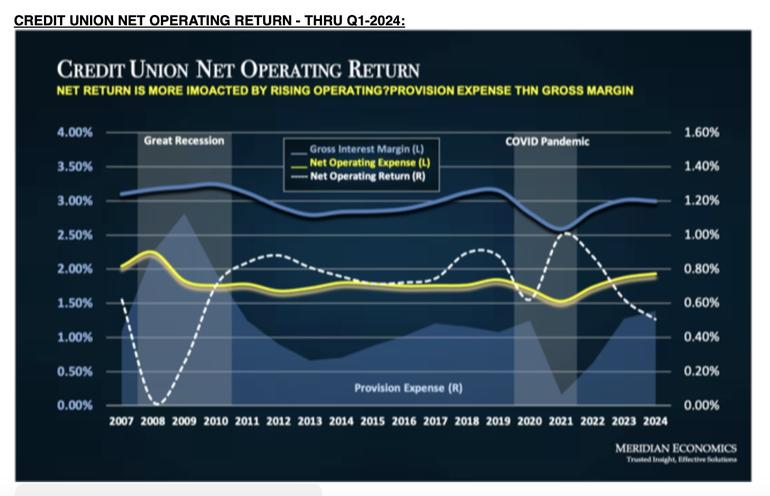
Therefore, said Turner, that 11 basis point decrease in Q1 can be directly attributed to a six-bases point increase in net operating expense and a five-basis point increase in provision expense.
Higher Provisions, But…
“The higher provision expense comes despite a decline in loan delinquency from 0.83% to 0.78% but net charge offs increasing from 0.61% to 0.80%,” Turner stated. “But, the higher net charge-offs comes at the same time when regulators are demanding greater loss reserves being retained by many institutions - sometimes in spite of their actual risk exposure - and oftentimes due to ill-conceived CECL modeling application. We consider this to be unnecessary given the fact that the Q1-24 data also shows that the industry as a whole is retaining 2.8-times the level of loan loss reserves than needed - based on their implied risk exposure on March 31, 2024. Moreover, this surplus of reserves crosses over each NCUA peer group category.”
Peer Performance
In his peer performance assessment, Turner stated:
- Larger credit unions (>$500million) continue to retain 85.8% of industry assets but account for only 15.7% of the number of credit unions. “This skews many of the industry’s overall performance data that might give a slightly different perspective.”
- Assets increased at an annualized pace of 9.1%. “Larger credit unions grew at a 10.1% so this implies that the remaining 84.3% of the industry (by number) collectively experienced a 3.4% increase,” he said.
- Total loans decreased -0.5% with larger credit unions increasing 0.4%. “This implies a -6.2% decline for the <$500million credit unions,” he said.
- Total shares increased 9.4% (annualized) during the first quarter of 2024. “Larger credit union experienced a 10.4% increase with the remaining 86-percenters collectively experiencing a more modest 3.9% increase.”
- Net operating return was rather constant at 0.51% across-the-board. “Yet, provision expense for the industry increased to 0.56% - with larger credit unions posting 0.60% of expense but the remaining sector recording a much lower rate of 0.20%,” Turner wrote.
- Earnings were much poorer for credit unions with <$10million in assets because of having narrower opportunities to find cost efficiencies. “Moreover, each peer group is challenged not only by particular quirks in demand but also by transactional volumes. For instance, there is a significant decline in average loan balances between the largest and smallest credit unions with balances for <$500million credit union at $21,040, compared to an average balance of $3,899 for credit unions with $10-50million in assets.”
For the full report and additional details, go here.
How to Sign Up For the Best Daily News Email in Credit Unions? (It’s Free!)
Every workday CUToday.info delivers the most comprehensive, freshest daily newsletter with the day’s news headlines, including links to the related articles. The Fresh Today newsletter is the most timely, relevant and widely-read source of news and information in the CU community. And it’s free!
If you haven’t yet signed up for the new email solution on which CUToday.info has partnered with ResponseGenius, you can do so here. Signing up requires less than one minute of your time—and it’s free!
Please note that after signing up you may need to go to your Spam/Junk folder and mark the morning headlines email as safe. CUToday.info does not provide its list of readers and emails to outside parties,
And did we mention it’s free?