

PALM DESERT, Calif.–Credit unions and financial services are always at some sort of crossroads, but there’s “something different” in the current crossroads, and it could be good news for CUs, according to one person.
Ryan Patel, a global business executive who is known as an expert in global business and in growing and scaling companies, and who is also a senior fellow with the Drucker School of Management, offered his insights on not just the crossroads at which credit unions are standing, but also on macro trends to be watching as well as a trend every CU should be taking advantage of.
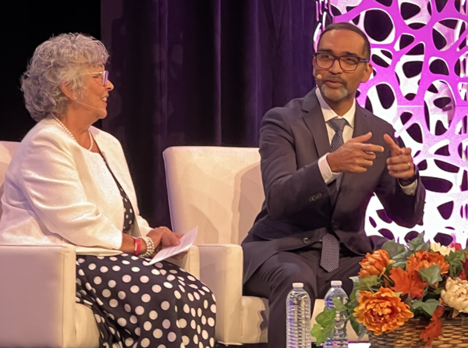
Ryan Patel and Diana Dykstra trade thoughts during Reach meeting.
Patel shared his thoughts during a Q&A at the California and Nevada leagues’ REACH Conference, with CNCUL President and CEO Diana Dykstra acting as the moderator:
Here’s a look at some of what was discussed:
Dykstra: Is the financial sector really at a crossroads?
Patel: I could be dramatics, but this industry is always at some crossroads every few years. What has changed is that this crossroads has the biggest opportunity we’ve ever seen for the financial services industry.
What has changed is it’s OK that you’re not in the middle. Typically, in the middle of crossroads you want to go north. But the North Star has moved. You don’t have to go the middle and go up, you can go straight to the North Star. One example is fintech partnerships. It’s great to have innovation and disruption, but the values we are seeing in the fintech space are dumb. Just dumb. But you have to pay attention to it. Now, don’t go backwards. You have an opportunity to grow.
The other crossroads I would want to call out is where are we at when it comes to being proactive? Financial services has always been so reactive. You can do a straight line to where you want to be, you can make up ground, because of fintechs.
Dykstra: What are some things in macro-trends to watch in this current climate that are applicable to our industry?
Patel: Recognize the interconnectedness. Recognize the global interconnectedness. Think of how we are so interconnected in business. It matters.
The second theme is be aware of the evolution in speed. Look around you. Look at other industries. What about the automotive industry? Three, four years ago some companies said they weren’t going to touch the electric vehicle. Now, everyone has at least one. (EV maker) Rivian has a larger market cap than Honda. Why is that important? That is an industry that said it was never going to change. It’s changing.
Domino’s is a technology company. Those were their words a handful of years ago. They spent so much money to become a tech company. Don’t let their success fool you. It’s been really, really tough for them to get to this point and now there are others are trying to catch up. Once you get that first crack at the consumer it’s up to you to know if you want to keep them.
Dykstra: What about consumer needs and refocus on fundamentals?
Patel: Consumer needs is interesting. I don’t know what you think of this statement: ‘You give the consumer something they don’t know they need.’ I was a late adopter to Alexa, but I knew this was coming. We’re talking about this because that is the evolution of smartplex. Best Buy does smart homes. It’s here, whether you like it or not. What does that mean to consumer needs? I didn’t know I needed this (pointing to smartwatch).
How lazy are we getting? This home industry is an example, because we didn’t think we needed it. And boy, do we need it now.
As for the fundamentals, a lot of companies that are valued highly aren’t making money. That’s one thing I know that won’t last forever. The fundamentals always need to be strong, but it’s hard work to abide by that. It’s people, culture, profitability, transparency, being an empathetic leader--we didn’t even know that existed a few years ago.
The fundamentals of being kind also go a long way.
Dykstra: What are some watershed moments we should be paying attention to?
Patel: I ran a campaign with Mastercard on cybersecurity. I did it because 60% of small businesses get cyberattacked and they don’t know it and millions and millions of dollars are lost. Hospitals are paying ransoms and it’s only going to continue to increase. There are some basic things you can do. It’s going to mean there’s more of a learning curve and you will have to train your members, and that is not easy.
You cannot ignore the damage from breaches such as Facebook. People do not want to share information anymore. People get annoyed. They want to know where their data is going. They care and are going to care more.
There is something here with Meta and the metaverse. Augmented reality in manufacturing and training is already happening. We are moving toward that in e-commerce. That type of experience is going to happen.
Dykstra: What should we know about changing labor dynamics?
Patel: Who has the leverage now, employers or employees? Employees! It’s the first time since the 1960s when the employees, the unions, have clear leverage. At our lunch table there was this conversation around hiring and finding the right people.
It’s not just about compensation, although let’s not kid ourselves, the money still matters. Pre-pandemic, it was happening. But now (potential hires) want to know whether volunteer hours are available, want to know what do you support? People are taking less money in exchange. COVID has really provided a different lens.
The outlook for work has also changed in the gig economy. There are 55-million gig workers in the U.S. People want to work where they want to work and to do the things they love. Passion really came to the top in COVID. Unfortunately, as people return to the office, we are forgetting that conversation.
Dykstra: You recently worked with Adidas and you wrote a piece about their collaboration
Patel: I see all these big strategies and my background is in scaling things. I see people throw around buzzwords like collaboration. I saw Adidas and Allbirds collaborate. They actually created a shoe together and they are two competitors. They did so to solve sustainability for their brands.
I wrote that collaboration is great if you work together, but if you’re trying to solve a real problem you can only do so much by yourself. These partnerships are going to be a real change.
Why does it matter to you? Change is here. Change ain’t going anywhere. So, the things you do have to be very genuine.
Dykstra: What is the one trend the financial services industry will see more of in next five years that we are not thinking about today?
Patel: Financial institutions are going to be content creators. Not that you make money off the content, such as with subscription models. You all are going to provide education through the content.
What you do in the physical community is impactful. Shouldn’t you be doing that with your digital community. You can make that a great experience. You can create educational videos. The content you create is up to you. There are financial literacy videos on Tik Tok that are off the roof. Can you do that? People are looking to you for that because they trust you. You want them to engage with you. It needs to be meaningful engagement. You do that in person—you need to do that digitally, too.
With financial literacy, we are not doing enough. It’s clear. People talk about inclusion, but just banking them doesn’t mean they’re included. You want to build financial wealth for people. To do that you can’t just build it from scratch, you have to educate all kinds of perspectives. I think what is different for credit unions is you have an audience that is paying attention to you. But quit talking about it; do it.