

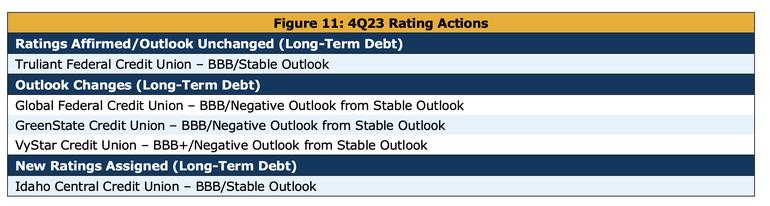
NEW YORK–The “more challenging operating environment” created by rising rates can be seen in a new analysis of the performance of the country’s 20 largest credit unions, with the report forecasting some overall positives for the industry even as it revises its outlook for three of those CUs to Negative from Stable, primarily based on weaker- than-expected earnings profiles largely due to NIM compression and rising credit costs.
The “Fourth-Quarter 2023 U.S. Credit Union Compendium and Expectations for 2024” report from KBRA, a global ratings agency, posits that despite the challenges, the “Fed’s efforts at curbing inflation could benefit CUs via consumer resiliency, as CUs tend to lend toward low-to-moderate income customers who are negatively impacted by higher inflation, unemployment, and higher borrowing costs.”
That said, borrowers continue to face near-term pressures from the increase in interest rates,” according to the report.
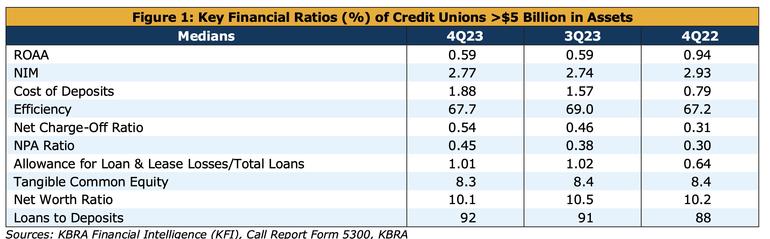
“CUs greater than $5 billion in assets have experienced modest revenue compression in 4Q23 due to rising funding costs and lower nonsufficient fund (NSF) fees,” according to KBRA. “Cost pressures resulted from investing in new technologies intended to enhance customer experiences and contribute to differentiated deposit-gathering strategies over the longer term.”
The Highlights
The report further notes:
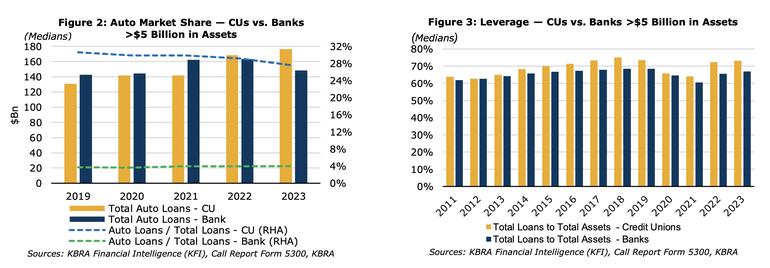
- Since the Fed began to raise interest rates in 2021, CUs have experienced robust growth in auto loans, as outstanding auto balances for the 75 largest CUs surpassed the 275 largest banks (i.e., institutions over $5 billion in total assets) and represented around 30% of total loans as of 4Q23 for CUs compared to approximately 4% for the banking counterpart.
- The growth in both auto loans and longer duration residential mortgages was strong during the lower rate environment, which has exacerbated impacts from repricing within the funding base. “Net interest margin (NIM) appears to be stabilizing despite these headwinds, and we anticipate similar trends will continue throughout the year,” the report states.
- Adoption of technological advancements such as the FedNow product—a platform for instant payments—could drive future deposit growth and fee revenue, as well as essentially limiting or replacing the need for and potential risks in clearing houses.
- Aside from technology, CUs have also been active in opening branches, largely in the South and Midwestern U.S.; conversely, branch consolidation has been a theme for banks to gain efficiency and scale in densely populated markets.
- Larger CUs have also announced and/or executed purchases of about 30 banks since February 2022, which were typically digestible at less than or equal to 10% of total assets and are in smaller secondary markets with lower cost deposits, and/or easily recognized synergies.
- The report forecasts ongoing CU consolidation throughout the industry, noting 29 CU mergers closed in Q124 alone.
‘Meeting the Challenges’
“Overall, KBRA expects the industry to meet the challenges of higher funding costs, weaker earnings, and the early onset of asset quality deterioration by way of slowing growth and building on the industry’s strong capital positions,” the company said. “In summary, KBRA expects CUs to continue to face a challenging operating environment in 2024, marked by a weakened earnings profile from persistent funding cost pressures, growing provision expense related to deteriorating credit conditions, and a limited ability to reduce operating expenses.
The Forecast
“Our expectation for 2024 is that higher provision expense will further weigh on earnings power, as demonstrated by higher delinquencies, NPAs, and NCOs through 2023. Potentially reducing funding pressures are the benefits the industry receives from a solid, customer-centric core deposit base with a small amount of nonmember deposits (i.e., brokered deposits),” the report continues. “However, CUs that have leaned into higher-cost borrowings in recent years to fund the gap between loan growth and deposits could face further earnings pressure. The potential offset to these funding pressures would be a slowing of balance sheet growth and potentially allowing lower-yielding earning assets to run off the balance sheet, which could help stabilize NIM going forward.”
For additional information, go here.
The Best News Reporting in Credit Unions. To Your Inbox. Every Day. For Free!
The biggest, best and freshest news reporting in credit unions remains free, and now has an added bonus---free shipping to your email address! That’s right. Each morning CUToday.info delivers its daily Fresh Today news update offering the latest headlines and breaking news right to your email, with the easy-to-read headlines format allowing you to click on the stories that interest you most in order to learn more. So stop paying those bank-fee-like subscription prices from other so-called “news” publications!
If you haven’t yet signed up for the new email solution on which CUToday.info has partnered with ResponseGenius, you can do so here. Signing up requires less than one minute of your time—and it’s free!
Please note that after signing up you may need to go to your Spam/Junk folder and mark the morning headlines email as safe. CUToday.info does not provide its list of readers and emails to outside parties, and we will not be contacting you to sell you an extended warranty or sending you any links so you may cash in on an inheritance you didn’t know was coming.
And did we mention it’s free?