

MADISON, Wis.– The credit union industry average for return-on-asset ratios will fall to 0.2% in 2020, and go negative at -0.35% in 2021 due in part to a surge in provisions for loan losses, according to CUNA Mutual’s newest Trends Report.
The Trends Report, which reflects data through March, further shows membership growth skidded during the first quarter to just 400,000, significantly slower than the 1.1 million added in the first quarter of 2019. What growth has occurred is taking place at the largest CUs, with those below $50 million in assets actually showing a decline in total membership over the past two years.
Here's a look at how credit unions performed by category, according to the Trends Report.
Total Credit Union Lending
Credit union loan balances rose 0.3% in March, faster than the 0.2% pace reported in March 2019 and 6.9% during the last 12 months. CUNA Mutual noted March is historically the third weakest loan growth month of the year, with seasonal factors typically shaving off 0.24 percentage points from the underlying trend growth rate. The second and third quarters traditionally experience the strongest loan growth for credit unions, the Trends Report reported.
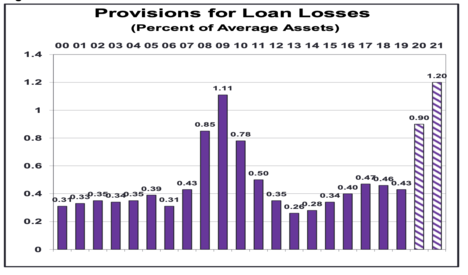
Noting the COVID-19 pandemic is expected to keep interest rates at the lowest level in history and the unemployment rate at the highest in modern history for the next two years, CUNA Mutual said it is now forecasting credit union return-on-asset ratios to fall to 0.2% in 2020, and -0.35% in 2021. The major factor contributing to the fall in credit union earnings is a surge in provisions for loan losses form 0.43% in 2019 to 0.9% in 2020 and 1.2% in 2021, the company said.
Credit Union Consumer Installment Credit (CUCIC)
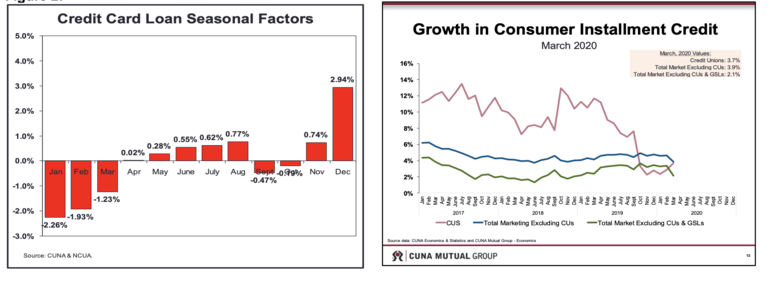
Credit union consumer installment credit balances (auto, credit card and other unsecured loans) rose 0.8% in March, better than the 0.1% pace set in March 2019, due to strong growth in unsecured personal loan (0.7%) used-auto lending (0.3%) and banks tightening their credit standards.
The Trends Report states credit card balances fell 1.4% in March due to seasonal factors that typically shave 1.23 percentage points from the underlying trend growth as members use tax refunds and bonuses to pay down outstanding credit card balances. Credit union consumer installment credit grew 3.7% during the last year, which is slightly below the 3.9% for the total market excluding credit unions, the Report adds.
Vehicle Loans
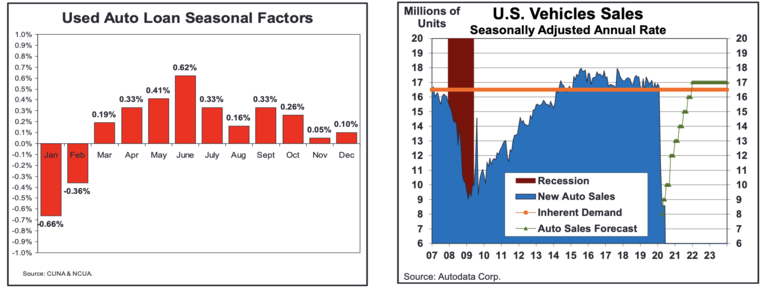
Credit union used-auto loan balances grew 0.3% in March, the same as the 0.3% reported in March 2019.
“The used-auto buying and lending season begins in March and runs through October. March’s used-auto loan seasonal factors usually add 0.19 percentage points to the underlying trend growth rate,” the Trends Report states. “On a seasonally-adjusted annualized growth rate basis, used-auto loan balances rose 6.6% in March, the fastest pace since the fall of 2018.
“The March collapse of vehicle sales is only the beginning as we expect 2020 sales to be the lowest since the Great Recession of 2008-2009,” the Trends Report continues.
Real Estate Secured Lending – First Mortgages and Other Real Estate
Credit union fixed-rate first mortgage loan balances rose 1.3% in March, faster than the 1.2% increase reported in March 2019, the Trends Report states, citing the significant drop in interest rates.
“Deteriorating household balance sheets, falling consumer incomes and a falling capacity to service debt has increased mortgage credit risk and therefore encouraged credit union lenders to tighten lending standards,” the Trends Report states.
The Trends Report pointed to the CoreLogic Home Price Index, which shows single family home prices rose 1.3 in March from February, the fastest pace since 2018. During the last 12 months, home prices rose 4.5%, the fastest pace since 2018.
“The recent weakness in housing demand has led to a big drop in applications for purchase mortgages,” the Trends Report states. “This weakness will lead to decline in house prices in the second half of the year.”
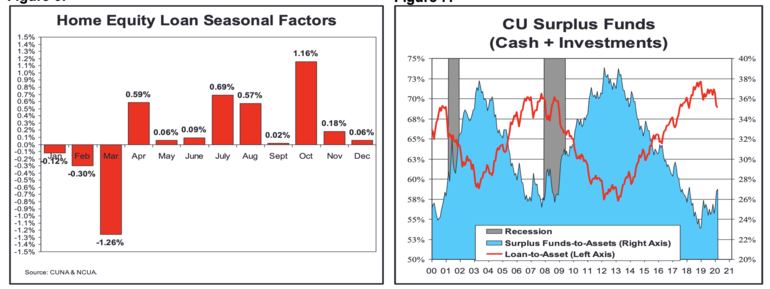
Meanwhile, according to the Trends Report, home equity loan balances fell 0.8% in March as members used bonuses and tax refunds to pay down some of their lines of credit.
“Because of these seasonal factors, March is typically the weakest month of the year for home equity loan growth, with balances falling 1.26 percentage points below the underlying trend growth rate,” the Trends Report states. “However, credit union home equity loan balance growth rate accelerated to a 4.1% seasonally-adjusted annualized growth rate in March, as members began to tap into home equity to provide liquidity during the COVID-19 economic slowdown. With home prices currently at record highs, many members have an abundance of home equity to tap into.”
Surplus Funds (Cash + Investments)
Credit union surplus funds as a percent of assets rose to 27% in March from 25.9% last year, as credit unions placed strong deposit growth into investments as loan growth slowed, CUNA Mutual’s economists said.
During March, a 0.9% surge in savings balances funded a 0.3% increase in loans and a 1.5% increase in surplus funds, the Report notes, adding external borrowings rose a strong 9.5% in March. Surplus funds are expected to rise to 30% of assets by the end of the year, the loosest liquidity position since the second quarter of 2016, as loan balances grow only 2% and savings balances rise a very strong 12%, CUNA Mutual is forecasting.
The company is further predicting loans as a percent of assets are expected to fall from 68.8% today to 65.8% by December 2020.
“During 2019 the average return on loans was approximately 4.9%, and the average return on investments was 2.2%, so the three percentage point shift in assets from loans to surplus funds this year will depress asset yields by eight basis points [(4.9 – 2.2) x 0.03],” the Trends Report states. “The percentage of credit union surplus funds with a maturity greater than one year fell to 44.9% in March, down from 47% last year as more funds were invested short term.”
Savings and Assets
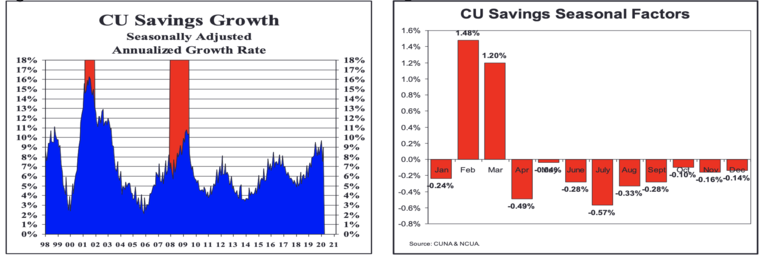
Credit union savings balances surged 0.9% in March, but below the 1.8% gain reported in March 2019, due to the seasonal factors of tax refunds and bonuses being deposited in credit union members’ regular share accounts and money market deposit accounts, which increased 2.3% and 0.9%, respectively, according to the Trends Report.
Credit union savings balances grew 9% at a seasonally-adjusted annualized growth rate in March, due to a rising national savings rate (savings as a percent of disposable personal income) and consumers spending less on gasoline in the first couple months of the year, CUNA Mutual said, adding the savings-per-member growth rate rose to 5% during the last year, up from 4.4% during 2019.
“We forecast credit union savings balances to grow 12% in 2020 due to the COVID-19 recession,” the Trends Report states.
Capital & Other Key Measures
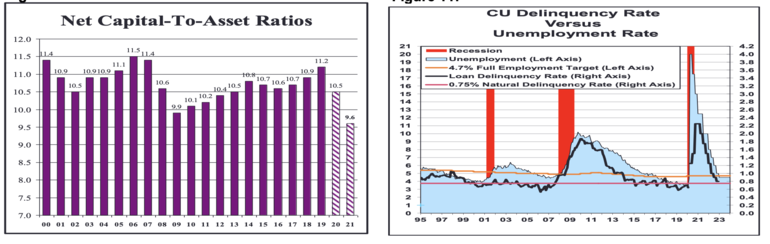
The credit union average capital-to asset ratio rose to 11% in March 2020, up from 10.9% in March 2019. In the year ending in March, credit union capital rose 9.9% while assets grew 8.4%, which increased the capital ratios 1%, or the approximate difference between the numerator and denominator growth rates, CUNA Mutual reported.
During the first quarter, credit unions reported strong deposit and asset growth due to low gas prices, and capital ratios could fall to 10.5% this year as the capital growth rate slows dramatically (3%) but asset growth surges (10%), CUNA Mutual stated.
The credit union loan delinquency rate (loans two or more months delinquent as a percent of total loans outstanding) fell to 0.63% in March, down from 0.7% in December 2019, but up from 0.58% in March 2019, according to the Trends Report.
“With the unemployment rate expected to remain above 10% through 2021, we can expect the credit union loan delinquency rate to rise above 2.2% over the next few months,” the Report stated.
Credit Union Numbers
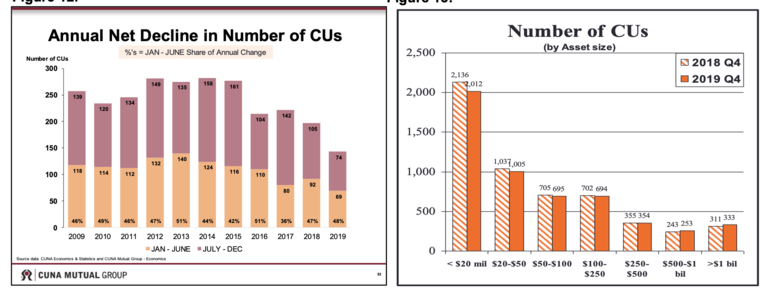
As of March 2020, CUNA estimates 5,407 credit unions were in operation, 27 fewer than February. During the last 12 months, the number of credit unions fell by 154, slightly below the 198 annual decline set one year ago, according to CUNA Mutual.
During the first quarter of 2020, the number of credit unions fell by 53, above the 42 lost in the first quarter of 2019. Slightly more credit union mergers take place in the second half of a year compared to the first half.
“At the end of 2019, 333 credit unions reported assets greater than $1 billion – 22 more than the year before,” said CUNA Mutual. “These large credit unions control more than 69% of all credit union loans, but make up less than 6.2% of all credit unions. The number of credit unions with assets less than $20 million fell by 124 to reach 2,012 as these credit unions either grew into the larger asset class or merged with a larger credit union.”
Credit Union Membership
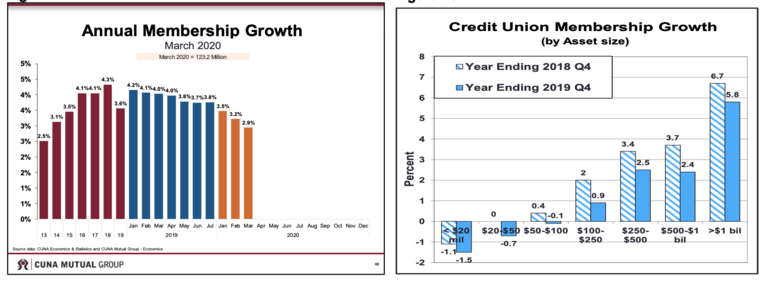
Credit union membership growth slowed significantly in the first quarter of 2020, adding 0.4 million new memberships, significantly slower than the 1.1 million added in the first quarter of 2019, according to the Trends Report. On a growth rate basis, memberships are up 2.9% in the year ending in March 2020, below the 4% pace set in the year ending in March 2019.
“Credit unions should expect membership growth to slow to 1% in 2020, before picking up slightly to 1.5% in 2021,” the Trends Report states. “Most of the membership growth is taking place at credit unions with assets greater than $500 million due to organic growth and mergers. Credit unions with less than $50 million in assets lost memberships during the last two years.”