

HOLLYWOOD, Calif.–There is a centrifuge now rapidly spinning and separating the companies—and people—who will survive in the future, and it’s being powered by the six R’s, according to one person.
Rich Karlgaard, a forecaster, futurist and publisher of Forbes, told the California and Nevada leagues’ REACH Conference here there are steps every credit union can
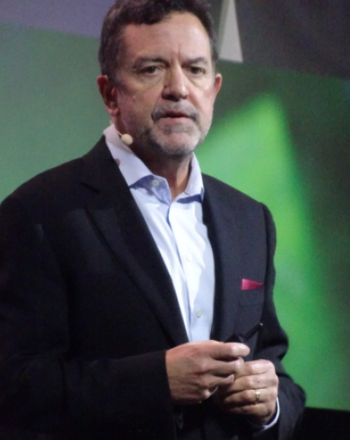
Rich Karlgaard speaks to the Reach meeting
take to better prepare for what’s coming, but he made it clear it isn’t going to be easy/
Here is a look at some of the issues covered by Karlgaard during his remarks:
The Election & The Economy
Karlgaard said that a “blue tsunami” did not occur in this week’s elections, but a “blue wave” did, especially at the state level.
“What you do see is Trump’s coalition is getting stronger in places where it is strong but more fragile in places where it isn’t as strong: the suburbs and some rural areas,” he said. “Donald Trump would not win Wisconsin today; he picked a fight with the most iconic company in Wisconsin: Harley Davidson. I would hope this would moderate Donald Trump, but that will probably not be the case.”
Noting the economy has just finished one of its strongest six month stretches in U.S. history, he expressed disappointment there hasn’t been sustained 3% growth for the last several years, which he believes is possible. “We are a $20 trillion economy today, and had we grown at 3% since the recession we would be a $22 trillion or $23 trillion economy,” said Karlgaard. “Given the federal government would take $600 billion of that, that’s a lot of debt or infrastructure or a lot of good things that could happen.”
At a macro level, Karlgaard said what is taking place is the emergence of a “two-speed economy.”
“It’s as if the economy is in a giant centrifuge and it’s sorting out businesses that work, careers that work, communities that work, and cities that work, versus those that are really struggling,” he said. “The divide between those aligned with the future and those struggling to find their way forward is more dramatic than it used to be, and not just in the United States but around the world.”
The Six R’s
What is driving the centrifuge? According to Karlgaard, the decline or prosperity of companies is being caused by the six R’s: reach and retention, relevance and reputation, revenue and ROI.
“You can fail while standing on your feet. You can be alive, but you’re not the same,” he said of companies that are not what they once were. That’s what happened to Forbes and a lot of legacy media companies. When I joined Forbes in 1992, it had castles in France and Morocco and an island in the Pacific and Steve Forbes got around on a 727, and we had a yacht. All of it is gone. We were so profitable as a $200 million company we had those kinds of things. We almost died in 2008 and 2009 and we recovered, but we will never have that kind of profitability even as our revenue has recovered, because Google has changed the game.”
Technology
Like many others, Karlgaard observed that technology is not slowing down but speeding up. “We’ve learned to bow at the altar of Moore’s Law. In business terms, what that means is 30% annual improvement in digital bang for the buck,” he said,
The press, according to Karlgaard, has been “obsessed” with artificial intelligence, but this time with good reason.
“The new engine is the data explosion with IoT, AI, predictive analytics, driverless vehicles, augmented reality, etc.,” he said. “There have been false dawns in the past, but there is something new now and it’s being driven by a much more powerful, faster engine. And we’re not even to quantum computing yet.”
Extreme Asymmetric Warfare
“Asymmetric venture capital funding leads to repeated assaults on profit models of legacy companies that can’t get funding to conduct multiple defenses against multiple attacks,” he said. An example: Uber is valued at $72 billion, while GM is valued at $52 billion (and the latter’s investors are more concerned with receiving a dividend, not preparing for the future).
Apps to Future Proof Organization
The following applications are going to be critical to “future-proofing” any credit union, according to Karlgaard:
- Digital Fluency. “That’s more than a fancy website. It means the head of the organization, the board, all C-level people and not just IT, have to take ownership of the digital future. Any company that has IT locked up on the audit committee is really missing it. Put it in your strategic committee and make them own this stuff.” He shared Mickey Drexler’s observation that he had underestimated how fast technology would upend things. He did so while serving on board of Apple.
- Cultural Clarity. The most adaptable cultures are organized as tringles of equally strong sides: Execution, Values, Strategy. “Everybody would say this, everybody talks a good game, but have you ever gone to a company website or an annual report where people looked unhappy? Values should be as strongly held as the execution and strategy.” He noted it’s easy to make great two-year decisions that turn out to be really poor five-year decisions.
- Human Development. Karlgaard the average pay at Facebook is more than $240,000 annually (including stock options), meaning other companies have to consider Moneyball-like strategies. “Who in your organization is being undervalued?” Northwestern Mutual likes late bloomers.