

HOLLYWOOD, Calif.–Tomorrow credit unions are going to be fundamentally different organizations than today, needing to understand new processes, prepare for machines talking to machines, and possibly even paying members to use their data, according to one person.
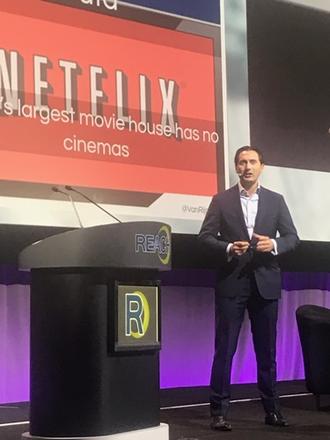
Mark van Rijmenam
Speaking to the California and Nevada leagues’ REACH Conference, Mark van Rijmenam was one of three consecutive presenters who all touched on similar trends about changes being driven by technology. In this case, van Rijmenam, the founder of Datafloq and author of “Think Bigger–Developing a Successful Big Data Strategy for Your Business,” said three mega-trends are coming to a confluence, and while it’s critical CU leaders understand what’s happening, in some cases it’s too late, he suggested. Moreover, what’s ahead for everyone may play out positively or negatively for humanity, as no one yet knows what might happen, he cautioned.
“The organization of tomorrow revolves around data,” van Rijmenam said. “Every organization is a data organization. If you want to use all the data, you have to rethink all your processes and customer touchpoints, as well as what kinds of products you offer. Once you are a data organization, it’s important to put smartness into your organization. You must create a culture of collaboration among humans and machines.”
Three Mega-Trends
According to van Rijmenam, three “mega-trends” are taking place: Analytics, Blockchain and Artificial Intelligence.
There are three levels of analytics, according to van Rijmenam, that move an organization from hindsight (descriptive analytics) to insight (diagnostic analytics) to foresight (predictive analytics), according to van Rijmenam.
“We must move from content to context and consider more than just standard data sources,” van Rijmenam added.
Blockchain
Blockchain is receiving the “hype of the year that it’s going to change the world,” said van Rijmenam, who added it’s also hype that is largely deserved.
“It is extremely disruptive in how you can use it to run your organization,” he told the RREACH meeting. “What it allows is something we have never had before, peer to peer collaboration without an intermediary. In the end, blockchain is nothing more or less than a database. But instead of being owned by one organization, is it owned by everyone who has access to it. That changes how everyone collaborates, because now everyone has access to the same data.”
Watch Smart Contracts
When it comes to Blockchain’s potential, van Rijmenam urged credit unions to pay particular attention to “smart contracts,” which he described as a “killer application” on blockchain. Smart contracts are an “if this, then that” scenario with three distinctive characteristics: Autonomous, self-sufficient and decentralized.
What blockchain also will significantly change, said van Rijmenam, is the entire concept of identity and control over the use of one’s data. Blockchain holds the potential for what is known as “self-sovereign identity,” which brings control back to the user, he said.
“One flaw today is we can’t use our own identity, we need other parties to identify who we are,” van Rijmenam said. “This is about a new identity that you fully control. It makes identity personal, private, persistent, portable and protected.”
Five Areas of Impact
Blockchain’s impact will primarily be felt in five areas, according to van Rijmenam:
- Data Governance. “This is extremely important. If you record wrong data or biased data on the blockchain, it will remain there indefinitely.”
- Data Security
- Data Privacy
- Data Ownership. “With the blockchain you have the opportunity for full control over your own data. You can take your data with you. But that also changes everything for organizations; we are used to having full control over our customer profiles and using that to create better products. In the future, that is not possible anymore. In the future, you cannot simply collect and store customer data, you will now need technical consent and maybe even to pay for data if you want to use it.”
- Data Sharing. “You can put some data in a vault and using a smart contract, specify who has access to the data, for how long, and how it will be used. All of a sudden, you can share data with a competitor,” said van Rijmenam.
van Rijmenam said he believes the blockchain offers huge advantages for the financial sector (although Bitcoin could pose a significant threat) in the form of increased transparency, increased financial solutions, instant settlements, reduced error handling, improved capital optimization, reduced counterparty risks, and improved contractual performance.
Artificial Intelligence
van Rijmenam said deep learning is getting smarter and bringing the world closer to artificial general intelligence (AGI). AGI is when AI is as intelligent as human beings (followed in the next step by Super Intelligence, which is infinitely smarter than humans and has the ability to control the world, he said).
As have other speakers to credit union meetings, van Rijmenam predicted AI will make auto loans and car insurance disappear. For those who want more insight to what lies ahead, van Rijmenam recommended watching the video “Humans Need Not Apply,” which can be found here.
“AI is going to change the world, but it’s not really certain if that is for the good or for the bad,” observed van Rijmenam. “Two algorithms at Facebook that needed to talk to each other created a new encryption that humans could not understand, and the plug had to be pulled. Increasingly, we will have to watch algorithms to see if they are doing what they were created to do. We need responsible AI that is explainable AI, has safety engineering and has machine ethics. It’s extremely difficult, especially when you have AI creating AI.”
Human to machine (H2M) and machine to machine (M2M) processes are going to require organizations, including credit unions, to develop different approaches, he said, adding he believes there are “tremendous opportunities” to be had.
Four Steps to Take
“Start building the organization of tomorrow using a model based on four steps,” recommended van Rijmenam. The four steps are:
- Datafy (turn touch points into digital)
- Distribute (use blockchain and the cloud)
- Analyze (use descriptive, predictive analytics to create knowledge)
- Automate (not just with smart contracts, but also using AI to make the organization more effective and efficient, while being responsible).