

HOLLYWOOD, Calif.–The credit union branch is much like the dinosaurs in the Jurassic Park movies, according to one person: they just keep coming back and finding a way to survive (both the dinosaurs and the movies themselves).
The reason, said Travis Horan, SVP of Innovation Solutions, FTSI in Monrovia, Calif., is that credit unions were “born from adversity” and continue to find their way through challenges by evolving through various stages of “branch transformation.”
Horan told the California/Nevada leagues’ REACH Conference that those credit unions that are thriving share two commonalities: a focus on accelerating the digital and transformation of the physical.
While noting he wasn’t there to talk about digital, Horan did say, “If we don’t put an emphasis on transforming our digital channels, streamlining processes, and removing friction, then it won’t matter what we do in our physical branches.”
To illustrate the transformation of the branch, Horan shared three CU examples:
Rivermark CU, Portland, Ore.
Horan said Rivermark faced challenges similar to many CUs, but responded by facing those decisions and turning to their members for input, including focus groups. From that, Rivermark CU identified some priorities, including a desire for better conversations, access and convenience, as well as member expectations that it “bring the cool.”
“Their approach was to blow up their business model and start from scratch,” said Horan.
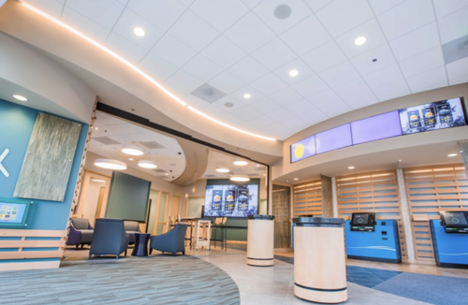
Rivermark has built sleek branches with modern interiors and smaller footprint than it used previously, including elimination of the teller line. It even built one 10x10 foot “Branch in a box” on space it leases for $500 a month in a local strip mall, he said.
The result has gone beyond just a reduction in operating costs. In first 18 months following its branch transformation, Horan said Rivermark experienced a 60% growth in membership, 27% increase in loan apps, and a two-time increase in branch sales.
“Not all of that is due to the branch and the technology. It’s also due to the great cultural shift they went through. That shift was enabled through the branch and technology redesign,” he said.
Financial Partners CU
FPCU identified one key issue, according to Horan. “They needed to have better conversations, so they could help members meet their goals. Helping members to meet their goals made them more loyal.”
To that end FPCU reimagined its teller line and started from scratch, after finding too many members were standing in line, he said. It responded by moving to more self-service options.
“There were some initial struggles with a fully self-service branch when members would leave disappointed,” said Horan. So FPCU added video tellers “and everything changed. They are still able to offer self-service to those who want it, and they were also able to extend hours.”
The results: conversations have gotten better, there has been a 32% increase in referrals, and a 5x increase in appointments. And it did all that by decreasing costs 54% across its 17 branches, he said.
Texas Tech Credit Union
According to Horan, Texas Tech CU realized the way it was doing business was antiquated, as was its membership and technology. It started over to the point of remodeling a branch in which it had invested $2 million just two years earlier, creating a new, modern environment that uses greeters to help steer lower-value transactions to self-service or assisted self-service options.
It also built a micro-branch in a hospital that does more lending and transactions than its main branches. The results: 54% growth in assets, 37% growth in memberships, and 53% growth in loans.
One Final Piece of Advice
“Though a particular technology or branch design worked for them, that doesn’t mean it will work for your credit union,” Horan said. “You have to find ways to create deep member empathy and reimagine your business model.”