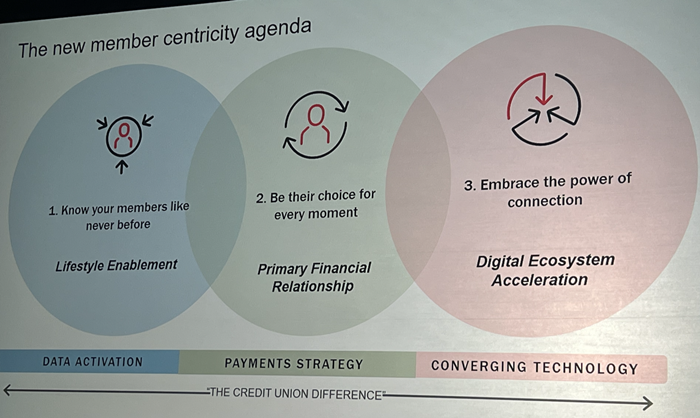
PALM DESERT, Calif.–Credit unions that want to prosper and meet the future will only do so if they first meet their members where they are needed—as PayPal is clearly doing, according to one member survey that ranked fintechs ahead of their own CU when it comes to meeting needs.
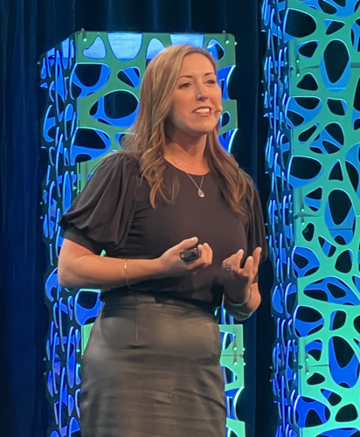
Samantha Paxson
The good news, according to one person, is there is a clear roadmap in place if credit unions are willing to make investments and change mindsets. And at the center of the map is what Samantha Paxson, chief experience officer with CO-OP Financial Services, called “the great reset.”
Speaking to the California and Nevada leagues’ REACH Conference, Paxson reviewed for credit unions in attendance the extensive research CO-OP has conducted as well as insights drawn from the eight-to-10 billion transactions handled by the CUSO for its member credit unions each year to develop insights into what a very much-evolved consumer is now seeking in a financial services provider.
In a point Paxson stressed on several occasions, it’s all about meeting “our members where they need us.”
A Big ‘A-Ha’
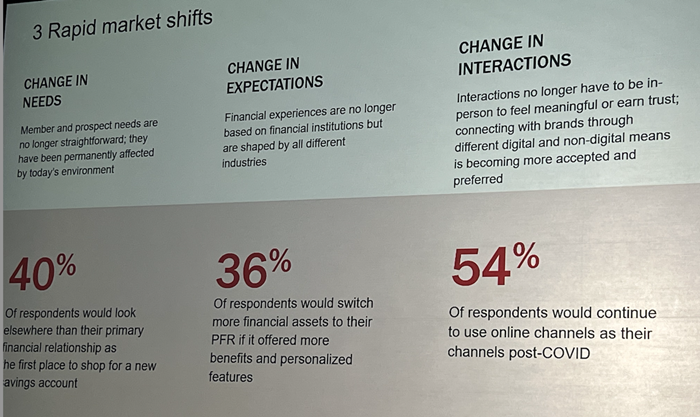
Based on research conducted by CO-OP in conjunction with EY that involved 2,000 CU members and another 1,000 prospective members, CO-OP was able to identify three big market shifts that occurred as the pandemic has taken place, according to Paxson.
The research uncovered fragmented financial relationships among consumers, Paxson explained, with the average person reporting five such relationships. The five providers included credit unions, fintechs, a national bank, a regional bank a wealth management firm (the latter was listed by 8% of respondents).
“One of the biggest a-ha’s from all of this is the most trusted financial provider in the market today is PayPal,” said Paxson, showing her audience a graphic that made clear PayPal was favored by a wide margin. Credit unions were second (in a survey that was two-thirds CU members), followed by Bank of America, JPMorgan Chase, Fidelity, and other brand-name providers.
But it’s the fintechs like PayPal that have exploded in popularity, said Paxson, and they have done so by excelling at the three “trust managers”: Data protection and privacy, demonstrating respect, and “cares about my needs.”
“The fintechs are anticipating what those needs are,” Paxson said.
Three Urgent Calls
All of the research and other findings have created three “urgent calls to action,” Paxson said.
Paxson noted credit unions have typically built their product and service offerings, along with related marketing, around life stages. But fintechs have shown a greater capacity for demonstrating they understand their customers by instead building their offerings around “lifestyle enablement” and “offering needs based on solutions.”
“Our members believe (PayPal/Ally/Chime) will be there for them when they need them,” said Paxson. “Lifestyle banking is where traditional demographics meets more personalized life needs. The part they are getting better is they are looking at needs-based data. They understand the solution mix, the needs, the outcomes the member is seeking to accomplish.”
The CO-OP/EY research found five “microsegments of personas” that are not just demographically based, but also needs based, Paxson said.
Those five microsegments are:
- Wanderlust Professional
- Holiday Card Family
- Movers and Shakers
- Rainy Days, No Umbrella
- Retirement Ready
Not About the Silos
Today, almost all credit unoins start off with a siloed approach to financial services, said Paxson. But to take that to a more member-centric model requires more curated experiences that understand members and “meet them where they are,” she said. “This is about designing experiences with the member-experience in mind. It’s about making you super-easy to use and having members understand all the ways you can help them solve their problems. The whole key here is not to think about your products and services as products and services.”
Not surprisingly, the CO-OP/EY research found the top solutions for which CUs are known among consumers are loans, savings and checking.
“Those are great, but we need to move toward active relationships,” Paxson advised.
‘Impactful Features’
Among the kinds of “impactful features” that would help cement those active relationships, according to Paxson, would be to offer members control over personal data, virtual access to a financial planner, up to $10,000 in instant funding, “white glove” loan service, relationship pricing discounts, and more.
The research found offering those kinds of curated offerings can drive a 34% increase in share among members and a 40% increase in share among prospects.
“Adding impactful features to the basics captures market share,” said Paxson.
Paxson said there are three broad things to be thinking about in making it easy for members:
- Member centric loyalty drives engagement
- Recurring transactions
- Digital acceleration and enablement
What about the Branch?
All of the discussion around digital also raises questions about the future of credit union branches, Paxson acknowledged, saying the new question is how to marry the in-person experience with the digital experience.
The answer, according to Paxson, is “We just change it depending on the needs of members, because both are important. They want both. It’s how they work in concert. They want digital. They want touch.”
But she also noted, “We really see payments as the service delivery engine. This is where fintechs are leading. We are seeking to create this hyper-converged experience for your members.”
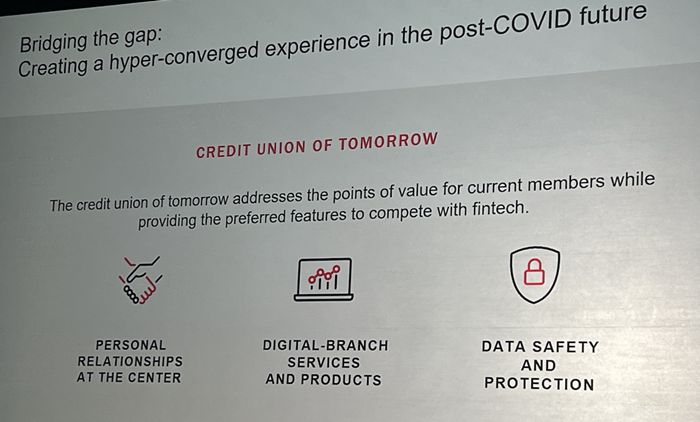
Becoming ‘Essential’
Credit unoins must determine their investment path, understanding that a commitment to lifestyle banking leads to growth, said Paxson prior to outlining the kinds of returns CUs can expect if they maintain traditional market parity, if they don’t invest, and if they do invest.
Finally, Paxson noted CO-OP has invested aggressively in new products, solutions and experiences, including $117 million over the past three years.
“We can do hard things,” she said. “And we can show the credit union difference in this way. At CO-OP we believe credit unions should be the most essential financial services providers in the market.”