

ONTARIO, Calif.–Why do so many people who are already credit union members or bank customers still go to payday lenders? And what can CU leaders do to better help these borrowers?
Credit unions were given some answers and insights into both those questions in remarks by Alex Horowitz, a researcher for Pew Charitable Trusts’ consumer finance project, to the California and Nevada Leagues’ Virtual REACH 2020 Conference.
Horowitz said the typical payday borrower earns $30,000 a year, or $2,500 a month or approximately $15 per hour. For many their income is volatile.
“More than 80 million Americans are paid hourly. They may have enough income to get through the year in aggregate, but maybe not at any one point in time,” he said. “That’s a lot of what people using alternative financial services are solving for.”
Interestingly, Horowitz said most users of alternative financial services have checking accounts and just 6.5% are unbanked. Most have an account with a credit union or bank, but also use alternative financial services “because their needs aren’t being met,” Horowitz said.
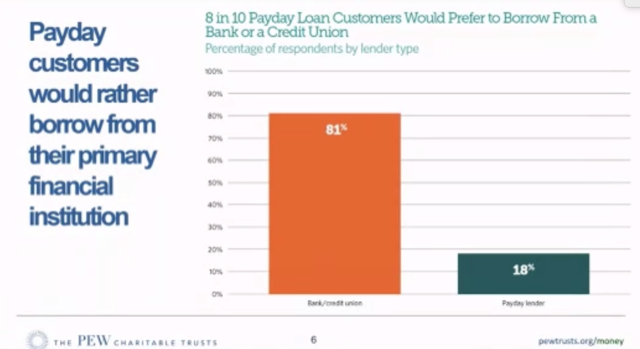
“Eight in 10 payday loan customers would prefer to borrow from a bank or credit union,” Horowitz continued. “They are not doing that because their bank or credit union isn’t offering the small loans; they’re too hard to get, take too long, etc. These customers are not scared off by what appears to be a high APR.”
Some Good News
There is some good news, according to Horowitz, pointing to the May 2020 joint agency guidance that greenlights CU and bank small installment and line of credit lending. He said the guidance enables the automation needed for viable and fair small-loan pricing, and noted the CFPB has issued a template for bank and CU loans.
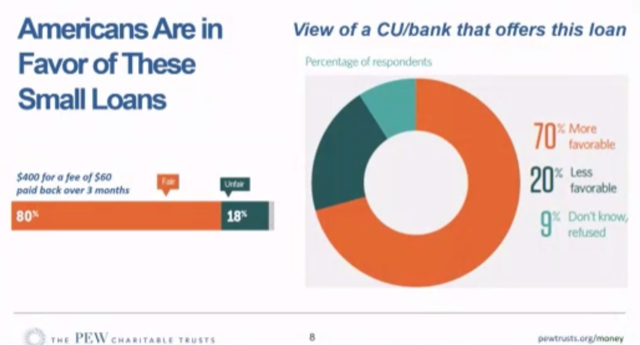
A survey of the general public found 80% favor a $400 loan for a fee of $60 paid back over three months, with 80% saying that’s fair. An even higher portion of payday loan borrowers thought the pricing was fair.
Some lenders are afraid of another risk, said Horowitz, but it’s proven to be unfounded.
“We’ve heard some concerns from banks and credit unions about reputational risk from the perspective of the public, but that is not justified,” said Horowitz. “Instead what we’ve heard is reputational enhancement.”
Horowitz said competing in the small-dollar loan market is not as simple as just offering a product. Instead, he added:
- Lower prices are important, but not enough
- Speed, certainty and ease are essential. Borrowers will choose payday loans if CUs cannot provide all three
- Credit unions can outperform high-cost lenders on all three counts with a mobile/online platform that automates underwriting and origination
As a final reminder, Horowitz urged CUs to remember, “Decision making is different when people are under distress. This is the opportunity to save low and moderate income households year after year.”
Horowitz said competing in the small-dollar loan market is not as simple as just offering a product. Instead, he added:
- Lower prices are important, but not enough
- Speed, certainty and ease are essential. Borrowers will choose payday loans if CUs cannot provide all three
- Credit unions can outperform high-cost lenders on all three counts with a mobile/online platform that automates underwriting and origination
As a final reminder, Horowitz urged CUs to remember, “Decision making is different when people are under distress. This is the opportunity to save low and moderate income households year after year.”