ALEXANDRIA, Va. –Newly released data from NCUA on federally insured credit unions’ performance during the third quarter show overall growth in lending and deposits, but that also includes a strong increase in delinquencies.
The agency also said the number of CAMELS Code credit unions 3, 4 and 5 continues to rise (see separate reporting), while the nation’s smallest credit unions actually outpaced their larger brethren once again when it comes to making loans.
Overall, NCUA reported total loans outstanding in federally insured credit unions increased $132 billion, or 9.1% , over the year ending in the third quarter of 2023, to $1.59 trillion. Total assets rose by $79 billion, or 3.7%, to $2.23 trillion during the same period, while insured shares and deposits increased $23 billion, or 1.4% , to $1.72 trillion, from one year earlier
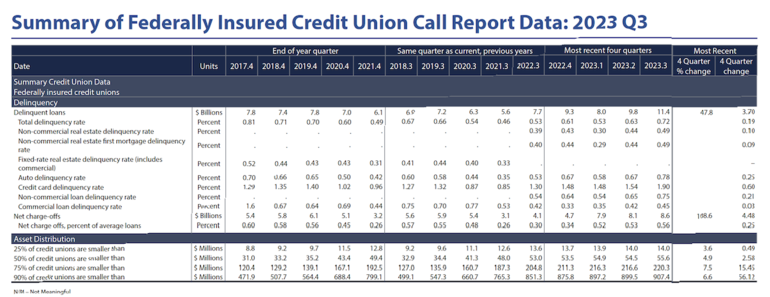
The industry delinquency rate for Q3 was ,72 basis points, up 19 basis points from one year earlier.
The credit union system’s net worth increased by $11.4 billion, or 5.0% , over the year to $239.2 billion, according to NCUA. The aggregate net worth ratio — net worth as a percentage of assets — stood at 10.73% in the third quarter of 2023, up from 10.60% one year earlier.

Todd Harper
‘Steady & Stable,’ But…
“The credit union system remains largely stable in its performance and is relatively resilient against economic disruptions,” Chairman Todd M. Harper said in a statement. “However, the NCUA is seeing growing signs of financial strain on credit union balance sheets and household budgets, along with growing consumer financial stress as reflected in the rising delinquency rate. Credit card and auto loan delinquencies are elevated at 190 and 78 basis points, respectively.”
Harper said NCUA is urging CUs to remain “diligent in managing the potential risks on their balance sheets and when monitoring economic conditions and the interest rate environment.”
More extensive remarks from Harper related to the latest numbers can be found in separate reporting on CUToday.info.
The data was released as part of the agency’s Quarterly Credit Union Data Summary and is based on call reports filed by 4,645 federally insured credit unions, which represent 138.8 million members.
Overall Highlights
Among the overall highlights of the Quarterly Data Summary Report for the third quarter of 2023:
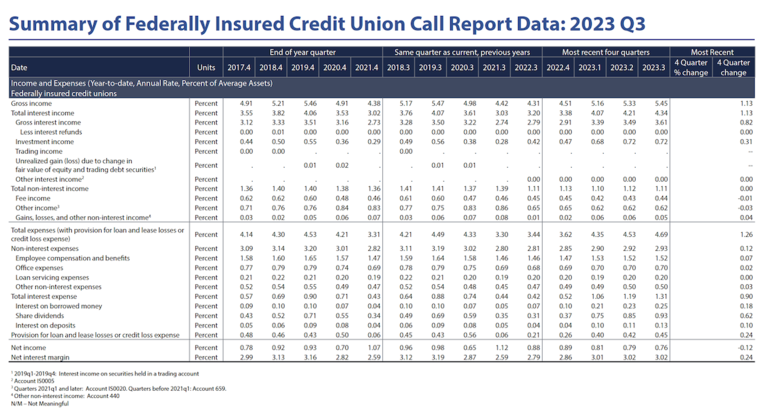
- Net income for federally insured credit unions in the first three quarters of 2023 totaled $16.6 billion at an annual rate, down $1.9 billion, or 10.3% , from the first three quarters of 2022. Interest income rose $27.9 billion, or 41.4% , over the year to $95.3 billion annualized.
- The credit union system’s provision for loan and lease losses or credit loss expense increased $5.5 billion, or 125.5% , to $9.9 billion at an annual rate in the first three quarters of 2023.
- Total loans outstanding increased $132.0 billion, or 9.1% , over the year to $1.59 trillion. Credit union loan balances rose in most major categories, compared with the third quarter of 2022. “The rate of growth, however, has slowed compared to recent quarters,” NCUA said.
- Total shares and deposits rose by $16.1 billion, or 0.9% , over the year to $1.88 trillion in the third quarter of 2023. Regular shares declined by $91.1 billion, or 13.4% , to $588.0 billion. Other deposits increased by $118.7 billion, or 15.0% , to $910.5 billion, led by share certificate accounts, which grew $185.9 billion, or 72.0% , over the year to $444.2 billion.
- Total assets in federally insured credit unions rose by $79 billion, or 3.7% , over the year ending in the third quarter of 2023, to $2.23 trillion.
- Total loans outstanding increased $132 billion, or 9.1% , over the year, to $1.59 trillion. The average outstanding loan balance in the third quarter of 2023 was $17,824, up $839, or 4.9% , from one year earlier.
- The average outstanding loan balance in the third quarter of 2023 was $17,824, up $839, or 4.9% , from one year earlier.
- The delinquency rate at federally insured credit unions was 72 basis points in the third quarter of 2023, up 19 basis points from one year earlier. The net charge-off ratio was 56 basis points, up 25 basis points compared with the third quarter of 2022.
- Insured shares and deposits rose $23 billion, or 1.4% , over the year ending in the third quarter of 2023, to $1.72 trillion.
- The loan-to-share ratio stood at 84.8% in the third quarter of 2023, up from 78.4% in the third quarter of 2022.
- The credit union system’s net worth ratio was 10.73% in the third quarter of 2023, compared with 10.60% one year earlier. The credit union system’s net worth increased by $11.4 billion, or 5.0% , over the year to $239.2 billion. The aggregate net worth ratio — net worth as a percentage age of assets — stood at 10.73% in the third quarter of 2023, up from 10.60% one year earlier. The agency reminded that beginning in 2023Q1, these ratios exclude the Current Expected Credit Loss (CECL) transition provision.
- The net worth ratio for prompt corrective actionwas 11.02% in the third quarter of 2023. This ratio considers the CECL Transition Provision, as applicable.
- Net income totaled $16.6 billion at an annual rate in the first three quarters of 2023, down $1.9 billion, or 10.3% , compared with the same period a year earlier.
- The net interest margin for federally insured credit unions was $66.5 billion at an annual rate in the first three quarters of 2023, or 3.02% of average assets. That compares with $58.7 billion, or 2.79% of average assets, in the first three quarters of 2022.
- The annualized return on average assets for federally insured credit unions was 76 basis points in the first three quarters of 2023, down from 88 basis points in the first three quarters of 2022. The median annualized return on average assets across all federally insured credit unions was 67 basis points, up 17 basis points from a year earlier.
- The number of federally insured credit unionsdeclined to 4,645 in the third quarter of 2023, from 4,813 in the third quarter of 2022. In the third quarter of 2023, there were 2,908 federal credit unions and 1,737 federally insured, state-chartered credit unions. “The year-over-year decline is consistent with long-running industry consolidation trends,” NCUA said.
- The number of credit unions with a low-income designation declined to 2,575 in the third quarter of 2023 from 2,621 one year earlier. “However, their share increased from 54% of all federally insured credit unions in the third quarter of 2022 to 55% in the third quarter of 2023,” according to the agency.
- The number of complex federally insured credit unions (those with total assets greater than $500 million) rose to 710 from 708 one year earlier. NCUA said 418 opted into the Complex Credit Union Leverage Ratio (CCULR) framework with an average CCULR of 11.83% . Another 292 reported under the Risk-Based Capital (RBC) framework with an average RBC ratio of 15.00%, NCUA said.
- Federally insured credit unions added 4.5 million members over the year, and credit union membership in these institutions reached 138.8 million in the third quarter of 2023.
Additional Income Statement Details
Additional balance sheet data according to NCUA:
- Non-interest income rose $1.0 billion, or 4.5% , to $24.4 billion annualized, largely reflecting an increase in other non-interest income.
- Interest expense totaled $28.8 billion annualized in the first three quarters of 2023, up $20.1 billion, or 228.4% , from one year earlier. Non-interest expense grew $5.3 billion, or 8.9% , over the year to $64.4 billion at an annual rate in the first three quarters of 2023. Rising employee compensation and benefits, which were up $2.8 billion, or 9.1% over the year, accounted for more than half of the increase in non-interest expenses.
- The aggregate net interest margin widened by $7.8 billion, or 13.4% , over the year to $66.5 billion at an annual rate in the first three quarters of 2023.
Performance by Asset Category
In what NCUA described as a break with long-running trends,” credit unions with less than $10 million in assets reported the strongest growth in loans and net worth over the year ending in the third quarter of 2023.
During a call with the media, NCUA’s Harper said that data point is driven in part by the largest of CUs being forced to slow their lending due to liquidity challenges (see separate reporting).
Meanwhile, credit unions with assets of at least $1 billion continued to report the strongest membership growth.
NCUA also reported:
- The number of federally insured credit unions with assets of at least $1 billion increased to 424 in the third quarter of 2023 from 414 in the third quarter of 2022. These 424 credit unions held $1.7 trillion in assets, or 76% of total system assets. Credit unions in this category reported loan growth of 10.6% over the year. Membership rose 5.6% . Net worth increased 5.7% .
- The number of federally insured credit unions with assets of at least $500 million but less than $1 billion declined to 286 in the third quarter of 2023 from 294 in the third quarter of 2022. These 286 credit unions held $208.7 billion in total assets, or 9.4% of total system assets. Credit unions in this category reported 1.6% growth in total loans outstanding over the year. Membership declined 4.0% , while net worth increased 0.3% .
- The number of federally insured credit unions with at least $100 million but less than $500 million in assets declined to 1,058 in the third quarter of 2023 from 1,076 in the third quarter of 2022. These 1,058 credit unions held $242.0 billion in total assets, or 11% of total system assets. Credit unions in this category reported a 6.3% increase in total loans outstanding over the year. Membership edged up 0.2% . Net worth rose 5.0% .
- The number of federally insured credit unions with at least $50 million but less than $100 million in assets declined to 642 in the third quarter of 2023 from 674 one year earlier. These 642 credit unions held $46.7 billion in total assets, or 2.1% of total system assets. Credit unions in this category reported a 2.6% increase in total loans over the year. Membership declined 3.5% . Net worth rose 3.5% .
- The number of federally insured credit unions with assets of at least $10 million but less than $50 million declined to 1,297 in the third quarter of 2023 from 1,380 in the third quarter of 2022. These credit unions held $34.1 billion in assets, or 1.5% of total system assets. Credit unions in this category reported a 7.2% increase in loans over the year. Membership declined 3.4% , and net worth rose 1.3% .
- The number of federally insured credit unions with less than $10 million in assets declined to 938 in the third quarter of 2023 from 975 in the third quarter of 2022. These credit unions held $4.0 billion in assets, or 0.2% of total system assets. Credit unions in this category reported a 12.5% increase in loans over the year. Membership declined 1.0% . Net worth grew 7.9%.