

CHICAGO–The first half of 2022 concluded with a “normalization in serious delinquency rates” to pre-pandemic levels for most credit products as lenders continued to expand access to credit cards and personal loans, according to a new TransUnion analysis.
The data was released as part of the company’s Q2 2022 Quarterly Credit Industry Insights Report (CIIR), which also shows how the number of consumers with credit cards and personal loans has reached record highs, driven by an increase in loans to non-prime consumers.
“Consumers are facing several challenges that are impacting their finances on a day-to-day basis, namely high inflation and rising interest rates. These challenges, though, are happening against a backdrop where employment opportunities are still plentiful and jobless levels remain low,” said Michele Raneri, vice president of U.S. research and consulting at TransUnion.
A ‘Welcome Development’
“We see lenders offering more access to credit to non-prime consumers, some of whom are new to credit. This is a welcome development as more consumers have gained access to credit during a time when high inflation has placed a greater burden on their wallets. While delinquencies generally rise after a period when more non-prime borrowers secure loans, the rates of delinquency remain mostly at or below pre-pandemic levels, particularly for cards and personal loans.”

In Q2 2022, TransUnion reported that loan growth to non-prime borrowers has mostly been observed with unsecured personal loans and credit cards. These two credit products were utilized more by consumers in the last year due to higher costs of everyday goods and services.
For instance, the share of balances for unsecured loans held by subprime borrowers has risen from 8.1% in Q2 2021 to 11.8% in Q2 2022, TransUnion said. Subprime balance distribution for credit cards rose to 6.9% in Q2 2022 from 5.3% in Q2 2021.
In another sign that the consumer credit markets are performing relatively well, TransUnion said its Credit Industry Indicator (CII) increased to 119 in Q2 2022 – up from 116 in the previous quarter and at the same level as it was in Q2 2021.
The CII is a quarterly measure of depersonalized and aggregated consumer credit health trends that summarizes movements in credit demand, credit supply, consumer credit behaviors and credit performance metrics over time into a single indicator, according to the company.
Examples of data elements categorized into these four pillars include: new product openings, consumer credit scores, outstanding balances, payment behaviors, and 100+ other variables.
“Rising levels for the CII generally indicate an improvement in the overall health of the consumer credit market,” TransUnion said. “The stable CII level in Q2 2022 compared to the prior year period was due to the increases in credit demand and supply, as consumers increased their applications for and originations of credit products, particularly cards and personal loans, over the past year, somewhat offset by rising YoY delinquencies from the extremely low levels seen in Q2 2021.”
The Specifics
Specific findings in the report include, according to TransUnion:
Gen Z Leading Growth in Credit Card Originations
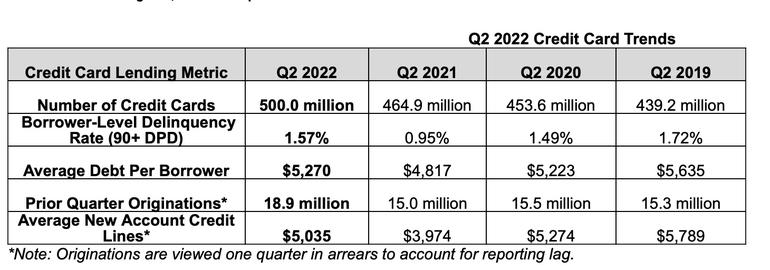
“The number of general-purpose credit cards topped 500 million for the first time ever at the conclusion of Q2 2022, up from approximately 465 million in Q2 2021. The increase was led by Gen Z as originations to this generation rose 31.6% between Q1 2021 and Q1 2022 (originations are viewed one quarter in arrears). Overall, originations were up 26% in the last year. The subprime segment’s total balances grew 51.7% YoY which is the highest growth rate ever achieved,” the report states. “At the same time, average credit lines remain below pre-pandemic levels, with the exception of super prime which hit an all-time high. Serious delinquency rates (90+ days past due) for borrowers rose to 1.57%, but remain near pre-pandemic levels.”
Personal Loan Total Balances Reach Record $192 Billion
“Total personal loan balances reached a record $192 billion in Q2 2022 – a 31% increase from last year. Total balances nearly doubled for subprime borrowers (up 92%) while more modestly increasing, by 10%, for super prime borrowers,” according to TransUnion. “Originations in Q1 2022 (viewed one quarter in arrears) grew nearly 60% year-over-year to reach 5 million, with all credit risk tiers experiencing at least 20% growth from the previous year. Subprime borrowers saw the largest rise in originations at 71%. As subprime borrowers take a larger share of personal loan accounts, serious borrower delinquency rates (60+ days past due) have now risen four straight quarters. The 3.37% Q2 2022 reading is up 47% from last year, though it remains near the levels seen prior to the pandemic.”
Auto Loan Performance Mixed
“Serious auto loan delinquencies (60+ days past due) increased 40 basis points between Q2 2021 and Q2 2022, but performance differs for recent vintage loans. For instance, loans originated in Q2 and Q3 2020 continue to outperform pre-pandemic vintages while loans from Q2 and Q3 2021 are beginning to perform on par with them,” TransUnion said. “Originations in Q1 2021 declined 8.3% from the previous year, though they remain above Q1 2019 levels. The cost to finance vehicles remains high, as witnessed by a $2,000+ year-over-year increase in average auto loan debt per borrower in Q2 2022. Used vehicles are helping propel the debt metric, with average used vehicle monthly payments rising 22% on a year-over-year basis to $505 in Q1 2022.”
HELOCs Continue Resurgence
“Available home equity of mortgage holders continues to grow, hitting an aggregate total of $18.4 trillion in Q1 2022 (latest data available) and is up 22% YoY and 52% over the last 5 years. Approximately 80 million consumers have available equity in their homes, with a median equity of $223,000 and around 4.5 million homeowners having more than $1 million in available equity. As a result, homeowners are tapping the record levels of equity in their homes, with HELOC and home equity loan originations increasing YoY by 41% (the highest volumes booked since the end of 2019) and 29%, respectively,” according to TransUnion. “As home equity grew, the slowdown in mortgage originations accelerated in Q1 2022 with purchases dominating originations for the fourth consecutive quarter. Compared to the previous year, where refinance dominated origination volumes and accounted for 58% of new mortgage loans, in 2022, purchase volumes outpaced refinance volumes, up by 18 percentage points from 42% in Q1 2021 to 60% in Q1 2022. Purchase volumes decreased from 1.6 million in Q1 2021 to 1.3 million in Q1 2022 (down by 20% YoY) while refinance volumes decreased from 2.3 million in Q1 2021 to 870,000 in Q1 2022 (down by 62% YoY).”
The report added that approximately 2.2 million total mortgages were originated in Q1 2022, down 45% from the previous year. Q1 2022 volumes, though, remain above pre-pandemic levels with the average volume of originations between 2010 and 2019 averaging about 1.5 million per quarter. Serious mortgage loan delinquencies in Q2 2022 remain near record lows and have remained flat since Q2 2021.
The Very Best in CU Reporting. For You. For Free. Or Your Money Back.
Don’t forget to check your Spam/Junk email folder if you haven’t been receiving your free, popular and daily CUToday.info news headlines.
And if you haven’t yet signed up for the new email solution on which CUToday.info has partnered with ResponseGenius, you can do so here. Signing up requires less than one minute of your time.
CUToday.info has received very positive response from readers following the move to an improved provider of the daily headlines, but many also noted they did need to go to their Spam/Junk folder and mark it as safe.
The new email solution has not only improved every reader’s delivery experience, but it also features a fresh, new format that is easy to read, especially on mobile devices.
Please note and/or make your IT department or email administrator aware the emails will be coming from the domains CUTodayinfo.com and CUTodayinfoReply.com.