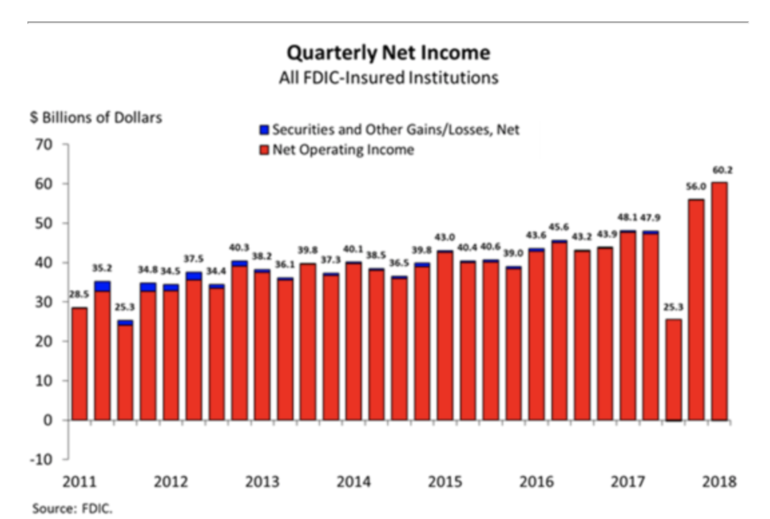
WASHINGTON–Profits continue to soar at the nation’s commercial banks and savings institutions.
According to the FDIC, banks reported aggregate net income of $60.2 billion in the second quarter of 2018, up $12.1 billion (25.1%) from a year ago. The improvement in earnings was attributable to higher net interest income and a lower effective tax rate, according to the agency’s latest Quarterly Banking Profile.
Of the 5,542 insured institutions reporting second quarter financial results, more than 705 reported year-over-year growth in quarterly earnings. The percentage of unprofitable banks in the second quarter declined to 3.8% from 4.3% a year ago, the FDIC said.
“It is worth noting that the current economic expansion is the second longest on record, and the nation’s banks are stronger as a result,” said FDIC Chairman Jelena McWilliams. “The competition to attract loan customers will be intense, and it will remain important for banks to maintain their underwriting discipline and credit standards.”
The Numbers
Additional findings in the Q2 FDIC report include:
- ROA Is Up. The average return on assets among banks increased to 1.37%, up from 1.13% in the second quarter of 2017.
- Community Banks Report Robust Numbers. In the second quarter, 5,111 insured institutions identified as community banks reported $6.5 billion in net income, an increase of $1.1 billion (21.1%) from a year earlier. Higher net operating revenue and a lower effective tax rate boosted second-quarter net income, the FDIC reported. Net operating revenue rose by $1.8 billion (8%) from the second quarter of 2017, led by higher net interest income (up $1.6 billion, or 9%) and noninterest income (up $201.9 million, or 4.5%). Loan-loss provisions declined by $193.5 million (22.5%), while noninterest expenses were $934.2 million (6.6%) higher.
- Margins Increased as Average Yields Outpaced Growth in Funding Costs. Net interest income was $134.1 billion in the second quarter, up $10.7 billion (8.7%) from a year ago, the largest annual dollar increase ever reported by the industry, according to the FDIC. More than four out of five banks (85.1%) reported an improvement in net interest income from a year earlier. The average net interest margin increased to 3.38% from 3.22% in the second quarter of 2017, as average asset yields increased more rapidly than average funding costs.
- Non-Interest Income Increased 2% From One Year Ago. Noninterest income of $68.1 billion, increased by $1.3 billion (2%) from the second quarter of 2017. The annual increase was led by higher servicing fees, fiduciary activities, and net gains on the sale of other assets.
- Loan Balances Expanded 4.2% from the Second Quarter of 2017. Loan and lease balances increased by $104.3 billion (1.1%) from the first quarter of 2018, as all major loan categories registered growth. Over the past 12 months, loan and lease balances grew by 4.2%, a slight decline from the 4.9% annual growth reported last quarter, the FDIC said.
- The Noncurrent Loan Rate Declined, While Net Charge-Off Rate Remained Stable. The amount of loans that were noncurrent — 90 days or more past due or in nonaccrual status — declined by $7.7 billion (6.8%) during the first quarter. The largest declines in noncurrent balances were for residential mortgages (down $5.2 billion, or 9.7%) and commercial and industrial loans (down $1.2 billion, or 6.8%), according to the FDIC data. The average noncurrent loan rate declined to 1.06% from 1.15% in the first quarter of 2018. Net charge-offs increased by $446.4 million (4%) from a year earlier, led by a $918.9 million (12.8%) increase in net charge-offs for credit cards. The average net charge-off rate (0.48%) remained stable from a year ago.
- The “Problem Bank List” Continued to Decline. The FDIC’s Problem Bank List shows a decline from 92 to 82 banks during the quarter, the lowest number since the fourth quarter of 2007. Total assets of problem banks declined from $56.4 billion in the first quarter to $54.4 billion. Other notable bank activity during the quarter included merger transactions that absorbed 64 institutions, two new charters were opened, and no banks failed.
- The Deposit Insurance Fund’s Reserve Ratio Increased to 1.33%. The Deposit Insurance Fund (DIF) balance rose by $2.5 billion during the second quarter, to $97.6 billion on June 30, driven by assessment income. The DIF reserve ratio of 1.33% rose from 1.30% at the end of the last quarter. Estimated insured deposits increased by 0.3% from the previous quarter and 4.5% from a year ago, the FDIC said.