

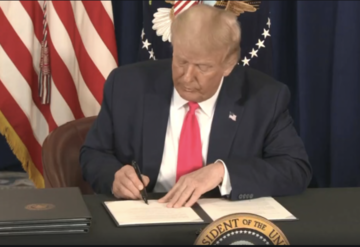
WASHINGTON–What kind of financial relief will be brought to Americans by the executive orders signed by President Trump over the weekend? Not much, according to a number of analysts who continue to stress it’s Congress that needs to act.
The executive orders are expected to be challenged in court over their constitutionality, as Congress controls spending. And the point could become moot if Republicans, Democrats and the White House can come together on a deal.
But a polling of a number of experts by the New York Times in the wake of the executive orders suggested the following should the order play out:
Unemployment Benefits
With the July expiration of the extra $600 a week in federally paid unemployment benefits, the president’s order calls for an extra $400 per week in expanded benefits. But policy analysts told the Times the plan is so complicated, and potentially costly, that people won’t get that money quickly, if at all.
“Nobody is going to see this money in August, and we’ll be lucky to see it in September,” Andrew Stettner, a senior fellow at the Century Foundation, a public policy research group, told the Times.
The plan is full of caveats, the Times noted: First: It actually translates to an additional $300, not $400, for recipients because the federal government would pay for only 75% of cost. States would have to kick in the other 25%, or $100 per recipient, per week.
There are also several other catches.
Payroll Taxes
Individuals would still owe your payroll taxes under the terms of the president’s memo, as would employers. What would change would be when some of the taxes for the period from Sept. 1 to Dec. 31 are due.
But it would only apply to people who earn under $4,000 every two-week pay period, according to the memorandum, or about $104,000 a year. Those who earn more than that would still be subject to withholding, up to the annual limit of$137,700, the Times reported.
“At some point soon, the Internal Revenue Service will presumably issue guidance saying when the money is due, under what the White House is calling a deferral’ of these taxes,” the Times noted. “But the order also states that the Treasury Department shall ‘explore avenues, including legislation, to eliminate the obligation to pay the taxes deferred.’”
The measure faces long-shot odds, according to the analysts interviewed.
Student Loans
The White House memorandum aims to extend relief by three months.
The Times noted that under the terms of the CARES Act, the Education Department and its loan servicers put all federal student loan borrowers into administrative forbearance.
“If the memorandum holds — and it’s not clear who would stand against providing relief to millions of people who borrowed to pay for higher education — the forbearance will last through Dec. 31,” the Times analysis stated. “The Department of Education has not yet said how it might carry out the memorandum.”
Eviction
The president also issued an order on assistance to renters that doesn’t offer much immediate hope for people on the brink of losing their housing, according to the Times.
A federal freeze on evictions has expired, and renters have no governmental protection unless state or local officials have put their own moratoriums in place. The order directs various federal agencies to consider what they can do with existing authority or budgets to help further, “but immediate relief for desperate renters seems unlikely via this order,” the Times said.