

CHICAGO–The credit card industry is rebounding strongly from the early impacts of the COVID-19 pandemic with Gen Z leading the way in terms of originations and bankcard balance growth, according to a new report.
TransUnion’s Q3 2021 Quarterly Credit Industry Insights Report (CIIR) also found that this youngest generation of consumers are performing well on these credit products, the company is reporting.
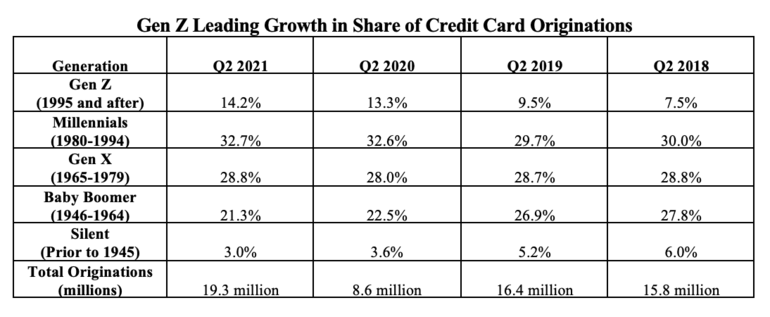
“During the height of the pandemic in mid-2020, card issuers pulled back and tightened new card volume. Since then, credit card originations have nearly doubled – increasing from 8.6 million in Q2 2020 to a record 19.3 million in Q2 2021,” TransUnion said in releasing the findings.
According to TransUnion, the return in consumer demand was most pronounced for Gen Z as the share of originations increased to 14.2%, a jump from 13.3% last year and 9.5% just two years prior.
“Similar to previous generations, as more Gen Z consumers come of age they are actively expanding their credit products across the wallet. For most consumers, the first credit product of choice tends to be a credit card,” said Matt Komos, vice president of research and consulting at TransUnion. “As we enter this new phase of the pandemic where accommodation programs are not as prevalent and liquidity sources such as stimulus funds are drying up, it is a natural next step for consumers to reassess their current credit obligations and apply for new forms of credit – especially if access to credit was minimal in the first place.”
Return to Consumer Spending
On top of the record level of credit card originations is a return to consumer spending, particularly among the younger generations, TransUnion pointed out, adding that in Q3 2021 Gen Z average balance per consumer increased 13.9% YoY – the only generation with two consecutive quarters of growth. Millennials also showed average balance growth per consumer with a 1.8% YoY increase, the report states.
“As originations and balances rise for Gen Z, their serious delinquency rates continue to decline,” TransUnion stated.
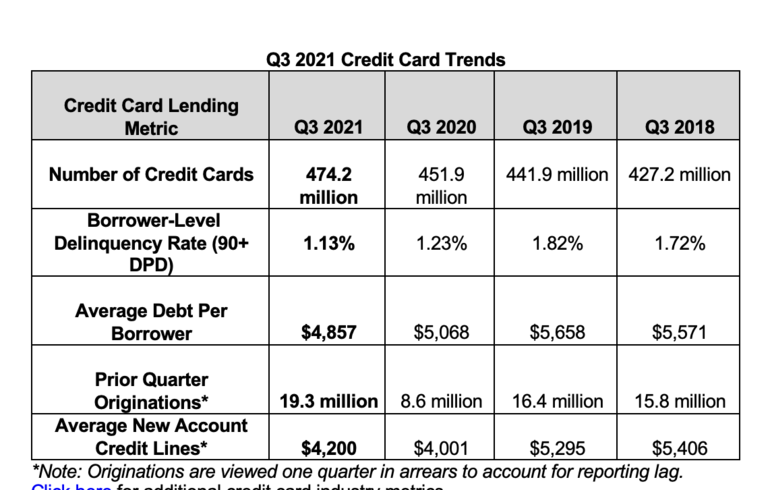
The TransUnion report added that in Q3 2021, the 90+ day borrower level delinquency rate was 1.52% for Gen Z consumers, a decline from the 2.31% (90+DPD) rate observed pre-pandemic in Q3 2019.
‘Ramping Up for Growth’
“As the economy continues to show signs of recovery, card issuers are ramping up for growth and bringing younger consumers into the fold,” said Paul Siegfried, senior vice president and credit card business leader at TransUnion. “Card issuers are eager to meet the rising consumer demand for Gen Z by expanding access to credit and are actively managing credit line levels at origination to control for risk. These younger generations have shown interest in growing their credit obligations through both traditional products such as credit cards as well as through forms of credit such as buy now, pay later.”
The company said a recent TransUnion study found that while buy now, pay later (BNPL) and Point-of-Sale (POS) have emerged as popular types of financing among Gen Z and Millennial consumers, these offerings have not had a major impact on the usage of other forms of credit. In fact, BNPL/POS applicants generally use other forms of credit more so than the rest of the credit active population.
According to TransUnion, in addition to recent credit card growth, the Q3 2021 CIIR also found that the auto, mortgage and personal loan industries have demonstrated renewed signs of strength since the height of the COVID-19 pandemic.
TransUnion noted a key driver for this expansion of credit was the record level of 19.3 million originations – a 17.2% YoY increase from Q2 2019 – which especially saw growth among non-prime consumers. Total credit lines also notched an all-time high at $3.9 trillion, an increase of 3.6% YoY with growth observed in the prime and above risk segments.
A Look at BNPL
A separate TransUnion study found that while BNPL and POS have emerged as popular types of financing among Gen Z and Millennial consumers, these offerings have not had a major impact on the usage of other forms of credit. In fact, BNPL / POS applicants generally use other forms of credit more so than the rest of the credit active population.
In addition to recent credit card growth, the Q3 2021 CIIR also found that the auto, mortgage and personal loan industries have demonstrated renewed signs of strength since the height of the COVID-19 pandemic.
The full TransUnion report can be found here.