WASHINGTON–New research offers some insights into how consumers are using smartphones to manage their money.
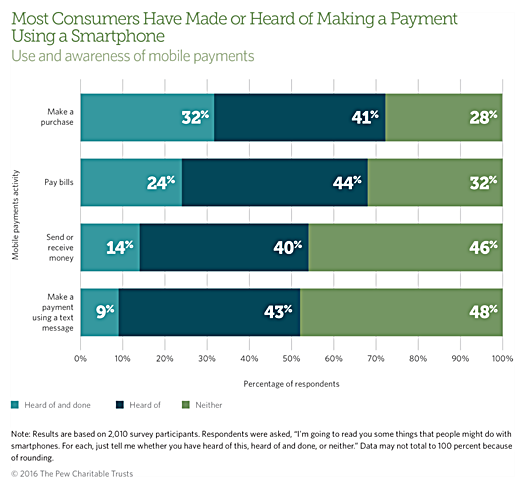
Released by the Pew Charitable trust, the survey found 46% of U.S. consumers saying they have made a mobile payment.
Among the survey findings:
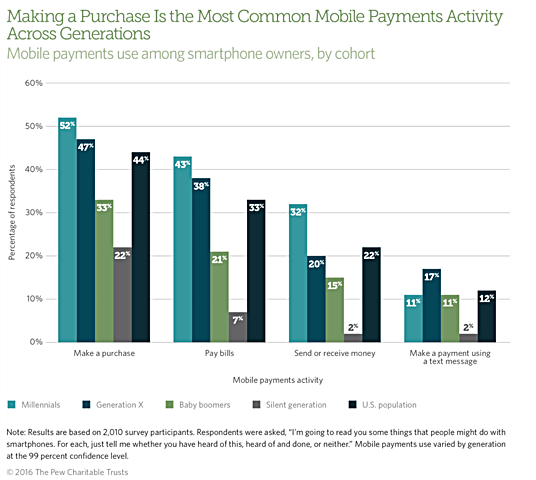
- Age is the most predictive of mobile payment use. Millennials and Gen Xers use mobile payments most (they make up 55% of the U.S. adult population, but 72% of mobile payments users).
- Consumers see a number of benefits to using mobile payments, particularly receiving alerts, electronic receipts, rewards, discounts, and help with budgeting.
- Making a purchase through a smartphone web browser or downloaded app is the most common mobile payments activity.
- But consumers often don’t know how mobile payments compare with other payment methods in terms of convenience, cost, privacy, and security.
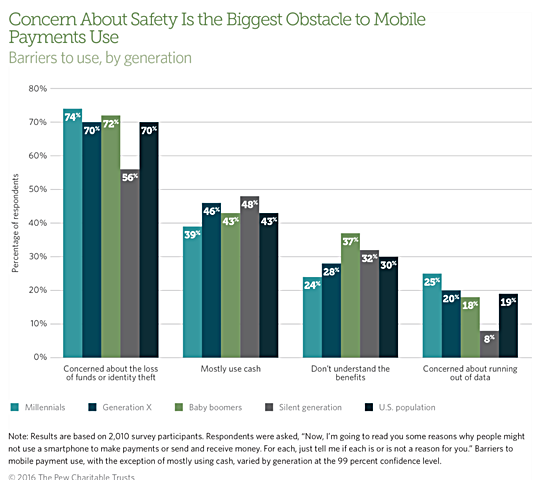
- Barriers to usage include concerns about the safety of mobile payments technology, which might result in identity theft or the loss of funds, and poor compatibility with cash-based transactions.
- Consumers want the data they generate by use of mobile payments to be secure and protected and access to it to be limited across entities, from phone carriers to app developers and advertisers.
“Concern about the safety of mobile payments technology is the biggest obstacle to usage and is cited across generations as a barrier,” said Joy Hackenbracht, research officer for Pew’s Consumer Banking project. “There is a knowledge gap. Consumers often don’t know how mobile payments compare with other payment methods. We found 53% of consumers say they don’t know whether mobile payments are safer than other payment methods. That’s significant, because reducing this uncertainty has the potential to increase use.”
Pew said it found, perhaps not surprisingly, that getting a smartphone is the most common catalyst cited for adoption of mobile payments technology, and Millennials and Gen Xers are far more likely than those from older generations to own smartphones. The majority of basic phone owners (77%) say they are unlikely to buy a smartphone in the next year, meaning the age gap in smartphone ownership will probably persist, Pew reported. Smartphone ownership also varies dramatically by annual household income. Only 53% of consumers earning less than $25,000 annually own a smartphone compared with 81% of those earning $50,000 or more annually, Pew said.
“Millennials and Gen Xers in particular are motivated to use mobile payments in part because they like receiving rewards, discounts, alerts, and electronic receipts,” said Pew. “Consumers are also interested in avoiding fees, such as overdraft or check cashing fees, and using their smartphones to help them budget. In fact, research shows that consumers are using smartphones to help with budgeting more than in previous years.
The survey found the use of cash to make payments is cited across generations as a barrier, because cash cannot be easily loaded onto a smartphone. Cash is still a very common payment method, and consumers average about 8.5 retail cash purchases a month, Pew said.
The full study can be found here.