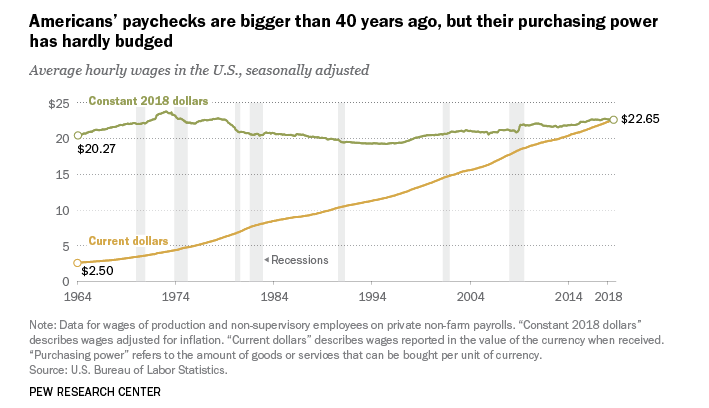
WASHINGTON–The U.S. employment numbers may be strong, but new analysis indicates the average credit union member has gained little ground over the last four decades.
Research conducted by the Pew Research Trusts found that “despite some ups and downs over the past several decades, today’s real average wage (that is, the wage after accounting for inflation) has about the same purchasing power it did 40 years ago. And what wage gains there have been have mostly flowed to the highest-paid tier of workers.”
Pew said the average hourly earnings for non-management private-sector workers in July were $22.65, up three cents from June and 2.7% above the average wage from a year earlier, according to data from the federal Bureau of Labor Statistics.
“After adjusting for inflation, however, today’s average hourly wage has just about the same purchasing power it did in 1978, following a long slide in the 1980s and early 1990s and bumpy, inconsistent growth since then,” Pew said. “In fact, in real terms average hourly earnings peaked more than 45 years ago: The $4.03-an-hour rate recorded in January 1973 had the same purchasing power that $23.68 would today.”
Pew said that similarly, when looking at the “usual weekly earnings” of employed full-time wage and salary workers – tells much the same story, albeit over a shorter time period.
Weekly Numbers are Similar
“In seasonally adjusted current dollars, median usual weekly earnings rose from $232 in the first quarter of 1979 (when the data series began) to $879 in the second quarter of this year, which might sound like a lot,” Pew said.
But in real, inflation-adjusted terms, the median has barely budged over that period: That $232 in 1979 had the same purchasing power as $840 in today’s dollars.
Wage gains have primarily gone to the highest earners, according to Pew.
“Since 2000, usual weekly wages have risen 3% (in real terms) among workers in the lowest tenth of the earnings distribution and 4.3% among the lowest quarter,” Pew said. “But among people in the top tenth of the distribution, real wages have risen a cumulative 15.7%, to $2,112 a week – nearly five times the usual weekly earnings of the bottom tenth ($426).”
Pew said one theory holds that rising benefit costs – particularly employer-provided health insurance–may be constraining employers’ ability or willingness to raise cash wages.
The full report can be found here.