WASHINGTON—Pending home sales bounced back in much of the U.S. during February but weakening affordability and not enough inventory on the market restricted overall activity compared to a year ago, according to Pending Home Sales Index released by the National Association of Realtors.
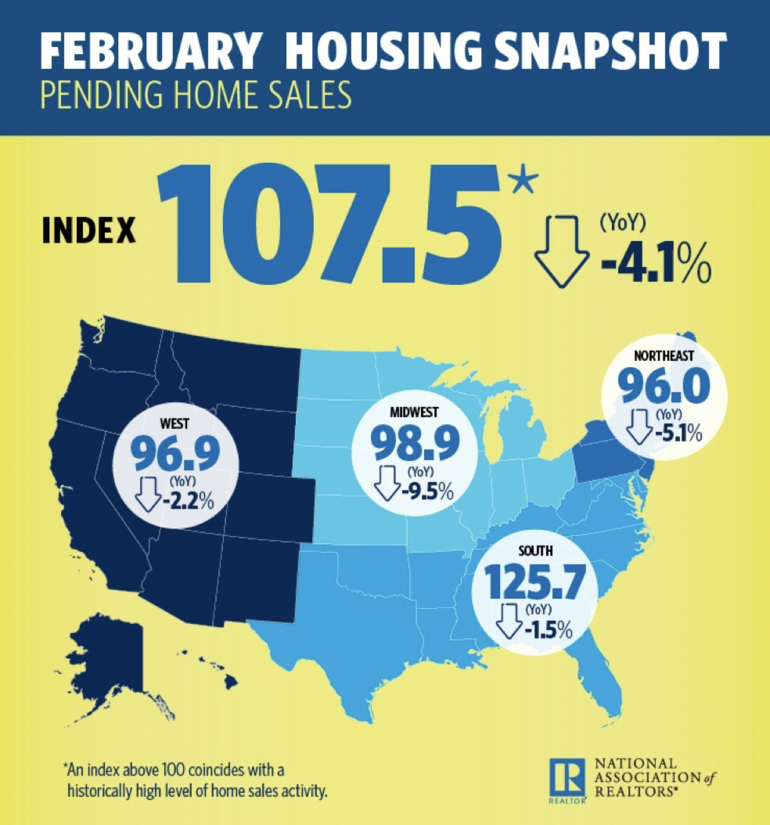
The Pending Home Index, which is a forward-looking indicator based on contract signings, grew 3.1% to 107.5 in February from a downwardly revised 104.3 in January. Even with last month’s increase in activity, the index is 4.1% below a year ago, the NAR said.
“Contract signings rebounded in most areas in February, but the gains were not large enough to keep up with last February’s level, which was the second highest in over a decade (112.1),” said Lawrence Yun, chief economist with the NAR, in a released statement. “The expanding economy and healthy job market are generating sizeable homebuyer demand, but the miniscule number of listings on the market and its adverse effect on affordability are squeezing buyers and suppressing overall activity.”
Looking forward, Yun added, “Expect ongoing volatility in the Northeast region at least through March. Although pending sales there bounced back in February following January’s cold weather-related decline, the multiple winter storms over these last few weeks likely put a chill on contract signings once again this month.”
With the start of the spring buying season in full swing, Yun said he believes one of the top wild cards for the housing market in coming months will be how both buyers and potential sellers adjust to the steady climb in mortgage rates since late last year.
The NAR noted prospective buyers continue to feel the strain of swift price growth – up 5.9% so far in 2018 – and the higher borrowing costs will only add to the pressures placed on their budget. Meanwhile, more would-be sellers deciding to balk at listing their home for sale out of uneasiness of losing their low mortgage rate – especially if they refinanced in recent years – would not be good news for any alleviation of the ongoing supply shortages in much of the country.
“Homeowners are already staying in their homes at an all-time high before selling, and any situation where they remain put even longer only exacerbates the nation’s inventory crunch,” said Yun. “Even if new home construction starts picking up at a faster pace this year, as expected, existing sales will fail to break out if these record low supply levels do not recover enough to meet demand.”
For the year, Yun is forecasting existing-home sales to be around 5.51 million – flat from 2017. The national median existing-home price is expected to increase around 4.2%. In 2017, existing sales increased 1.1% and prices rose 5.8%.
According to the NAR, the PHSI in the Northeast surged 10.3% to 96.0 in February but is still 5.1% below a year ago. In the Midwest the index inched forward 0.7% to 98.9 in February but is 9.5% lower than February 2017.
Pending home sales in the South rose 3.0% to an index of 125.7 in February but are 1.5% lower than last February. The index in the West climbed 0.4% in February to 96.9 but is 2.2% below a year ago.