

MADISON, Wis.–The coronavirus pandemic's effects on credit unions are readily apparent in the newest CUNA Mutual Trends Report, which uses phrases “biggest drops in history,” “raises concerns” and “slowest pace since 2011” in its analysis.
In this case, the references are to credit card loan balances, interest rate risk and CU membership growth, respectively, according to the Trends Report, which includes data through April 2020.
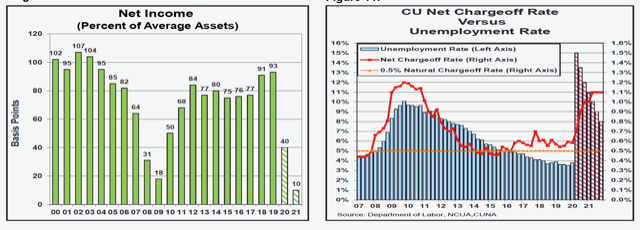
“For the full year we now expect credit union net income as a percent of average assets to fall to 0.4% in 2020 and 0.1% in 2021,” the Report states. “The COVID-19 recession could push credit union earnings ratios below what credit unions reported during the Great Recession of 2008-2009.”
Here's a look at how credit unions performed by category:
Total Credit Union Lending
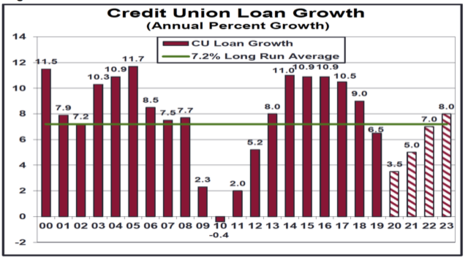
Not surprisingly, credit union loan balances rose a “scant” 0.1% in April, slower than the 0.6% pace reported in April 2019 and 6.4% during the last 12 months due to the full implementation of the COVID-induced economic lockdown, CUNA Mutual noted.
Every loan category reported negative growth rates except fixed-rate first mortgage loan balances which rose 1.2%.
“Expect credit union loan balances to rise only 3.5% in 2020 and 5% in 2021, below the long run average rate of 7.2%, due to low consumer confidence and high unemployment rates,” the Trends Report forecasts. “Most of the growth will be concentrated in fixed-rate first mortgage loan balances.”
Credit Union Consumer Installment Credit (CUCIC)
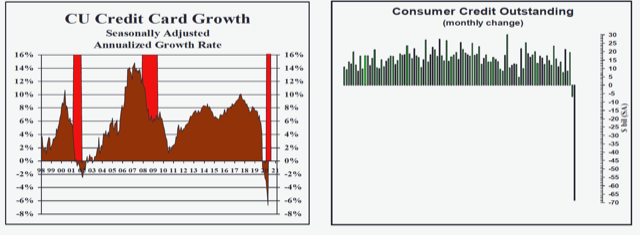
Credit union credit card loan balances fell 4.3% in April, below the 0.7% rise in April 2019, as the effects of COVID-19 economic lock down were in full force. On a seasonally adjusted annual rate, credit card balances fell 6.7%, the biggest drop in history .
Total consumer credit in the U.S. fell by $68.8 billion in April, revolving credit fell $58.3 billion and nonrevolving credit (auto and student debt) fell $10.5 billion.
“Expect consumer credit to contract as long as the economy remains at least partially shut down. Revolving credit balances (which include credit card spending) will continue to decline because of the large number of people who have lost their jobs in the last three months,” the Trends Report states. “Moreover, supply side constraints will reduce credit creation as credit quality begins to deteriorate and lenders move quickly to tighten their lending standards.”
Vehicle Loans
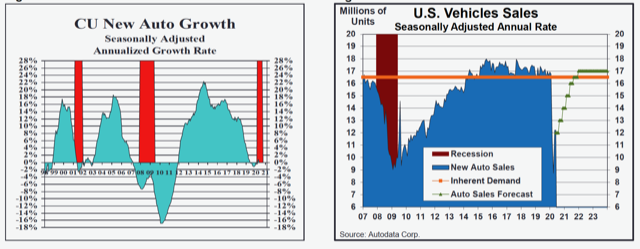
Credit union new-auto loan balances fell 0.3% in April, below the 0.1% gain reported in April 2019. On a seasonally adjusted annual rate new auto loan balances rose only 0.9% in April. Credit unions are offsetting the slowdown in auto purchases and financing by encouraging more auto loan refinances in an effort to get more earning assets on their balance sheet, CUNA Mutual said.
April is expected to be the sales bottom as the economy begins to reopen in May, CUNA Mutual said, but don’t expect auto sales to return to its long run average of 16.5 million sales pace due to high unemployment, cautious consumers and an all-time low in the number of miles driven per licensed driver.
Real Estate Secured Lending – First Mortgages and Other Real Estate
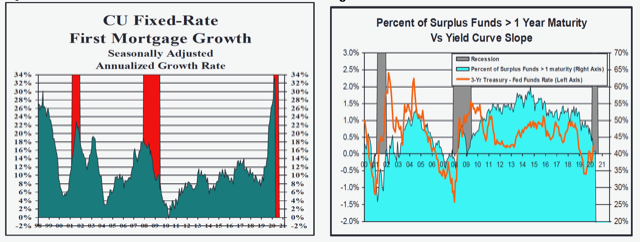
Credit union fixed-rate first mortgage loan balances rose 1.2% in April, above the 0.1% increase reported in April 2019, due to historically low mortgage interest rates, according to the Trends Report.
Credit union fixed-rate first mortgage loan balances rose 33% at a seasonally adjusted annual rate in April, the fastest in credit union history.
“However, adjustable-rate first mortgage balances fell 0.6% in April as members preferred fixed-rate loans. Fixed-rate first mortgages now make up 77% of all credit union first mortgage loan balances, up from 72% last April and the highest in credit union history,” the Trends Report said. “This raises concerns for interest rate risk if and when market interest rates rise…Housing supply remains tight, but there are few signs that there will be a strong rebound in demand for purchase mortgage activity.”
Surplus Funds (Cash + Investments)
Credit union surplus funds as a percent of assets rose to 29.5% in April, up from 25.1% last April, as credit unions’ deposits grew faster than loans, the Trends Report stated.
During the last year, credit unions added $69 billion in loans to their balance sheets and $126 billion in investments. These assets were funded by $178 billion in new savings deposits and $16 billion in additional capital (net income). Credit unions reduced total borrowed funds by $4 billion.
The yield curve slope (as measured by the difference between the three-year Treasury interest rate and the Fed Funds interest rate) remained relatively flat in April at only 17 basis points, due to the Federal Reserve’s massive quantitative easing program (printing money to buy financial assets), the Trends Report stated.
The flatter yield curve caused credit unions to decrease the percentage of surplus funds with a maturity of greater than one year to 41% – down from 50% last April.
Savings and Assets
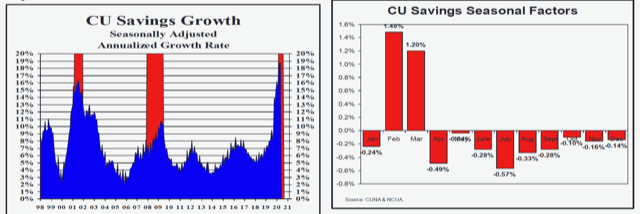
Credit union savings balances rose a “remarkable” 4.7% in April, compared to the 0.6% drop reported in April 2019, CUNA Mutual reported. The deposit surge was caused by reduced member spending, low gas prices, $1,200 stimulus checks, tax deadline extension and volatile equity markets. Savings balances grew at a record 18.7% seasonally adjusted annual rate in April.
“Expect savings balances to grow 14% in 2020, the fastest pace since the stock market crash of 2001 when deposits grew 15%,” the Trends Report says.
Capital and Other Key Measures
Credit union return-on-asset ratios averaged 0.91% in the first quarter of 2020, below the 0.95% reported in the first quarter of 2019, due to falling interest rates, lower loan-to-asset ratios and rising provision for loan losses, according to the Trends Report.
“For the full year we now expect credit union net income as a percent of average assets to fall to 0.4% in 2020 and 0.1% in 2021,” the Report states. “The COVID-19 recession could push credit union earnings ratios below what credit unions reported during the Great Recession of 2008-2009. This earnings comparison between the last two recessions reminds me of Mark Twain’s famous quote “History doesn’t repeat itself, but it often rhymes.”
CUNA Mutual’s economists urged CU leaders to expect the unemployment rate to remain above 10% for all of 2022 and the first half of 2021.
“This will push the credit union net charge-off-to-average-loan ratio to 1.1% in 2021, up from the 0.58% reported in the first quarter of 2020, due to members moving from a liquidity crisis to a solvency crisis. The charge off rate is not expected to surpass the rate reported in 2009 due to recent prudent loan underwriting,” the Report states.
Number of Credit Unions
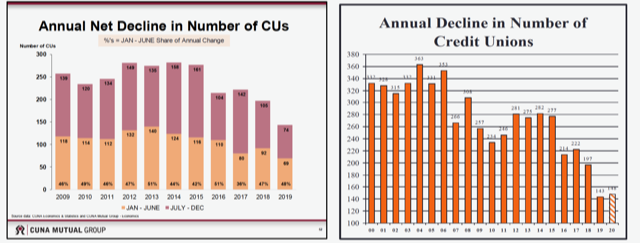
As of April 2020, CUNA estimates 5,406 credit unions were in operation, one fewer than in March. During the first four months of 2020, approximately 54 credit unions ceased to exist because of mergers, purchase and assumptions or liquidation.
“This rate is slightly above the 49 credit union decline reported during a similar time period in 2019,” CUNA Mutual said. “In 2019 the number of credit unions declined by 143 with 69 occurring during the first half and 74 taking place in the second half of the year.”
The Report said credit unions should expect the pace of credit union consolidation to slow in 2020 and 2021 due to credit union managers being more focused on managing day to operations during the COVID-19 recession rather than dealing with possible merger opportunities.
CU Membership
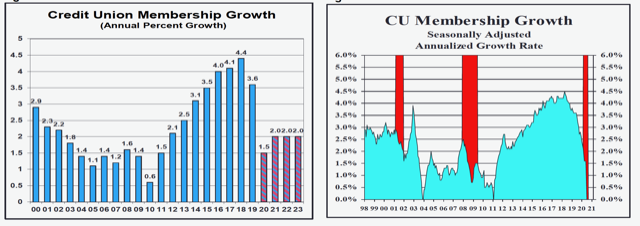
Credit union memberships grew a “very slow 41,000 in April, or 0.03%, down from April 2019 when the movement added 302,000 memberships at an increase of 0.25%,” CUNA Mutual said.
“In the year to April 2020, credit union memberships rose 2.7%, slower than the 4% pace set in the year to April 2019, the slowest pace since 2015,” the Report states. “The membership growth slowdown was driven by the slowdown in loan demand and the loss of 20.7 million jobs in April, according to the Bureau of Labor Statistics.”
CUNA Mutual said credit unions should expect membership growth to slow to 1.5% in 2020 and 2% in 2021 due to slower credit demand, massive job losses and past indirect auto loan members closing their credit union account when loan is paid off.
Credit union membership growth slowed to a 1.6% seasonally adjusted annual rate in April, the slowest pace since June 2011.