MADISON, Wis.–The early effects from the coronavirus pandemic cannot yet be seen in the latest report and forecast from CUNA Mutual—but it can be seen in the forecast for what’s ahead. Indeed, the report urges CUs to prepare for the lowest yield-on-assets ratio in history.
The company’s April Trends Report, which includes data through February, noted that month showed 275,000 new jobs and a decrease in the unemployment rate to 3.5%. But as the company’s economists note, the coronavirus has led to new economic forecasts showing the economy contracting at a 20% annualized pace in the second quarter, the unemployment rate rising to more than 15% and deflationary pressures pushing the inflation rate into negative territory.
Here’s a look at how credit unions performed by category:
Total Credit Union Lending
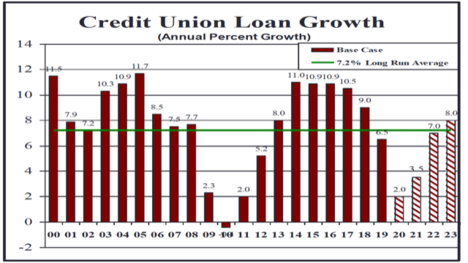
The COVID-19 pandemic is expected to decrease credit unions’ loan growth rate to only 2% in 2020, down from 6.5% last year, due to dismal new auto sales and weak home sales, CUNA Mutual said.
“This will lower credit unions’ loan-to-asset ratio from 71% today to 65% by year end, which will be the lowest since 2015,” CUNA Mutual said. “Fewer loans will contribute to the lowest earnings since the Great Recession. We are now forecasting credit union return-on-asset ratios to fall to 0.3% in 2020, down 63 basis points from the 0.93% reported in 2019.”
The Trends Report noted credit union loan balances rose 0.2% in February, faster than the no change pace reported in February 2019 and 6.8% during the last 12 months. February is historically the weakest loan growth month of the year.
Credit Union Consumer Installment Credit (CUCIC)
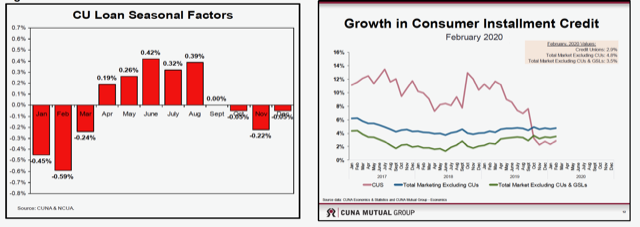
Credit union consumer installment credit balances (auto, credit card and other unsecured loans) year-over-year growth rates have been declining over the last six months due mainly to a slowdown in auto loans, according to CUNA Mutual. Credit union consumer installment credit grew 2.9% during the last year, slower than the total market excluding credit unions which grew 4.8%.
Vehicle Loans
The COVID-19 pandemic is expected to decrease new vehicle sales by 50% during the 2nd quarter compared to one year earlier. The CUNA Mutual analysis said the significant drop in new auto sales will have a large negative impact on credit union new auto lending for the remainder of 2020.
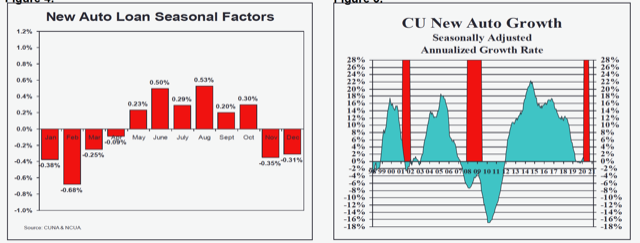
Credit union new auto loan balances are expected to fall more than 20% this year, greater than the decline reported during the Great Recession of 2008-2009. New auto sales are not expected to return to its 16.5 million long run inherent pace until the summer of 2022, according to the Trends Report.
The report goes on to note credit union new auto loan balances fell 0.7% in February, below the -0.5% loss reported in February 2019. February is historically the weakest new-auto loan growth month of the year, with seasonal factors typically adjusting -0.68 percentage points from the underlying trend growth rate.

Real Estate Secured Lending – First Mortgages and Other Real Estate
The COVID-19 pandemic is expected to decrease credit union purchase mortgage activity this year due to massive job losses and grim income expectations reducing the demand to purchase a home, the Trends report states, even as mortgage rates decline to unexpected lows.
Expect home prices to fall 2-3% in 2020 as the economy goes into a deep recession, household income growth declines and overall homebuyer confidence weakens. The anticipated fall in prices will mark the first decrease since the housing crash of the Great Recession, the Trends Report stated.
Surplus Funds (Cash + Investments)
“The COVID-19 pandemic is expected to decrease credit union loan-to-asset ratios to 65% by the end of 2020, down from 71% at the end of 2019, due to expected loan growth of 2% and expected asset growth of 12%,” the Trends Report states. “This six-percentage point change in the mix of assets, from higher-rate loans to lower-rate surplus funds, will lower credit union yield-on-assets ratios 16 basis points this year, holding all else equal. But of course, all else is not being held equal as market interest rates hover around record lows. This ‘rate effect” could push yield-on-asset ratios down further a 54 basis points. This combined 70 basis point effect could lower credit union yield-on-asset ratios from 4.05% in 2019 to 4.35% in 2020, the lowest in credit union history.”
The Trends Report notes surplus funds rose to 26.8% of assets in February from 25.3 in January due to a surge in savings deposits. Moreover, the ratio is up two percentage points from the 24.8% reported in February 2019 due to deposit growth exceeding loan growth over the last year (9.5% versus 6.8%).
Currently, according to the report, 56.4% of surplus funds have a maturity of less than one year, up from 50.9% last year, the highest percentage since June 2009. The recent drop in short-term interest rates and the majority of surplus funds invested short term will lead to a significant drop in the yield on surplus funds this year.

Savings and Assets
CUNA Mutual is forecasting the COVID-19 pandemic will increase credit union deposits by 12% in 2020 due to falling gas prices, falling discretionary spending, the volatile stock market and $1,200 stimulus checks.
“Credit union savings balances surged 2.5% in February, exactly the same as the 2.5% gain reported in February 2019, due to the seasonal factors of tax refunds and bonuses being deposited in credit union members’ share draft and regular share accounts, which increased 5.5% and 3% respectively,” the report states.
According to the Trends Report, credit union savings balances grew at a 10.2% seasonally adjusted annualized growth rate in February, due mainly to lower gas prices reducing consumer spending.
“We forecast credit union savings balances to grow 12% in 2020, significantly above the 7% long run 30-year average,” the report states.
Capital and Other Key Measures
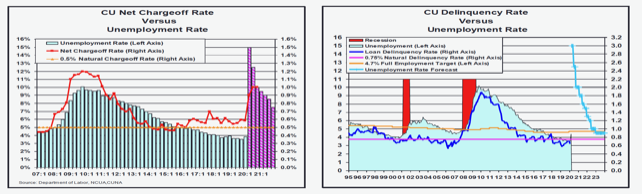
CUNA Mutual said the COVID-19 pandemic is expected to double the credit union loan charge-off rate in 2020 compared to 2019, as the nation’s unemployment rate rises over 15%. The report said the credit union industry’s average loan net charge-off rate rose to 0.59% in the fourth quarter but was down from the 0.61% reported in the fourth quarter of 2018 and above its “natural” long-run rate of 0.5%. In other words, 50 cents of every $100 dollars of credit union loans are normally charged-off each year. The charge-off rate typically exhibits a quarterly seasonal pattern whereby the loan charge-off rate rises 0.05% in the fourth quarter and then declines during the next three quarter, CUNA Mutual said.
Number of Credit Unions
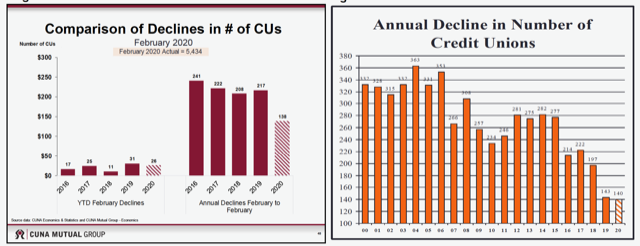
The Trends Report states that as of February 2020, CUNA estimates 5,434 credit unions are in operation, down 138 from February 2019.
“The pace of credit union consolidation was -2.5% in the year to February due to the following factors: retiring Baby Boomer CEOs, rising regulatory/compliance burdens, low net interest margins, rising concerns over scale and operating efficiency, rising competitive pressures and members’ demand for ever more products, services and access channels,” the report states. “There are still more credit unions in the U.S. than banks or savings institutions. At the end of 2019, there were 4,518 banks and only 659 savings institutions in the U.S. But total assets of the banking industry reached $18.6 trillion in 2019, almost 11.3 times greater than the $1.650 trillion held by credit unions. We are forecasting the number of credit unions will decline by 140 in 2019.”
Credit Union Membership
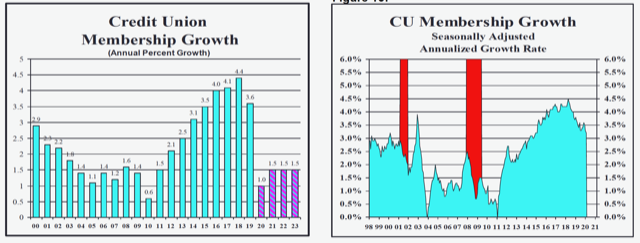
CUNA Mutual stated the COVID-19 pandemic is expected to slow credit union membership growth over the next few years after growing over 3.5% during the last 5 years.
“Americans typically join credit unions to obtain credit. With loan growth expected to fall to only 2% this year, membership growth will fall to only 1%,” the report states. “Americans also join credit unions when they obtain a job at a business with an associated credit union. With millions of Americans expected to lose jobs this year, this avenue of membership growth will also be blocked. And finally, much of the strong membership growth over the last few years was due to a large surge in indirect auto lending. New indirect auto lending is essentially shut down. And as old indirect auto loans are paid off, many of those members will close their credit union account.”
The Trends Report said credit union membership growth slowed significantly during first two months of 2020, adding 230,000 new memberships versus the 372,000 reported in the first two months of 2019. In percentage terms, credit union memberships rose 0.19% in February, 0.41% year-to-date and 3.4% during the last 12 months. Memberships grew at a 3.2% seasonally adjusted annual rate in February, down from 3.7% in February 2019, CUNA Mutual said.