SEATAC, Wash.–The Northwest Credit Union Association said it is now arming its member CUs with a new data-rich tool to support their advocacy and public awareness work this year.
The new community data was collected in NWCUA’s Community Impact Reporting Tool (CIRT) and is designed to document credit unions’ economic and community impact, in addition to highlighting credit unions’ efforts to enhance financial well-being, volunteerism, and provide charitable contributions.
It also focuses on special lending to rural communities, first-time homebuyers and service to populations credit unions are uniquely positioned to serve.
The economic impact report was prepared by ECONorthwest, which has provided data to credit unions in the Northwest for a number of years.
In addition to data, the NWCUA said it providing its members with communications collateral such as infographics, social media posts and a library of member stories, so they can customize and share the impact in their own communities.
‘Real, Tangible Value’
“The economic and community impact reports document how credit unions collectively generate and deliver real, tangible value to members and communities,” said Troy Stang, NWCUA president and CEO, in a statement. “Our strategic priority, in creating the Community Impact Reporting Tool, and in commissioning the economic study, is to position credit unions to help the public and policymakers understand exactly how credit unions’ not-for-profit, cooperative structure enables them to drive such impact.”
ECONorthwest has provided independent and relevant analysis to a diverse range of public agencies and private sector industries since 1974. In 2013, an ECONorthwest’s study, The Myth of the Uneven Playing Field, analyzed bank and credit union data from 1948 to 2012, “debunking bank claims that state and federal tax policies offered credit unions unfair competitive advantages over for-profit financial institutions,” the NWCUA said.
The firm’s new economic impact analysis continues to support the positive impact that credit unions’ state and federal income tax exemptions have on consumers, communities and on each state’s economy, the NWCUA added.
The association noted ECONorthwest’s most recent study measured the jobs, economic output and income supported by Northwest credit unions, as well as the impact of the direct benefits credit unions are able to deliver to their members because of their unique structure. The analysis also documented Northwest credit unions’ services to members and communities from the onset of the pandemic through June 2020, the NWCUA said.
Doing Good Things
According to the NWCUA, when many industries were forced to shut down and lay off workers, credit unions hired additional staff to help members, ECONorthwest found. The workforce at Idaho credit unions grew 3.2%, 1.3% in Oregon and 1.2% in Washington.
Key Findings
Other key findings in the newest report include:
- When members needed options to skip loan payments or to have loans modified, credit unions supported them, and waived a total of nearly $14 million in fees
- More than 22,000 small businesses that suffered economic impacts of each state’s “stay home” orders, received a lifeline from Paycheck Protection Program loans funded by credit unions. Despite reports that large national businesses received billion-dollar plus PPP loans from for-profit financial institutions, credit unions embraced the spirit of the program, helping the truly small businesses Congress intended to serve. According to ECONorthwest, the average loan amount across the region was slightly over $44,000.
- In support of their communities at the onset of the pandemic, Northwest credit unions contributed $7.1 million to local charities and volunteered 52,000 hours of community service.
‘Leadership Voices’
“Credit unions quickly and safely kept service flowing to members with technology, remote services and socially distanced operations,” Stang said. “They also served thousands of members who’d lost jobs or whose income had been interrupted, by providing emergency loans and options to skip payments, and waived millions in fees. Moving forward, Northwest credit unions will use their leadership voices and exemplary services to help guide communities back to financial well-being.”
The Economic Analysis
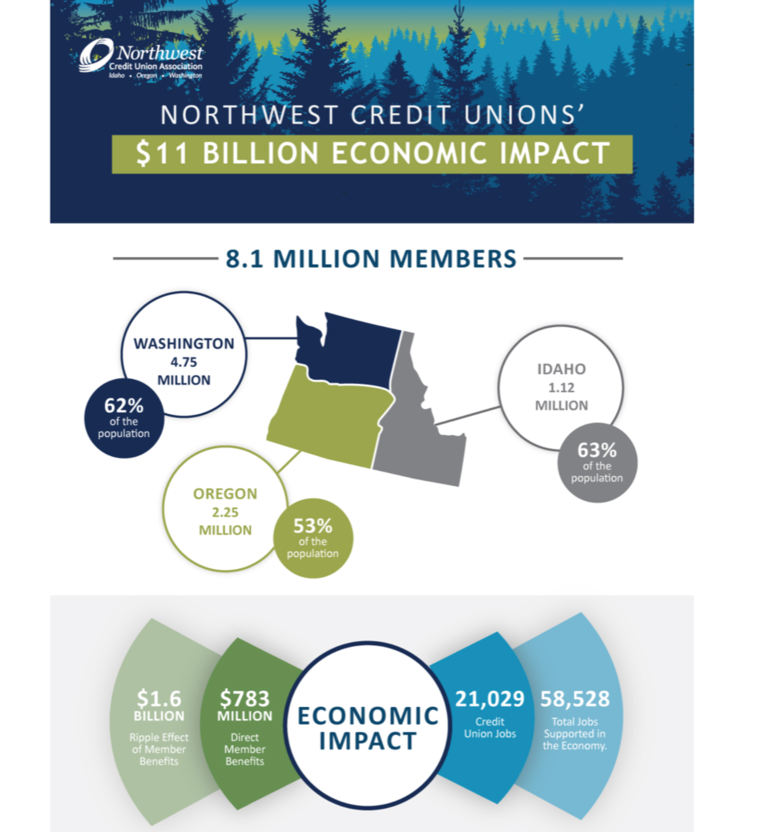
The NWCUA reported that in measuring Northwest credit unions’ economic contributions, ECONorthwest found credit unions in Idaho, Oregon and Washington delivered a $11 billion boost to their state’s economies in 2019.
Other topline takeaways include:
- Strong public awareness. The majority of Northwest consumers have chosen credit unions as their financial services partners. More than 8.1 million consumers in Idaho, Oregon and Washington are members of credit unions. This reflects growth ranging from 7.7% to 12.9% since ECONorthwest’s last economic analysis of the region’s credit unions in 2018.
- Members of Northwest credit unions received a collective $783 million in direct benefits such as lower fees, dividends, lower loan rates or other benefits enabled by credit unions’ not-for-profit structure. When members spent those benefits in local economies, the ripple effect was nearly $1.6 billion.
- Northwest credit unions provide family wage jobs to 21,029 professionals. According to economists, those jobs support a total of more than 58,000 jobs across the region.
A Proven Community Footprint
The data documented in NWCUA’s Community Impact Reporting Tool measures not only volunteerism and charitable contributions, but also the relevant products credit unions provided to Main Street throughout 2019, the NWCUA said.
The survey related findings include:
- Credit unions’ strong commitment to promoting financial well-being, with more than a quarter million Northwest consumers directly receiving financial education from a credit union
- Nearly $1 billion in loans that helped consumers buy their first home
- Nearly $3.7 billion in refinanced mortgages, allowing members to dedicate financial resources to other needs
- Community support by credit union employees who volunteered 180,000 hours
- Charitable contributions of over $27 million
Underscoring the Story
“Credit unions were founded with the people helping people mission, and Northwest credit unions are living up to it, day in and day out,” said Jennifer Wagner, executive vice president and chief advocacy officer, NWCUA. “This data will underscore the credit union story.”