

MEDFIELD, Mass.–Change has always been a constant in financial services—but dramatic changes taking place across five different areas is really putting a premium on the ability to respond—and survive, according to one person.

Mark Sievewright
Speaking to PSCU’s Virtual Member Forum, Mark Sievewright, who leads the consulting firm Sievewright & Associates, spoke to the challenges related to “Financial Services Macro-Trends and Strategic Considerations for Credit Unions,” said he has been in the industry for 30 years and “I can honestly say this is the period of the most intense change I can recall. Just one alone would be enough to change the course of the industry, but we are seeing five taking place at the same time.”
According to Sievewright, those five macro-trends include:
The Relentless Pursuit of Scale
“Oftentimes, we talk about this in our industry as consolidation. That will continue,” said Sievewright, predicting that by 2030 the current 5,000 U.S. credit unions will number be in the high 2000s. “The good news is scale is not just about size. Scale reflects our ability to generate a dollar of revenue tomorrow at a lower cost than we generate it today,” he said.
Digital Imperatives & Technology
“I anticipate digital becoming even more important, and not just in the lives of members, but in how we manage our credit unions and in how we start to do away with that patchwork of technology in our back offices,” he said.
Changing Consumer Attitudes & Expectations
Sievewright said there is a premium on convenience and speed of delivery, as well as a premium on personalization. “All of these are vital to credit unions in sustaining their businesses,” he told the meeting.
Demographics and Socio-Economic Shifts
While saying it’s “not just an age thing,” Sievewright nonetheless noted Millennials and Gen Z will soon be 75% of the workforce. “I’m a firm believer this new generation mostly will be digital and they won’t actually need that branch in anything like the same way it’s used now,” he said.
Changing nature of Competition
It’s no longer just the traditional foe, the banks, he said, but the fintechs and the big tech companies looking to offer financial services in various ways.
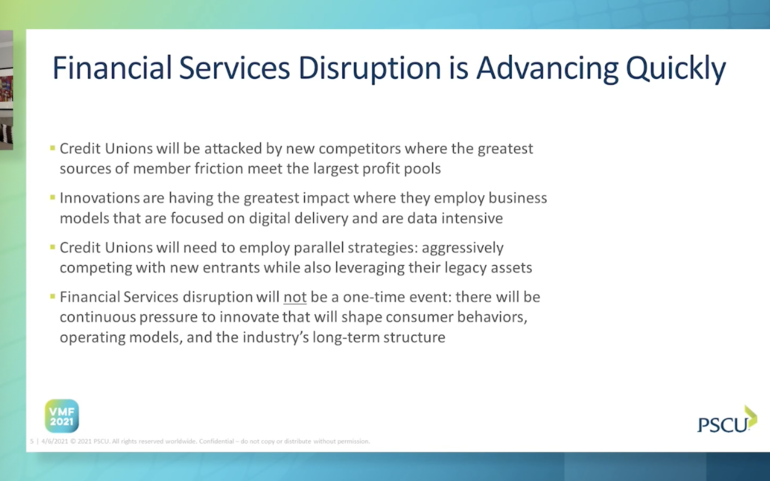
“Financial services disruption is advancing quickly,” Sievewright said. “Credit unions will be attacked by new competitors where the greatest sources of member friction meet the largest profit pools. Credit unions will be attacked by the big techs, the Amazons, Google, and Apple, as well as by the Chimes, Robin Hoods and Venmos.”
He noted the latter three already have relationships with 75 million Americans.
How to Respond?
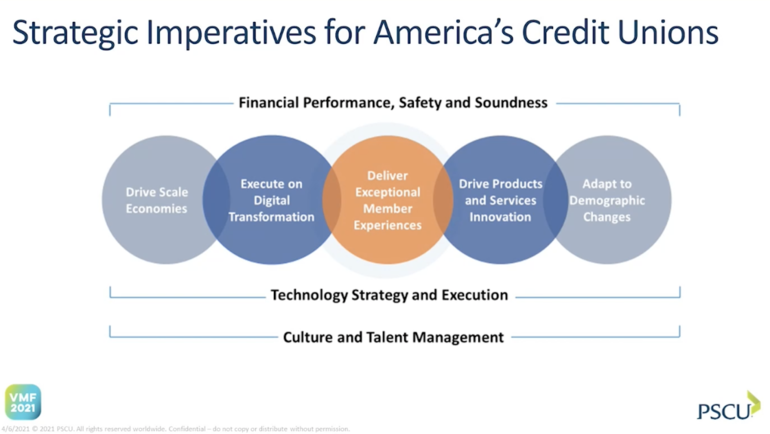
If he had to summarize what’s being discussed in the board rooms of credit unions around the country, it would be as seen in the slide below, he said.
Sievewright has another prediction, too.
“I think there is going to be a subtle shift over this decade into a new era of what I call ‘mullet banking’,” said Sievewright. “Mullet hairstyles look great from the front, but from the back they don’t look so great. We look great from the front--our offices, or mobile technologies--but from our backoffices, it doesn’t look so great.”