

ST. PETERSBURG, Fla.–How credit unions have quickly rolled out new digital and video offerings, what their plans are for branches, the potential for new alliances and more were all the subject of discussion during a panel hosted by PSCU.
During the CU executive panel as part of the CUSO’s Virtual Member Forum, credit unions discussed their experiences over the past year during the pandemic and how it has reshaped what they have planned for the future, particularly as it relates to branches.
Participating in the discussion were Kim Little, EVP/COO with Chartway FCU in Virginia; Sunil Tanneru, managing director, financial services with Accenture; and Nathanael Tarwasokono, president/CEO of Firstmark Credit Union in Texas.
The session was moderated by Mark Sievewright of Sievewright & Associates.
Below is some of what was discussed.
Sievewright: The pandemic has accelerated a lot of technology investments. What has it meant for you?
Tarwasokono: During COVID we saw a 30% decline in branch transactions. That traffic went to our phone center and online mobile banking. The 70% of traffic that remained moved primarily from in-branch to drive-throughs, and even after we reopened our branches those members didn’t return to the branch. We have a plan to consolidate branches within five miles of each other. We are closing branches permanently on Saturdays. We have increased staffing in call centers, and we have moved our digital platform to Lumin.
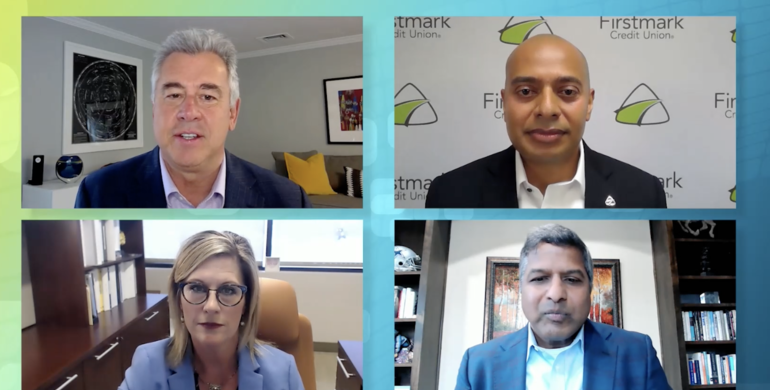
Participating in panel were, from top left, clockwise: Mark Sievewright, Nathanael Tarwasokono, Sunil Tanneru and Kim Little
Sievewright: You’re a multi-state credit union. What has the pandemic been like for Chartway?
Little: This has been an accelerant. We had to move to a remote workforce in a matter of weeks. We moved our call center (staff) to working from home, and many of them are still there now and we are trying to figure out the next thing for that. We also launched video banking. It’s exciting in that we were able to be very focused and very agile.
Sievewright: How have members adapted to video banking?
Little: Once they try it, they love it. There is a little skepticism at first. Historically our branches were kind of competing, if you will, with our digital. Now we’re saying best thing you can do is get people enrolled in video banking and mobile banking. It’s a slow and steady evolution. Like Nathaniel, we saw a 30% drop and that hasn’t come back.
Sievewright: How do you see the shift away, if there is to be one, from branching to digital? By 2030, will the nature of branches have changed?
Tanneru: There is going to be more change in our industry in the next 10 years than the last 100 years. It seems to be working fairly well. Is there going to be a relationship that is based on trust? That is one of the areas where credit unions have an edge, the trust of the member. It’s going to be less about can you serve them at the branch or digitally and more about can you serve them with trust?
Sievewright: What kind of strategies are you adopting for branches?
Little: The experience inside the locations is changing. I don’t think you need as many or that they will be nearly as big. I believe we will still need a physical footprint. All the research I’ve seen is people need to see a sign on the corner to personify that trust. For us, it’s are we in the exact right place, the right intersection, in growth markets? And then it’s about making sure the service inside the location is customized to the region. For instance, our members in Utah have an affinity for RVs that we don’t see in Virginia. We are also talking about consultative environments and a cashless society. What you want is someone will hold your hand and answer questions. Those kinds of advisory services are where we’re headed right now.
Tarwasokono: I think the products we’re selling are going to be more and more commoditized. I think a lot of the technology we use will be table stakes. We are training our employees to be financial coaches. What do you do to continue building financial trust? It goes beyond products and services.
The longer the pandemic takes place, the more likely the behaviors become more permanent.
Sievewright: What about the intensity of competition?
Tarwasokono: I saw interview an interview with (JPMorgan Chase CEO) Jamie Dimon in which he said all the fintechs should be scaring the crap out of us, and he didn’t say crap. What I think the industry must do is make progress, don’t shoot for perfection, don’t make big bets that could cost the credit union, but make sure that you are hedging disruption in some way.
Little: If you can’ beat ’em, join ’em. I do think you need some strategic alliances that line up with better versions of the products and services we offer.
It’s very scary. I think our industry has learned how to take a risk without betting the whole farm on it. I think we need partnerships with companies that have scale, a PSCU or a CUNA Mutual, that can do some of the preliminary legwork for a credit union.
Sievewright: How do we take on these new competitors?
Tanneru: A lot of this is driven by what you also see in the market around data privacy issues and what is happening with the proliferation of data. I could see how (someone) would like the small institution that hasn’t captured all your data.
But it’s a double-edged sword. You need to be capturing all this data in the spirit of how do you know this member better. How can you take the element of trust, of informed consent, and start to build that continued level of trust? If you know your customers really, really well, and credit unions are in better position than banks, how do you know what the next best move is for the customer?
Sievewright: I was part of presentation in which there was a poll that asked how many have a digital transformation strategy. We were surprised it was only about 20%. How are you approaching this vital strategic area?
Little: We do have a digital roadmap and it really is centered philosophically around leveraging digital tools and assets to create this easy, frictionless, intuitive experience for members. Chartway is not a build-it kind of shop. We lean into our business partners and leverage their scale. We partner with those that have open architecture to help us to see what we need.
Internally, we are transforming in that we are learning to not settle and learning to think about digital for the front end. Robotic process automation is not something you would have heard us talk about last year. We have a saying: ‘We leave a seat for the member in all of our conversations.’ We are thinking about how people consume products and services.