

TAMPA, Fla.–There is a valuable lesson to be learned by credit unions from unicorns.
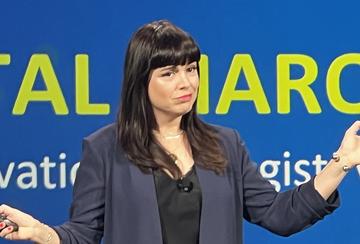
Lital Marom speaks at PSCU’s Member Forum.
That’s according to Lital Marom, an entrepreneur, engineer, author and leader of the consulting firm UNFOLD and the Academy of Tomorrow.
Marom shared her perspective on why and how credit union leaders must change during remarks at PSCU’s Member Forum.
Marom ran through an overview of the major economic shifts of this century that have only accelerated since the pandemic, affecting every CU’s present challenges and those that lie ahead.
“It’s been a tsunami powered by unicorns,” Marom said, referring to multi-billion dollar valuations attached to some relatively new firms that have quickly become established tech brands. “We call them unicorns because their growth and their scale is almost magical. It’s been transformational destruction on steroids. All of the transformation we’ve seen since COVID probably would have taken at least three to five years otherwise. Everything is moving faster. Innovation is also moving faster.”
Take a Picture—But It Won’t Last Longer
She reminded that Instagram was acquired for a billion-dollars when it had just 13 employees, while Kodak declared bankruptcy with 145,000 people on the payroll.
“If we step back and we look at all these unicorns, we actually see that they all have one thing in common and that one thing is what makes them so powerful. The good news is that one thing is also available to you and it will allow you not just to survive but to thrive in this constantly changing digital economy, and that one thing is the exponential organization model,” Marom told the meeting. “The way that they're built and the way that they operate is fundamentally different than those classic economy companies born prior to the digital era. There is a new blueprint for business.”
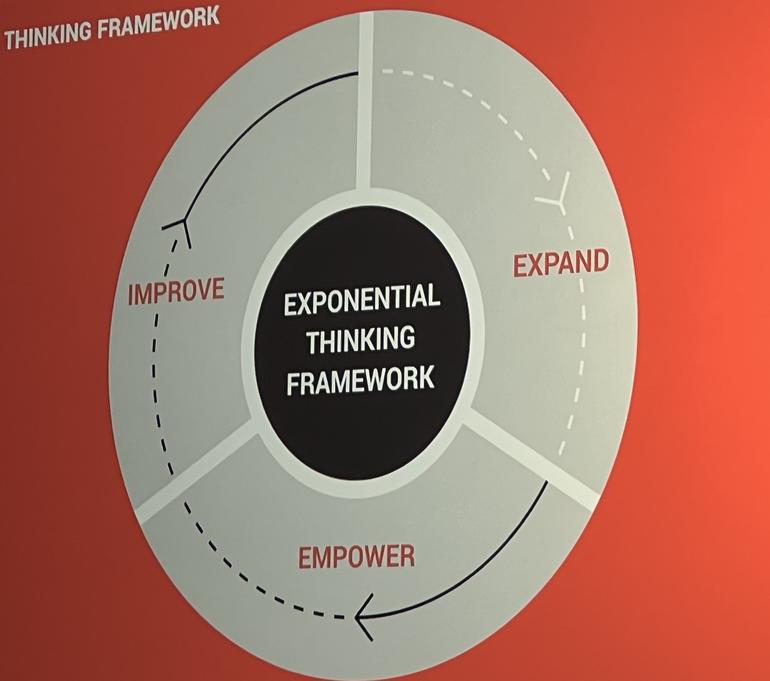
An engineer and a strategist, Marom said she has been studying the organizations that have become the 21st century’s leading brands to better understand what they have in common. That has led to what Marom called the “exponential thinking framework” that captures all these patterns and which can help legacy brands reengineer.
The First Challenge
One of the first big changes organizations must adapt to, according to Marom, is a large majority of the workforce is actually outside of the company in the form of gig workers and other partners.
“Data is the new currency,” said Marom. “In reality, we see a lot of companies that are data rich, but insight poor. It’s not just about collecting data for sake of collecting data, but finding real value in that data. Something very interesting happens when you run a data-based business. The boundaries of your business begin to dissolve.”
As an example, she cited LinkedIn, which added job listings and then knocked off Monster.com in the process.
Until recently, Marom said many organizations saw digital transformation as a bunch of different experiments taking place in different silos, with none of them talking to each other.
What’s Changing
But that is changing now, according to Marom.
“Winning teams get to the finish line together, not in silos, so it's all about breaking down silos in your architecture,” she said. “Customers today want everything to be digital, I don't even have to mention that. Then they want everything to be instant, personalized, relevant, human and contactless…Don’t just give me these general offers, give me something that's actually going to add value to my life with 24/7 access to a human or chatbot. someone that could give answers to all my needs.”
What Must be Cultivated
To meet those demands, she said companies are cultivating a learning culture.
“What I mean by a learning culture is that they see learning as the process, not just an end goal, and that process is more important than the end goal,” said Marom. “Learning basically never ends. When you get your university degree never ends. When you get the job you always wanted, learning never end. When I talk a lot with leaders about the importance of putting learning first, I often hear, ‘Yeah, you know. we sent her to master classes workshops to learn new skills.’ That’s awesome, it’s what you need to do, but then a lot of the time employees go back to work and they don't use many of those skills.
“So, what I'm talking here about is learning by doing in the workplace not just in the workshop,” Marom continued. “You must keep learning through experiments, learning through action.”
Three Big Fat Obstacles
That all sounds good, but Marom acknowledged there are typically “three big fat obstacles” that can get in the way of that kind of organizational refocusing.
The first is being overwhelmed by technology.
“Maybe you're extremely excited about technology, but the rest of their organization is afraid of it, so you keep getting this pushback from the front lines,” said Marom. “There may be this fear of being overwhelmed. There may also be this digital divide in the company; not every person knows how to use the technology or how to integrate it into their everyday work lives.”
The second big, fat obstacle is old-fashioned resistance to change, according to Marom.
“If what you’re doing is working for you and putting money in your pocket, why change?” she observed. “And if you’re not successful you might fall behind. This is about fear.”
The third issue is that many people don’t readily embrace being challenged, Marom told the PSCU meeting. To that end, she recommended reframing challenges as “opportunities.”
“It’s a choice only if you're willing to move from fear and feeling overwhelmed by technology to embracing it, being excited about it, moving from a fixed mindset to an open mindset,” Marom said. “Only then you can really reimagine your future and thrive.”
Where to Start?
Where does an organization start in that process? Where else, but with the humans, said Marom. And that begins by understanding that even as machines and AI become more prevalent and embedded in organizations, there are skills humans are still best at, including being creative, empathetic and passionate.
“Technology is getting so much better it is allowing us to do what we do best. To be human. To reimagine work. To not just automate work, but to add new value. To create new organizations, to do things better for our planet,” Marom said.
‘Exponential Thinking’
Marom urged credit union leaders to think much bigger.
“We have to think of how to use data to create value, to create new opportunities, to enter new markets,” she said. “What are the big transformative questions you need to ask yourself? We have everything we need. But we need to step up and ask the bold questions. The most important thing today is to think about the future. In reality, most leaders spend 5% to 10% of their time thinking about the future. Ninety percent of the time we make decisions based on past experience.
“In a world of constant change we can’t afford to operate this way. I believe leaders should spend 60% of their time looking forward. Why do 90% of digital transformation initiatives fail? Because most leaders think that technology alone will get us there. You have to have exponential thinking to get exponential results.”
Credit union leaders have no choice but to act, as Marom noted three trends are now converging in AI: big data, computing power and machine learning. “AI will not replace you. A human using AI will,” she observed.
Looking to Enter New Markets
The path to new markets, according to Marom, includes asking transformative questions in the exponential thinking framework. Those include:
- Expand. Organizations must think expansively, with questions such as in what other markets can we play? “The connecting thread across the potential opportunities and markets is your purpose,” said Marom.
- Empower. An example is “How can I empower others to create value?”
- Improve: One of the most important questions any one in business should ask, said Marom, is “How can I improve my customers’ lives?” They shouldn’t be asking, “How can I get more data?”
Feeling the FOMO? We Can Help
The biggest, best and freshest news reporting in credit unions remains free in ’23! Each morning CUToday.info delivers its daily Fresh Today news update offering the latest headlines and breaking news right to your email, with the easy-to-read headlines format allowing you to click on the stories that interest you most in order to learn more.
If you haven’t yet signed up for the new email solution on which CUToday.info has partnered with ResponseGenius, you can do so here. Signing up requires less than one minute of your time—and it’s free!
Please note that after signing up you may need to go to your Spam/Junk folder and mark the morning headlines email as safe. CUToday.info does not provide its list of readers and emails to outside parties, and we will not be contacting you to sell you an extended warranty or sending you any links so you may cash in on an inheritance you didn’t know was coming.
And did we mention it’s free?
Please note and/or make your IT department or email administrator aware the emails will be coming from the domains CUTodayinfo.com and CUTodayinfoReply.com