

TAMPA, Fla.–The first female president of Visa North America shared with credit unions gathered here the story of her path to the top, where she believes technology and payments are headed, her thoughts on where credit unions must be focused, and more.
Kim Lawrence, who was named president of Visa North America approximately 60 days ago, offered those insights during a Q&A with PSCU CEO Chuck Fagan during the CUSO’s Member Forum here.
Here’s a look at what was discussed during the Q&A:
Fagan: Tell us about your journey.
Lawrence: I have had a long journey at Visa. I started in the management training program 25 years ago. You talked (earlier) about how do we change the makeup and representation around our table? What brought me to this seat are three key ingredients.
First, I have always been incredibly driven. I've always wanted to work on a team, be successful individually and as part of a successful team and win for the company. I wake up every morning with a fair amount of fire in my belly…ready to go and to take on things. I think anybody at an executive level has to really have a lot of drive and want to go do big things.
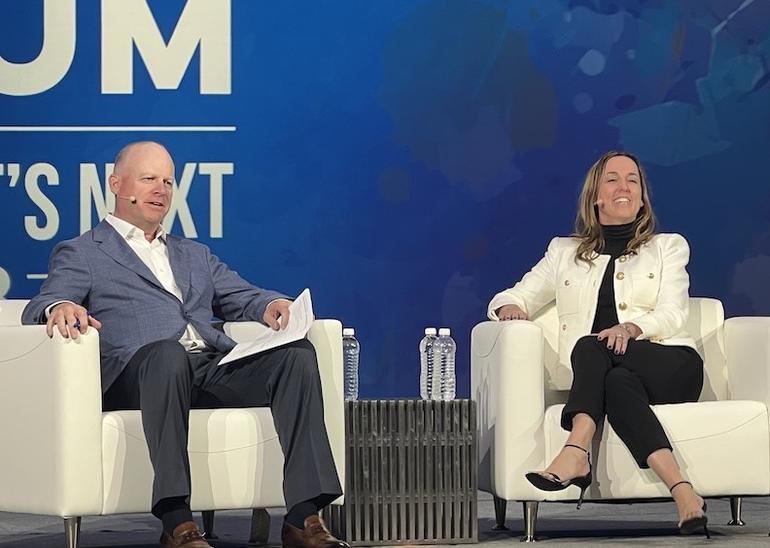
From left, Chuck Fagan with Kim Lawrence.
The second thing that has been really instrumental in my career is allies, sponsors, coaches, whatever you want to call them. I was on (the Visa president’s) team early on and (the then Visa president) kept bringing me along. I got to basically shadow him for 10 years. Our CEO and Visa really pushed me into things I didn't want to do, but they encouraged me to do what they thought I was capable of doing. When I was younger in my career, it wasn't those senior people, but it was more junior people that were helping me along the path.
The third thing is my family. I have kind of a not so normal situation. I am a wife and I have two kids, that’s very normal for the most part. But 10 years ago when I really got on this path for my career, my husband, who had a much bigger career than I did and when my kids were six and nine, which are tough ages when you're juggling everything--my husband just came to me one day and said, ‘I'm quitting my job like I'm going to be a stay-at-home dad and you go do your thing.’
As a woman and a mom, more than men you always get this question around “How do you do it?” The reality is at an executive level, we all miss out on things. I have missed out on a lot of important moments in my kids’ lives. It’s important to talk about this. It takes being intentional to help change the conversations around the table. When things open up it's just being mindful sometimes that as a society we don't all look the same. My husband was the only dad on the PTA and I was the only mom the moms never saw at the PTA meetings. But it works for us.
Fagan: PSCU and Visa are a partnership. I think we share a similar philosophy in that Visa wants to be an extension of PSCU, and we want to be an extension of our credit unions. Where do credit unions fall in your strategy?
Lawrence: Maybe a good way to kind of draw this distinction is that Visa’s purpose is to uplift everyone, everywhere, by being the best way to pay and be paid. You are focused on how you serve and service your communities and your members and so, out of the gate, our missions are incredibly aligned. We very much play a supporter role to you and to all of your credit unions and members. We work day in and day out with PSCU to make sure we're providing assets and capabilities and everything that you need to make payments part of your business in an easy and seamless way.
Fagan: Thinking about today’s world, what’s at the top of your mind as you think about strategy?
Lawrence: There are headwinds, but there's a ton of opportunities, too, and some of these headwinds actually create opportunities in my opinion.
The big ones are the obvious ones--the economy and the uncertainty and regulations that we all spend a lot of time on and talk about a lot.
And then there is the other thing on my list, the constantly emerging and evolving payments landscape. With regard to competition, the one area in particular where I think there's a lot of opportunity is payments. We all come to the office and we work on how we can grow the pie. But it's not like the pie is fixed and we're trying to carve up pieces of it. We are displacing cash, checks and traditional paper-based payments with digital payments. There’s a lot of new entrants coming in and just constantly changing the landscape.
Fagan: You are in the Bay Area, and there was a pretty big announcement around a financial institution failure there (Silicon Valley Bank). How does Visa view that and what do you advise?
Lawrence: We have to remind ourselves that we operate in this four party model and what that means to everyone who's a part of that model.
You have your users’ trust. If you're the consumer and you use your Visa card for a payment, you want the goods and services that come with it. It really puts that whole model to the test. We have lots of safeguards in place, lots of monitoring, lots of controls. We pressure-test our portfolio, the broader Visa portfolio, for concentration risk and things like that. We continue to do it.
We also stayed very close with regulators. I know our teams were directly involved with the FDIC during that whole time period and we'll continue to do that.
But I also think it's a good wake-up call for all of us to look where there is concentration in our businesses. Sometimes that pops up in unexpected places. How should all of you be thinking about this? I think this is an opportunity to really tout the trust and the safety that you all provide at a time when a lot of consumers are looking for safe places to put their money.
Fagan: What about the regulatory environment? What do you advise people in this room?
Lawrence: This group is probably one of the most powerful voices on this topic and Capitol Hill, as well as in state capitals. That's where these debates and fights are happening around regulation. You’ve got a little bit of fire for it. It’s critical that that we work together and that we all do our part in this ongoing fight around trying to prevent onerous regulation in this space.
The Credit Card Competition Act…is dressed up and positioned as bringing more competition to credit cards, when in fact there's never been more competition in the payment space than there is today. It’s really a veiled attempt to regulate interchange. They don't talk about interchange in that bill, but that's really what it is. We are continuing to experience the damaging effect that regulation has in payments. It has lots of unintended consequences in the credit card space and they're really potentially significant. Fraud is another big issue. You've got just the general risk around the availability of credit, which is critical to our economy for both consumers and businesses. It impacts consumer rewards. The list goes on.
The last thing I want to talk about is state-level legislation, which is really starting to pick up. The fight is starting to shift to the states. There have been nine states where interchange bills have been introduced. Just a few weeks ago North Dakota actually voted on a bill. It was defeated soundly, thanks to the rapid engagement by local teams. Staying vigilant at the state level is important. The biggest concern at the state level is payments are interoperable globally. The notion that a payment has to work one way in one state and another way in another state could be really crippling.
Merchants have done a very good job of simplifying this to a simple headline. The implication the networks keep raising is interchange, when in reality the biggest driver of interchange is consumers are using more and more digital payments. That part they don’t talk about.
Fagan: What about tap to pay, where the U.S. is lagging?
Lawrence: If you take one thing away today it is if you're not doing tap to pay you should get a plan and start working to do it today.
It’s coming along slower in the U.S., just like the EMV chip came along slower. The good news is we have a lot of experience on how this works around the world. Typically, the migrations work with EMV chip cards first, where you're dipping the chip, and then you fast-follow with contactless, because the dipping is so clunky.
I think that now we're close to 70 to 80% of these cards being contactless-enabled and the vast majority of merchants are enabled…We've hit sort of this tipping point that we've seen in the rest of the world. It will continue to grow until we hit a critical mass.
Fagan: How do credit unions remain relevant?
Lawrence: There are probably three big things I would say focus on right now, and then the fourth one, which is sort of motherhood and apple pie.
There are technologies right now that you need to keep pace with. You can’t let your pain get too far out of control. Tap to pay is really tables stakes for payments. You want it to be on your cards and to be the one that is driving top of wallet.
My 19-year-old son said he doesn't know how to use a checkbook; he uses only his phone for everything and the concept of having payment and credentials on his phone is critical, and that's the case with all of these next generations that are digitally native. Digital issuance…is an important capability. Start thinking about how you integrate that into your business.
I think credit issuance and particularly with small business (is important). Small businesses look to their community credit unions for support and service. I think close to 61% of small businesses use their personal credit cards for their business expenses, so it's a huge opportunity to think about how you create a product. Again, we've got a lot of this easily available you to create a product that is tailored to small businesses.
At the end of the day, the motherhood and apple pie piece is you’ve got to listen to consumers, your members. They will tell you what they want. They are very clear about their expectations. I think it's part of all of our jobs to help you meet them where they want to be.