

SAN ANTONIO–Five executives with PSCU/Co-op Solutions who are overseeing various aspects of the integration of the two companies’ products and services following their merger shared their respective views on how things are progressing.
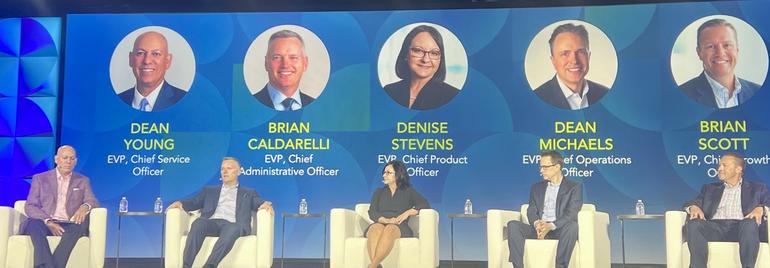
Participating in the panel discussion during the PSCU/Co-op Solutions Member Forum here were Dean Young, EVP chief service officer, who served as moderator, along with Brian Caldarelli, EVP chief administrative officer; Denise Stevens, EVP, chief product officer; Dean Michaels, EVP, chief operations officer, and Brian Scott, EVP chief growth officer.
Here is some of what was discussed:
Q: Share some of the key pillars in how we are going to nail this merger?
Caldarelli: (After DoJ approval), the other big piece was around the talent side and ensuring that we didn't lose the talent that we didn't want to lose. That is absolutely key on so many things in our culture.
I think there's really three big components that we looked at. One is building a new organization and I think we've all been in places where we said, ‘Hey, if we could do this again, if we could start a company from scratch, this is what we would do.’ That's really the mindset that we've taken. From our executive team, our board, our integration management team, it’s really looking at what is the best across both organizations without any bias…Ultimately, we’re trying to save the best and, look, if it's not from either one, we’re fine saying we're going to partner or we're going to build something else.
The Second Pillar
I think the second pillar is around focusing on execution. We would love for this to be as seamless and noise-free as possible. This is the largest integration, as far as we can tell, in the credit union industry ever—by a longshot. We are taking a whole lot of extra time to focus here.
The Third Pillar
I think platform is the final leg of this stool. It has to do with value creation and I mentioned that third because…getting the new organization right, getting the culture of the organization right trumps just about everything else.
Q: With the solutions set, both organizations offer lots of quality solutions. Could you share the process you’re going through to make sure we roll out the best of the best?
Stevens: We have the privilege of kind of going through and evaluating all of the duplications.
One of the key things we've been doing is creating a focus group that takes account of customers that were previously with Co-op, previously with PSCU, and helping us validate some of the assumptions we have around the product decision to the actual criteria. We're using about 36 criteria assessments.
This duplication and products allow us to really take a unbiased approach. We’re looking at things like product adoption and what's the feedback from the customers, so, it really allows us to then decide which product should be in each portfolio. The team is really evaluating how do we lessen the impact of any kind of change so that we don't create a burden for you.
Q: With the contact center, we are bringing together two massive organizations. There is lots of opportunity here in taking 10-million-plus calls. How are you thinking about this?
Michaels: This is a great opportunity to extend that leadership in the industry. I think what credit unions can expect as we're bringing this strategy together is…this is opportunity to take the best of the best from both organizations, whether it's the people, the process, or the technology. You'll definitely see that in the contact center.
I think the other thing that we're really seeing that I really get excited about is that there's actually, in some cases, an opportunity for a third option. Sure, we could use the IVR for Co-op or the IVR for PSCU, but neither one of those might really be purpose-fit for the new organization, for an organization that's double in size, for an organization that's really thinking about the future.
‘Under the Hood’
While we're under the hood we're really being intentional; it's not just about let's take this one or that one, but let's take the opportunity to ask can we upgrade our telephony system? That doesn't sound super-sexy, but can we more intelligently route calls? Could you have better reporting? Can we upgrade our IVR to an IVA, or interactive virtual assistant, so that instead of just having your member press buttons we could use things like natural language processing and conversational AI?
It's an interactive question and answer with the member, something that allows us to be a lot more efficient and effective, so it ends up being cheaper for credit unions, rather than going to a more expensive live agent.
Q: There is lots of momentum, but what are you hearing?
Scott: A lot of people have said, ‘You know, it's about time (you merged). But as a bigger company we have a greater responsibility to help service and support you and your members.
A lot of what I'm hearing is, how do you help us compete? How do you help us challenge big banks? And it's not the bank on the corner, it's truly the big banks and the fintechs that are coming into your space.
This is also one of the first times in the last 10 years that member financial health is really at risk. FICO scores have gone down for the first time in 10 years. We're seeing collections really ramp up. So, a lot of my questions are how do you support us? How do you help us grow? How do you help us improve the lives of our members?
We’ve got an opportunity to do this in the right way.
Scott: We have a question for you: What’s your team doing?
Young: I think what you'll see is a brand that comes out that recognizes the past--I think it's really important story path--but also takes us into the future. It will demonstrate the ethos of our commitments or promises and things of that nature to the market.
Our service teams, mainly client services which is your day-to-day contact, and then our client delivery team looked are super-focused. Our entire enterprise is in some shape or form is focusing on business as usual. We have a small percentage of employees dedicated to the IMO, roughly 2% to 3%. The other 98% are concentrated on what looks good for credit unions.
So, the two main goals of our organization are, number one, we have to get faster. We have to respond, resolve, execute.
Number two is serve as expected. You have to deliver on promises.
Q: Migration and the timeline are on everyone’s mind. Tell us about the roadmap and development?
Stevens: (CEO) Chuck (Fagan) tells me all the time, ‘No forced migrations, Denise.’ All the decisions we're making are with full transparency so as we've started to evaluate all of our opportunities within products and solutions, It really is about selecting the right partners, platforms and products to really create the product portfolio that creates value for you guys and that you need and want to compete.
It's a very, very competitive space, so making sure we're selecting and making really good decisions around the products platforms is highly important to us, and we're balancing that with impact, making sure that we don't change everything that you've come to know and love and that your employees are very used to using.
The Compass
Really, when we think about migration it is a very broad term. The focus group is really helping us kind of tag the level of impact. For instance, maybe we make a selection in a product or service that we believe is just going to (require you to) update your training. We want validation of that versus ‘We're about to make a change and it's going to impact one of your partners.’ If it maybe requires integration to your core, that's a high level of impact. The focus group is kind of our compass around the decisions.