ST. PETERSBURG, Fla.–PSCU has announced what it said is a record-setting patronage dividend of $37.4 million, with 30% being distributed in cash. Separately, it also released its latest analysis of card spend by CU members, showing a strong rebound.
PSCU reported the cash distribution to its owner credit unions this year is $20.5 million, including $6.7 million in capital credits and $2.6 million in revolving funds, representing what it said is also the largest cash payout in its history. Since its founding, PSCU said it has distributed more than $577.6 million in patronage dividends, with 51% paid in cash.
“In a year in which the credit union philosophy of ‘people helping people’ has taken on even deeper meaning, our commitment to the success of our owner credit unions and their members has not wavered,” said President/CEO Chuck Fagan. “Together, we have partnered to meet these challenges head-on and have become an even stronger cooperative. As we previously reported, PSCU completed our 2020 fiscal year with excellent top- and bottom-line growth. As we build on our strong momentum, we continue to invest a significant portion of our top-line revenue in capital expenditures – in addition to our $100 million three-year investment – to fuel future investments, all while providing record patronage dividends to our owners.”

Chuck Fagan
Fiscal Year Highlights
According to PSCU, highlights from its past fiscal year include that $100 million investment, the largest ever approved by its board. The investment has fueled multiple initiatives, including:
- Continued growth of Lumin Digital, PSCU’s cloud-native digital banking platform, with nine credit unions and more than 300,000 users currently on the platform, eight more implementations in process and a strong pipeline in place
- Commitment to improving credit union onboarding, solution delivery and program enhancement efficiencies, “as well as continued growth in strategic solution offerings including digital, risk management and data analytics offerings.”
- Deployment of additional robotic process automation (RPA) and machine learning capabilities to improve efficiency and speed to deliver.
PSCU said other highlights of the past year have included:
- Exponential growth in contactless, with PSCU slated to produce more than 6.8 million new contactless plastics – “the most significant volume in the credit union space – and deliver them to more than 100 credit unions to support natural and mass reissuance strategies in the current calendar year.”
- Continued investment in cutting-edge data, network and cybersecurity infrastructure tools, “including Linked Analysis, PSCU’s proprietary approach to intercepting and predicting fraud; the CUSO’s best-in-class security practices saved owners over $400 million in potential fraud dollars in fiscal year 2020.”
- Expansion of collections capabilities, tools and resources in anticipation of growth in delinquencies in the post-pandemic environment
- Onboarding of more than 900 Jack Henry & Associates (JHA) financial institutions, representing over 15 million accounts, fueling additional investment opportunities to benefit PSCU owners
- The acquisition of Primax, which PSCU said added scale to its core payments business and additional expertise in the small and medium-sized business card market
- Continued focus on building and leveraging a diverse, agile and digital workforce through both dedicated internal initiatives and industry partnerships.
PSCU reminded its annual meeting will be held virtually in 2021, with details forthcoming.
Strong Rebound in Card Usage
Separately, PSCU’s Advisors Plus and Data & Analytics teams also released its latest data on member card spend, and reported growth rates in credit and debit card usage by credit union members showed a strong rebound.
in the newest installment of the data, PSCU compared the 49th week of the year (the week ending Dec. 6, 2020 with the week ending Dec. 8, 2019). Week 49 performance data includes Cyber Monday (Nov. 30) and Giving Tuesday (Dec. 1).
“Growth rates rebounded to strong pre-Thanksgiving levels in Week 49, with positive spend performance in both debit and credit,” said Glynn Frechette, SVP, Advisors Plus at PSCU. “Following a dip in payment volume during the Thanksgiving holiday week, we saw a quick return to strong holiday spending buoyed by a record Cyber Monday. Strong performance in Card Not Present activity was fueled by healthy sales on Cyber Monday, strengthening cumulative holiday spending this season.”
The Growth Specifics
According to PSCU:
- Debit card spend remains well above last year’s results. For Week 49, debit purchases are up 18.1%, above the four-week average of +14.4%. Transactions are back up 3.4%, above the four-week average of +2.2%.
- Credit card spend has risen into the positive again, finishing up 5.7%, in line with the four-week average of +5.1%. Transactions finished at +0.7%, higher than the four-week average of -0.1%.
Contactless Solutions
Consumers continue strong usage of contactless, mobile wallets and card not present (CNP) alternatives, while using less cash, PSCU reported.
- Contactless “tap-and-go” transactions via dual interface cards continue to gain adoption, with debit showing notable strength. Debit contactless transactions as a percent of card present activity on contactless debit cards have doubled from around 8.4% in mid-January to 17.5% in Week 49.
- Contactless credit transactions have also grown from 6.5% in mid-January to 11.9% of card present activity on contactless credit cards in Week 49.
- “We continue to view these results as conservative, as the ratio considers the proportion of contactless activity to all card present transactions, not just those able to be tapped,” PSCU said.
Mobile Wallets
Mobile wallet (i.e. “Pays”) transactions and purchases for both credit and debit cards continue to show good growth with card present activity, PSCU said.
- Debit mobile wallet purchases finished Week 49 up 62.1% year over year, higher than the four-week average of +60.3%. Credit mobile wallet purchases are up 51.3% year over year, higher than the four-week average of +46.5%. These results represent six supported mobile wallets: Apple Pay, Fitbit Pay, Garmin Pay, Google Pay, LG Pay and Samsung Pay.
- “We continue to see more volume conducted via Card Not Present (CNP) transactions and this category benefited significantly from Cyber Monday,” PSCU said. “For credit, 60.1% of purchase volume and 51.3% of transactions are CNP. For debit, 48.4% of purchase volume and 34.2% of transactions are CNP.”
Purchase Mix & ATMs
Purchase mix has held steady and is up 7.8 percentage points year over year for credit and 7.9 percentage points for debit. Transaction mix also remains steady, up 11.2 percentage points for credit and 8.4 percentage points for debit year over year, PSCU said.
- Cash withdrawal transactions at the ATM remain down year over year. For the most recent week, the number of cash withdrawals was down 18.4%, higher than the four-week average of -20.2%. For the pandemic period of Weeks 13 to 49 total cash withdrawn is down 14.2%.
- From a merchant category perspective, purchase growth rates in Week 49 for most sectors returned to pre-Thanksgiving week levels for both credit and debit.
- Grocery spend was up 15.6% year over year for credit and 10.8% for debit, one of the sectors with the largest improvements for the week.
- Spending in the Entertainment sector also saw significant growth for Week 49. Although year-over-year spending is still down, credit finished at -42.7%, an 11.5 percentage point increase from the previous week. Debit spending finished at -23.9%, a 15.4 percentage point increase from the previous week.
- Service also saw large improvements week over week. For Week 49, credit spending finished up 16.6%, a 14.7 percentage point increase from the previous week. Debit spending finished up 24.1%, a 19.2 percentage point increase from the previous week.
- Spend in the Drug Stores sector slowed in credit, but saw a small increase in debit. Purchases are up 2.6% for debit, an increase of 1.8 percentage points week over week. Credit purchases are up 5.9%, down 2.4 percentage points from the previous week.
Regional Analysis
PSCU, which said it uses the regional segmentation used by the U.S. Bureau of Economic Analysis (BEA) for economic analysis, reported:
- Overall U.S. spend was up 5.7% for credit purchases. The Southeast (+9.3%) finished as the strongest region for Week 49. The New England (+0.9%) and Rocky Mountain (+0.5%) regions had the lowest credit purchase performance.
- Overall U.S. spend was up 18.1% for debit purchases. The Southeast (+20.4%) finished as the strongest region for Week 49. While the New England (+15.7%) and Rocky Mountain (+13%) regions had the lowest debit purchase performance, they still finished the week strong.
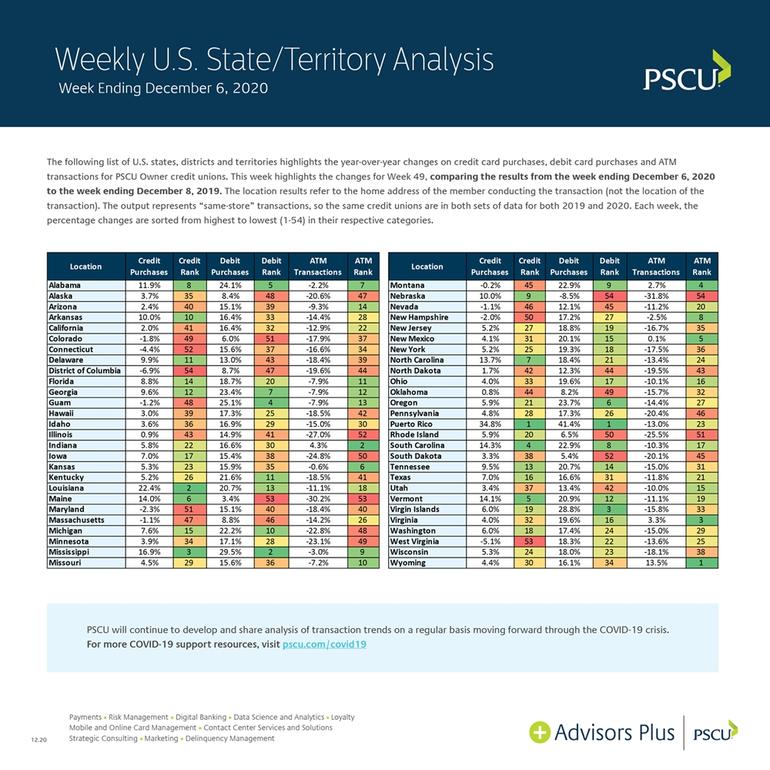
PSCU’s noted its Weekly U.S. State/Territory Analysis is available at www.PSCU.com/COVID19, and ranks U.S. states and territories by year-over-year performance for debit purchases, credit purchases and ATM transactions.
The Deeper Dive
In its newest deeper dive, PSCU said it continues to explore Holiday Spending in the Goods sector. The holiday shopping season arrived earlier this year, with many retailers advertising Black Friday sales throughout the month of November, the company noted.
Among the findings:
- Purchases within the Goods sector over the cumulative reported holiday period thus far (Nov. 2 – Dec. 6) are up 19.3% for credit and 27.4% for debit. So far in the 2020 holiday period, the two weeks preceding Thanksgiving (Nov. 9 – Nov. 22) have yielded the strongest year-over-year increases in purchases for credit and debit.
- Goods remains one of the sectors positively impacted by the COVID-19 pandemic, with much higher CNP activity, as more consumers are holiday shopping online than in physical stores. CNP purchases within the Goods sector over the cumulative reported holiday period are 57% for credit, up 9.8 percentage points, and 40.1% for debit, up 7.8 percentage points.
- For credit cards, Card Present (CP) activity is showing the effects of the growth in CNP. For this five-week holiday period, CP credit purchases are down 2.7% and CP credit transactions are down 8.7%. CP debit activity has stayed above 2019 levels with CP debit purchases up 12.7% and CP debit transactions up a modest 2.9%.
- Average purchases within the Goods sector are up 4.5% for credit and 11.6% for debit. Consistent with previous observations of consumer behavior favoring debit cards, the average purchase amount for CNP debit is up 14.4% or $6.85 compared to the same five-week holiday period in 2019. For the same subset on credit cards, the increase is 5.7% or $4.35.
- With holiday sales starting earlier than in prior years, there was a decreased impact from the shopping days immediately after Thanksgiving. “As Week 49 started with Cyber Monday (Nov. 30), it appears higher purchasing volumes have resumed. Credit purchases are up 15.5% and debit purchases are up 32.9%. Credit CNP purchases are 70.4%, up 5.8 percentage points, and debit CNP purchases are 52.3%, up 6.3 percentage points,” PSCU said.
- On Giving Tuesday (Dec. 1), credit purchases in the Charitable and Social Service Organizations category are up 68.2% and debit purchases are up 38.5%.