

LAS VEGAS–During a women’s leadership panel discussion here, four credit union leaders offered their views on gender equality in credit unions, how women often sell themselves short, how their organizations have talked about the challenge and more.
The discussion took place during Origence’s Lending Tech Live event in Las Vegas.
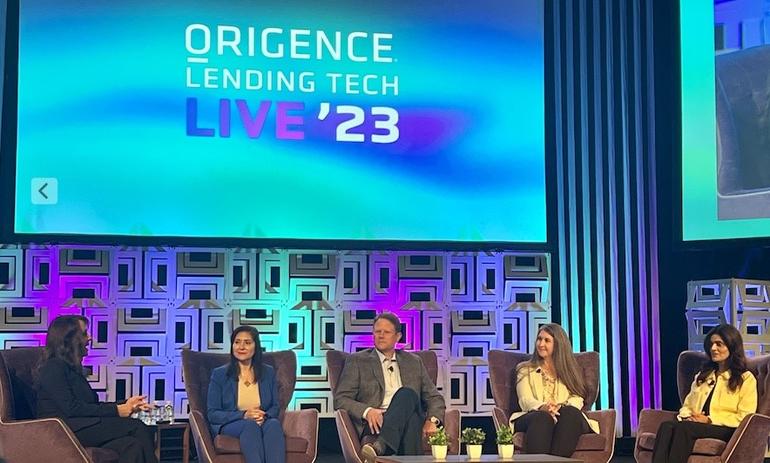
The panelists included: Maria Martinez, president and CEO of Border FCU; Neetu Bhagat, CFO with Origence; Keith Sultemeier, president and CEO of Kinecta FCU; and Kymrie Turner, SVP-consumer lending with America First CU. The panel was moderated by Erika Hill, VP-marketing with Origence.
Here's a look at the Q&A and what was discussed:
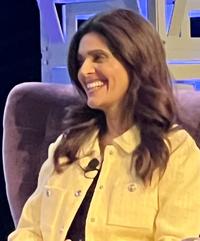
Neetu Bhagat
Hill: In your experience, what are some of the biggest challenges women are facing in achieving gender equality in the workplace, and how can we address them?
Bhagat: There are several. There are still preconceived notions and some conscious and some unconscious bias. There is implicit bias in who we consider leaders, and they tend to be masculine traits. Second, if you look at who we are hiring generally at the staff level, it's not an even split but a pretty even split—55% male, 45% female, or some combination therein. However, as we go to the first round of managers, the number of women and men that are getting promoted is disproportionate. For every hundred men there are 87 women promoted, according to a McKinsey survey. From there, women never ever fill this gap, because if you have fewer women to promote that just reduces the number that will go into leadership.
The third problem is this sort of societal norm where women are not trained to be asking for what they want and value, what they believe they're worth. They assume they will be valued and will be promoted, where men tend to be more assertive. This is where women probably fail themselves…in not asking.
Hill: What is a recommendation?
Bhagat: It has to be a conscious decision. It’s a systemic issue. You need policy changes to have things happen. We are seeing pay transparency. Traditionally, women never negotiate their salaries, men always negotiate their salaries. Paternity leave is another thing. Caregiving is not just a woman’s place, it should be a family place.
In companies, we have to make a conscious decision to keep measuring our metrics around general hiring and the promotions that are happening. We may need to educate our managers to look at promotions from an unbiased lens. Men are often measured on performance and women are measured on performance but also personality traits.
Turner: It really boils down to opportunity. Organizationally, it’s important to focus on training and promoting the culture of opportunities through being able to be ready. When you foster a culture in your organization of training, then when those opportunities arise the people that you have working for you will be ready. I think that's something the credit union I work for has done a really fantastic job of doing. They don't just care about the employees and teaching them how to handle members and how to take care of their day-to-day jobs. It really is about you as a person and making sure that when you get that opportunity you are ready for that.
Hill: Your thoughts?
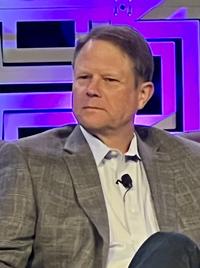
Keith Sultemeier
Sultemeier: As luck would have it, when I was preparing for this panel I was actually reading a couple of books that touched on gender equity. The biggest challenge and the biggest barrier is this idea of traditional gender roles, that the woman is the caregiver, that they stay home with the kids; you know, all of this 1950s kind of hogwash that persists.
The data I saw kind of stratified it into kind of an age pool when it comes to work and there is reason for optimism in that--and it's probably no surprise—the notion of traditional gender skews older. When you get into the mid-Millennial and lower it starts to be nonexistent, so there will be some progress.
In the meantime, to address what you’ve touched on, ask for what you're worth. As a company I think you can help that by doing routine pay equity analysis for all of your positions. These are kind of blind not biased views…of where do our people sit on these pay ranges. Is it equitable within the department and across departments? We do it twice a year and we'll provide adjustments based on those to make sure that everybody is getting paid equally and fairly for the jobs they're doing.
Hill: What do you think?
Martinez: Unfortunately, the corporate world was made by men for men. Incorporating ourselves into an area designed by men has been a challenge…If you look at somebody for how they look you know you're not looking at their credentials and credentials are so important.
When we prepare to excel in life we have to look at those around us, those who are mentors, those we can learn from and apply to ourselves…If you look, years and years ago this was not a women's world. We've made a lot of strides. Look at look at this room; we have a lot of women here. We have a lot of women in our credit unions, but when you start going into the C-Suite that's where we struggle, because I don't see a lot of people that look like me in the system and that's what we need to work at.
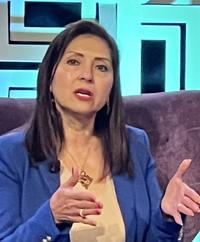
Maria Martinez
Hill: Why is gender equality so important to approach for credit unions when we talk about female leadership?
Martinez: It opens up the doors. People from the outside are going to view your organization as a very inclusive place. We move to neighborhoods that are what we want to be like. The same thing is true of organizations. We want places that look like us. It’s not about doing the checkmark, hiring someone Hispanic or a woman. It’s important that we don’t just talk about it, but really apply it. Look around your group—how can you be more inclusive?
Bhagat: If you don’t bring women along on the journey you are leaving a lot of talent outside of the organization. The research shows organizations that are more balanced tend to perform better, longer term. You attract better talent. Women want growth and opportunity, and if it’s not there they will jump ship. Through attrition you could really be losing top talent.
Hill: is there anything you’ve done in your organizations to identify top women and retain them?
Sultemeier: In the war for talent you will not be able to fill your jobs if you don't fill them with female leaders, because two out of every three college degrees today go to a female. Seven out of every 10 valedictorians today our female. So, if you're planning to fill your roles, especially your leadership roles in the future, you better be looking at these new, rising female leaders. If you want to cling to that traditional gender view that leadership is masculine, you’re going to do your credit union a disservice.
Turner: I think it’s important for credit unions to take a step back and remember at our core we are people helping people. I have loved the industry because we help each other.
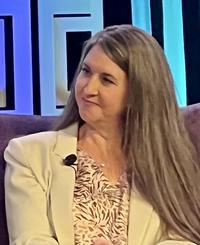
Kymrie Turner
We’ve been told for many years by Filene and other organizations that we need to do a better job of telling our story. But it also positions us on the national stage to be a great example of promoting women leadership. I think we’re walking down that path already, but we’ll continue to talk about this and this will continue to be a panel as we continue to have ‘first female this’ and ‘first female that.’
Bhagat: For women, one of the bigger issues, especially if they are single moms or primary caregivers, is flexibility. The pandemic answered one question for us, but the question of flexibility also needs to be around what time do I work? When do I work? And that is true whether male or female. If we are talking about equality, we do have to empower men.
Hill: What programs or initiatives have you implemented related to women’s development, such as ERGs or DEI?
Martinez: Back in 2020 we started talking about creating an organization within the credit union industry that could cater to women who were CEOs at credit unions of less than $300 million. We just wanted to get together and have a safe space where we could talk about issues that were affecting us as women, but also in the workplace. One of the leaders of the organization brought 13 women together, all CEOs, and we created the Credit Union Women's Leadership Alliance.
At first when we got together we would have our meetings, our planning sessions, and there was a lot of resistance because many of them thought, ‘Well, why can't we bring in men in the same asset size category?’ We came to the conclusion that the main reason we were going to do this together was for a safe space and that as women we needed that as an organization.
We are now a 501(c) 3 nonprofit organization and we've grown, I believe, to something like 179 members. We had our first conference last year in New Mexico and it was a big event. We invited men to come in and participate and be part of the panels and tell us about their perspectives, because as you know many of our mentors and many of the people that I look up to have been men.
It’s not like we want to eliminate men, because we need everybody.