

SAN DIEGO–Success is simple. Or more precisely, success lies in simplicity. And yet leaders and organizations continue to add needless amounts of onerous complexity in failed attempts to drive success, according to one expert, who shared some examples on how to (simply) tackle the challenge.
Speaking to Origence’s Lending Tech Live 24 event, Lisa Bodell, the founder and CEO of Future Think and the author of several books, including “Why Simple Wins,” posed a simple question: “How many of you wake up with a plan for what you want to do during the day and then at night realize you didn’t get most of that done?”
Laughter and nods from audience members made it apparent most knew the feeling.
Why the common lament?
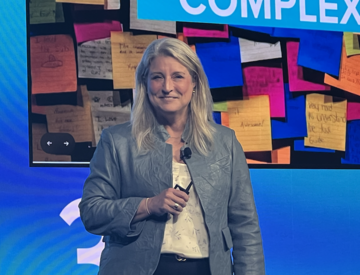
Lisa Bodell speaking to Lending Tech Live.
“There is too much to do that gets in the way of getting things done,” Bodell answered.
“Complexity is always going to be around and I would argue that some complexity is important and necessary, and that’s usually things that have to do with specialty or expertise,” she continued. “For instance, I want my pilot to go to flight school. I want my credit union to have security protocols in place. What I don’t want is for how they work to get into the way of what I want to do. Complexity exists but it doesn’t have to be complicated.”
Bodell said unnecessary complexity turns most work into “waste,” leading most workers to a daily existence of just attempting to execute on their calendars rather than getting anything done.
Getting Back Some Time
“Most of us can't get to the things we want to do every day,” Bodell observed. “If you could just get back 5% of your time to put towards more intentional work (which adds up to several weeks per year), imagine what you could do with that time personally and professionally. I think we underestimate the importance of how we work and…the impact of being able to do good work.”
Where organizations should focus, according to Bodell, is on using simplicity as a strategic advantage.
“I say strategic advantage because this is not a discussion about productivity, this is not a discussion about efficiency. That will happen,” she said. “Simplicity is much bigger than that. But if you go to your team and say, ‘I'd like you to simplify because I need you to be more productive,’ they will be incredibly insulted. But if you say, ‘You need to simplify so you can get to the work that matters to do, what you were hired to do in the first place, ‘ people are on board.”
The Enemy of Meaningful Work
Using an app to poll the audience, an overwhelming majority agreed that complexity in their daily work occurs often or very often, which Bodell said should be a red flag for the C-suite in any organization.
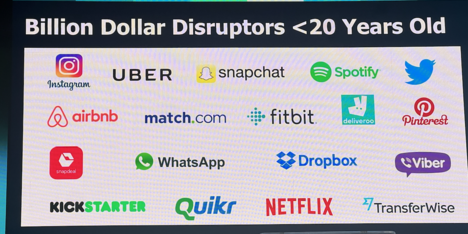
“Complexity is the enemy of meaningful work. People can’t focus and they can’t move fast enough,” Bodell observed. “Companies that operate with simplicity don’t just succeed, they completely transform industries and the way we live.”
She shared examples, as shown in the chart at right, of companies that have led such transformations over the last few decades.
Noting there were many in her audience who were also on personal devices as she was speaking, Bodell said, “We like to multitask. The bad news is a lot of complexity is self-imposed. The good news is it’s under our control.”
What happens with so many people in organizations is they don’t think of a workaround or a hack because they think they are “cheating,” Bodell said. “A lot of complexity is driven by fear--fear of looking stupid or being fired, and they hold back.”
The Complexity Trap
How does an organization get out of what Bodell called the “complexity trap?” She offered these observations:
- Less Focus: Volume vs. Value. “How many people are rewarded for doing less and simplifying things?”
- Less Agility: Internal vs. External. “If you are operating with complexity, you are on defense. If you are operating with simplicity, you are on offense.”
- Less Thinking: Doing vs. Thinking. “This is most important. If you are operating with complexity you have less time to think. You have to have an active process to think. With complexity, you are focused on doing and not thinking, you are focused on being productive and accomplishing things, not sitting around thinking. But if we don’t give people time to think, we don’t give them time to innovate.”
Thinking About Thinking
In another poll of her audience, this time asking where people do their best thinking, a word cloud of the responses revealed “in the shower” was the most popular answer, something Bodell said is consistent across numerous other groups she has addressed.
“We tend to do our best thinking when we are alone, when it is quiet and when we are not at work. I’ve never once heard anyone say, ‘I tend to do my best thinking on a Teams call’,” she said, drawing laughter. “Unless we clear out the space for thinking, we’re going to continue to get the same answers.”
Bodell said the best brainstorms actually come when people are given the questions in advance—which she dubbed a “question storm”—with employees given time to think about those questions alone.”
Why People Leave
“If we are strategic about our time, we can use simplicity to our strategic advantage,” Bodell said. “If you get the work right, you get the culture right. Too many of us think about work culture as fun and games and everyone loves it and they have ice-breakers that nobody wants to participate in. It’s great that we have colorful rooms, but if that’s all that’s needed Google would have a 100% retention rate. But they have a global simplification effort because they have problems retaining talent, because people want the work that they do every day to matter….If (employees) are on fire for making a difference, that's the culture. If I get the work right, they can do important things. This is why you want this as a strategic advantage. When you use people’s time right, they stay. When you waste it, they leave.”
The Cut the Crap Committee
Google, Bodell related, has created what it calls “Cut the Crap Committees” that are led by two people every month, with the leaders rotating.
“They report back at end of the month on all the crap they saw,” Bodell said. “Some people may be scared to lean into simplicity. Some have chief simplification officers and teams that reward people for cutting crap. The question is how much do you want to lean in? The good news is simplicity is largely free. But you have to set up a way for people to feel comfortable. And you have to measure it in more than just dollars.”
Credit Union Example Cited

As an example of one organization that tackled simplicity, Bodell pointed to Vancity Credit Union in Vancouver, B.C. She said the credit union created a simplification team initially with two people who were trained on agile, and then did “simplification sprints.”
It opened the team to anyone in the credit union who was willing to be accountable and who said they had a policy, procedure or form they wanted to simplify. In the first year the credit union did 18 sprints, and people were “begging to be able to do these sprints,” according to Bodell.
Bodell said the initiative has led to 300 policies and procedures being simplified or eliminated, 100 forms being simplified or eliminated, and more than 200 steps being removed for both members and employees alike.
“They said the response has been one of highest member satisfaction ratings ever, because they expected members’ time,” Bodell said.