

LAS VEGAS–Artificial intelligence is dominating the discussion inside credit unions, leading to concern, angst, excitement and more. There has also been considerable uncertainty over what AI really means and how to know if it’s working, and one expert here offered some answers and insights around the many questions CU leaders have.

Hilary Mason
Speaking to the Origence Lending Tech Live event, Hilary Mason, cofounder and CEO of Hidden Door, a game studio that uses machine learning, who prior to that was also co-founder and CEO of Fast Forward Labs, an academic and more, acknowledged there’s a paradox in the market right now.
“We are in a moment when AI is in the news in ways that contradict each other. In one way, it’s the future of all business. And then we have AI leaders who have released a letter saying it is an existential threat that’s on par with pandemics. The technology has come to the point where it is useful, where it can potentially do harm, and where everyone is trying to figure out what it actually is.”
While AI may be the buzz-tech du jour, Mason noted she was actually a professor of machine learning 20 years ago.
Stages of Technology
She shared the slide below to show the various stages of technology in the leadup to today.
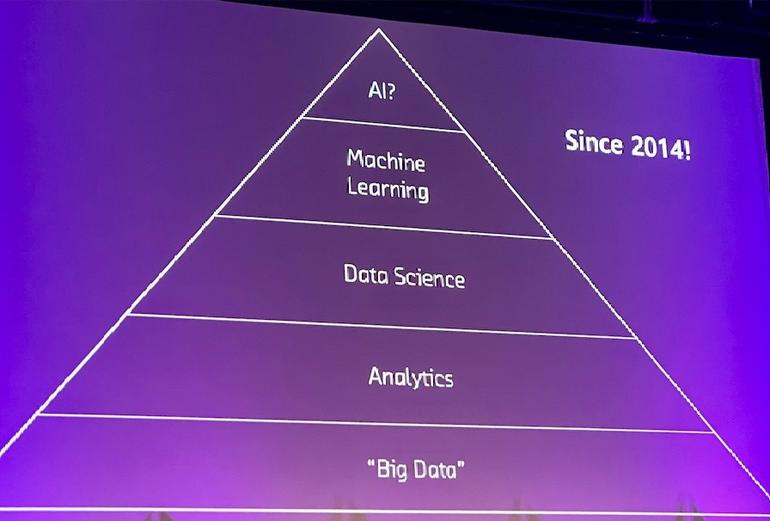
What Mason said she has learned during her career is “data is the foundation of modern business. The math is the same, but it applies differently to every business.”
AI is also about overcoming what has been a big challenge to earlier forecasting models and programs: the bias of earlier data.
“We now predict the future based on what's happened in the past and that's important because we can't predict the future if it doesn't look like the past, as every single data scientist found out when the COVID-19 pandemic happened and human behavior changed and all of our data models broke,” Mason pointed out.
Deep Learning
According to Mason, AI really began to gain ground when “deep learning” technologies took hold. And among the function within companies and credit unions where AI has been seeing the earliest applications has been marketing, which is among the most data-driven of functions, he said.
Why Is It So Hard?
So, why is deploying AI effectively so difficult to do well?
“Because it’s not one thing to do well,” explained Mason. “It’s a mathematical layer cake. The math is the same at the top and bottom, but there are layers of different capabilities that all have to interact well in order to execute on this. Inside a company you actually need to collect the data properly and accurately.”
To do that, Mason said a credit union needs:
- The provenance on that data
- To understand why it looks the way it looks and where it comes from
- IT support to be able to access it and ask questions of it
- Organizational support so that “when one side of your business says like here's a customer that's active, the other side of the business has the same definition of that
- The organizational and the talent support to know how to assign the right people to the right projects
- A way to ensure the CU is not redoing the same work over and over again
And after all that, said Mason, a credit union needs a “way to operationalize and maintain all of this. So, this is really not about the math or the technology, it's actually about people, process, and organizational systems. The tech is just one piece of it and it’s not even the hardest part.”
What Does Good Look Like?
Understanding what good, meaningful results mean when it comes to AI was defined by Mason as “consistent decisions across an organization.”
But within organizations there is another challenge, Mason observed. “It’s natural to think about this only in applications where you are spending money. It’s easy to count the dollars saved. The organizations that do this well also look for growth opportunities. It’s not just about automation.”
Who should be leading AI and machine learning efforts inside CUs and CUSOs and the like? Mason noted that while it’s now possible to get an advanced degree in data science, the curriculum behind that degree can be quite different.
“To be really great at this as a job you have to do these three things,” she said. “You have to be able to understand the mathematics well enough to build the models to know what you're doing. You need to be able to code. Some data scientists and AI folks are excellent software engineers, and some are not. And the third one is the most important and that's communication. That means you can sit down with somebody, ask them what problem or decision they're trying to solve or the decision they're trying to make go away and do an analysis with the data that's available and the tools you have, and they have to be able to come back and explain what they learned so better decisions can be made.
‘It Doesn’t Matter’
“It doesn't matter if you come to it from social science or if you're an English major,” she continued. “The best data teams I've ever worked on have people from all different backgrounds. It’s really that diversity that makes the quality of the work much better.”
What is Worth Doing
According to Mason, “Everyone knows what failure looks like, but mediocre and excellence look a lot alike at the beginning. The difference is with excellence you’re able to build on the things that work.”
Being able to differentiate requires someone who is best positioned to think about where the machine learning and the AI is going right, “and it's usually not the CEO and I say that as a CEO. It is usually the person who is out there with the product, with the customers. They're either in sales or support. It is the person who sees the behavior every day.”
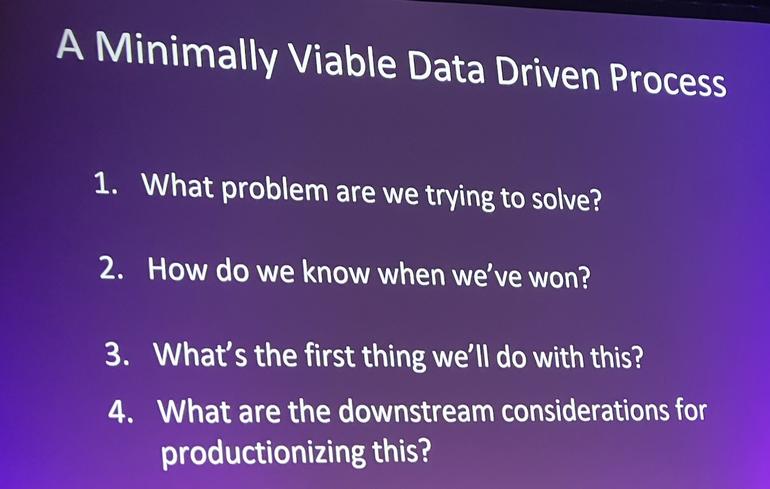
Overall, implementing AI is a process of continual learning and getting better, Mason said, recommending CU decision-makers use the steps below.
Ethics & Data Science
Mason said it is impossible in this moment not to talk about ethics when it comes to artificial intelligence. Mason, who is the co-author of a book called “Ethics and Data Science,” said the following questions need to be considered:
- Are those impacted by this project represented in its formulation?
- Are our evaluation criteria and testing process thinking about disparate impact?
‘Let’s Do It Right’
“AI lies to you,” Mason cautioned. “It magnifies bias, which is then scaled in decision-making. It hypes and encourages people to believe it.”
To overcome that, she said, requires bias testing, auditing, human overrides and fact checking.
“In 2023, data is foundational. These are things that could not be built before this particular moment in time,” Mason said. “We are now unlocking the ability to apply it to entirely new domains. So, let’s do it right.”