

LAS VEGAS–There is a “new era in automotive retail,” and credit unions gathered here were told what they should be watching for and given some strategies to consider in responding.
Speaking to Origence’s Lending Tech Live event here, Aleks Bogoeski, SVP-product and partnerships with the company, said the good news is credit unions on the CU Direct Lending platform have seen over the last 18 months the largest growth in 10 years in both new and used car financing.
But not “everything is rosy,” he added, pointing to the shifts that are now well underway.
“The changes impacting the auto industry are pretty multi-dimensional,” Bogoeski said. “To date, dealers have enjoyed a prominent position in the sales funnel. However, moving forward (see graphic below) is how we think the market is going to change.”
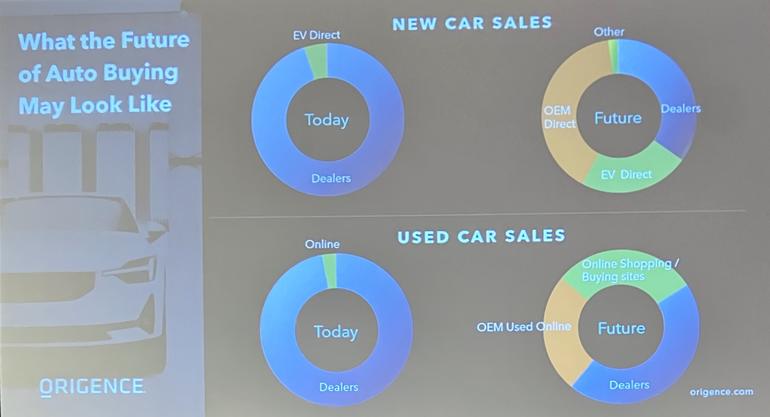
According toBogoeski, the biggest changes in the evolution of the market are found in:
- Online marketplaces and auto shopping channels
- Online direct-to-consumer used car sales models, including GM’s CarBravo offering which is being rolled out
- EVs and OEM direct-to-consumer auto sales models. “I think electrification is the biggest one driving this industry. The fact Tesla has been successful in going direct to consumer has put OEMs on notice,” Bogoeski said. “A lot of this is putting a lot of force on digitization and top of funnel.”
Big Move to EV
Bogoeski said 25% of car purchases are forecast to be online by 2025—just 18 months from now--up from 10% in 2020.
“In order for dealers to be successful in their showrooms, they are going to have to be successful online, and we are going to have to work with them in this channel,” Bogoeski said.

Aleks Bogoeski
Bogoeski pointed credit unions to four of the top five online auto marketplaces in the market today--cars.com, CarGurus, Autotrade and TrueCar—and noted credit unions are not working with any of them today, as these outlets prefer to work with one lender, rather than hundreds or even thousands of individual CUs. Origence is seeking to build that role, he said.
Looking to the EV market, Bogoeski said six manufacturers have already committed to eliminating internal combustion engine vehicles by 2035 (as has California). That is evident in the 49 new EVs launching in 2023, putting a dent in Tesla’s share, especially as costs come down, he noted.
The Bottom Line
“Credit unions need to be prepared to make more EV loans. That’s the bottom line,” said Bogoeski.
He noted the majority of EV loans are more than $44,000, but one in five are between $54,000-$64,000. While credit scores for EV buyers tend to be higher, that will “normalize” as well over time, Bogoeski said, before reminding those prime credit buyers also represent opportunities to capture higher deposits.
“The other things to consider are terms in EV financing,” said Bogoeski. “You’re really good at 84-month terms. You might want to lean into that. EVs are expensive right now, but they also tend to last a lot longer. You also want to think about the bundling of services, such as for home electric chargers, which are about $1,500. They’re not cheap.”
Bogoeski said Origence’s goal is to help drive and position CUs to be competitive in all the different channels outlined above. That includes its new FIDirect solution, where it is seeking to position one originator in each channel.
Changes in Retailing
“Tesla is also changing the way sales are made,” according to Bogoeski, citing how other OEMs have begun testing new models.
“It’s just more pressure in the pipes for us to change. The rate at which OEMs are engaging and integrating financing direct to consumers is accelerating. Ford has set up a new company for its EVs and is requiring dealers to invest to make EV sales.”
Overall, Bogoeski said OEMs are rethinking the entire role of auto dealers in the sales model.
“There is a lot happening in the industry,” he said. “Buick bought out a lot of its dealers. GM, with the launch of their new $200,000 Hummer, tested the waters in controlling pricing. And Ford did the same thing with the Lightning, constricting dealers on how much can they sell it for. They’re testing the waters here.”
All of the manufactures are looking at new ways to make money, especially in software and subscriptions, where Tesla has an enormous advantage. Stellantis, for example, has said it anticipates it will make more than $22 billion in software sales alone by 2030, Bogoeski said.
Strategic Questions for CUs
What does all this mean for credit union auto lending?
Bogoeski urged CUs to be thinking about pricing and underwriting guidelines and how those will change with EVs vs. ICE vehicles.
Other questions to be discussing, he said, include:
- Automated decisioning. “If you take nothing else away, we need to be better at automated decisioning. It’s a must. Decisioning speed and use of advanced automated decisioning tools and are essential to effective online experience.”
- Streamlined Membership Experience. “The process of memberizing someone is a friction. We need to think about how we lower that friction.”
- Technology and Partner Integrations. “Push your CUSOs. Push us. Embrace e-signatures and digital documents. One thing to really think about is making sure cybersecurity is a competency. Fraud is just going to become more prevalent. Leverage your partners.”
- Lending Channel Strategies “The whole point of a strategy is how do I position myself to win at the end. The CUSO rule change was powerful. Think about the channels you want to participate in and think about what you have to do to be successful. This has to be an ongoing competency.”