SAN DIEGO–Less than six months after entering into a lending partnership with Tesla, Origence is reporting credit unions have done more than a half-billion-dollars in loans for the EVs, while a Tesla executive offered his thoughts on what has taken place to date and what he believes lies ahead.
Christopher Yuan, senior manager, NA credit operations and partners with Tesla, and Bob Nealon, VP-business development with Origence, shared their thoughts during a Q&A at the Lending Tech Live 24 event in San Diego, with Yuan appearing virtually from Tesla’s headquarters.
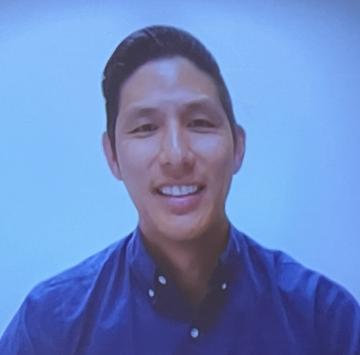
Christopher Yuan speaking remotely to Lending Tech Live meeting.
Origence, which offers lending through Tesla’s online purchase application via its FI Connect subsidiary, reported earlier in the meeting that since launching it has done 13,000 Tesla EV loans in the 36 states where it’s available, representing $550 million in loan volume. It has also done some loan subvention programs as part of that.
The Discussion
Here is some of what was discussed:
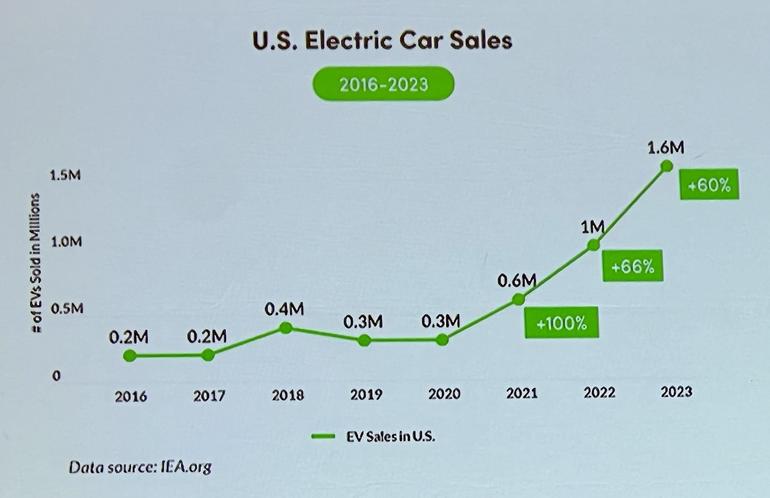
Nealon: It has been an amazing ride in a pretty short period of time. There were 1.6 million EVs sold last year, and if you look at the growth rates post-COVID, it’s amazing.
Yuan: We have been seeing quarter over quarter growth and it doesn’t seem to be slowing. We have the best-selling car in North America and we will continue to hold that place in 2024. I think the market is now realizing EVs are here to stay and will continue to grow. We’re OK with competitors joining the market. Our mission statement is to accelerate the transition to alternative energy.
Nealon: Clearly, Tesla has been the disruptor in EVs, and is dominant in the space. Any thoughts on market share?
Yuan: As more OEMs come into the EV marketplace, we welcome that. We opened our supercharging network to other EVs. We want to do whatever we can as an organization to grow sustainable energy, and not just vehicles. Tesla has 56% of market share for EVs, but that’s still a fairly insignificant share of total sales. There is still a ton of the market for us to capture. Our intent is to take away market share from the (internal combustion engine) market.
Nealon: What makes purchasing a Tesla so different and what is the consumer experience like?
Yuan: I do think from a consumer’s perspective this is the right model that every EOM should be moving toward. We are very customer-centric in everything we do. We want to have very transparent pricing, which is very different from what traditional dealers do. What we advertise is exactly what the customer will pay. We don’t have additional fees or costs on the transaction.
The pricing on our vehicles fluctuates. But in being customer-centric we always try in vehicle pricing to put the customer first. If the price goes lower before the customer takes delivery and after ordering, we will give them the lower of the two price points. In addition, there is no negotiation on the price or on the financing.
Our whole experience is done via the Tesla app. There is no pressure around how they want to buy the car or finance the car. Our job is to help the customer through the journey. We don’t push the customer to take one financing over another.
Nealon: How has EV financing vs. leasing trended?
Yuan: Leasing was not a big driver initially (at Tesla). But there has been a sizeable jump. This has been driven by the Inflation Reduction Act and its $7,500 tax credit. There is a provision in the IRA that allows that $7,500 tax credit to pass to the consumer. It ignores some of the requirements of some of the more traditional (provisions around source of materials and vehicle price). It’s somewhat of a loophole. Because of that, leasing has become very popular because the lessor that is the actual owner of the vehicle doesn’t have to align with those provisions.
We’re not the only OEM participating in this. It’s a way for OEMs and banks to provide compelling pricing.
Nealon: What would you tell the audience about the financing process?
Yuan: What makes Tesla different from the traditional F&I is we’re not here to sell the customer any ancillary products and our intent is always to provide the customer the best rate possible. We’re not incentivized on financing. That’s why having a partnership with FI Connect is so valuable. The majority of third-party lending had been driven by customers who wanted to get financing through credit unions. But the reality was Tesla, being a big organization, couldn’t go and partner with credit unions that were state specific or region-specific. That’s why the partnership with FI Connect just made sense. We are able to tap into credit unions collectively. It’s a no-brainer for us.
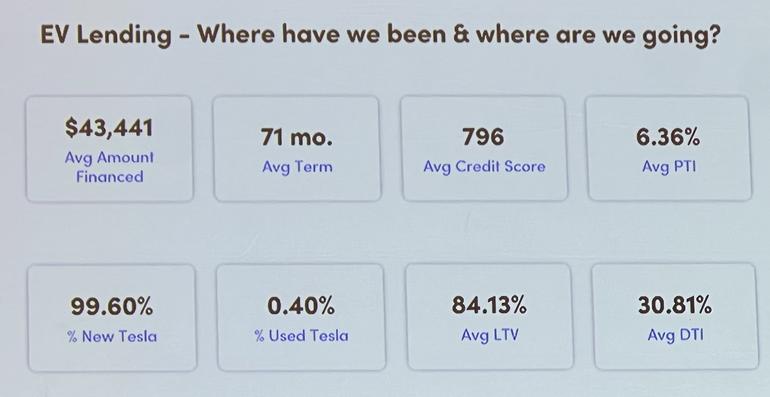
Nealon (who noted funded first loans with Tesla in September 202 in one state with one credit union): For the first couple of months it was a slow roll, testing things out and working hard to make this work. It’s been a five or six month time frame where we have been operating somewhat at scale in Tesla’s automated system. We’re one of their national lending partners and when you look at some of the volume we have been doing in the last few months, it’s something we are proud of and something we are going to see much more of in the future. Now, 24 credit unions are live with Tesla and quite a few are in the pipeline.
Nealon: What about used values?
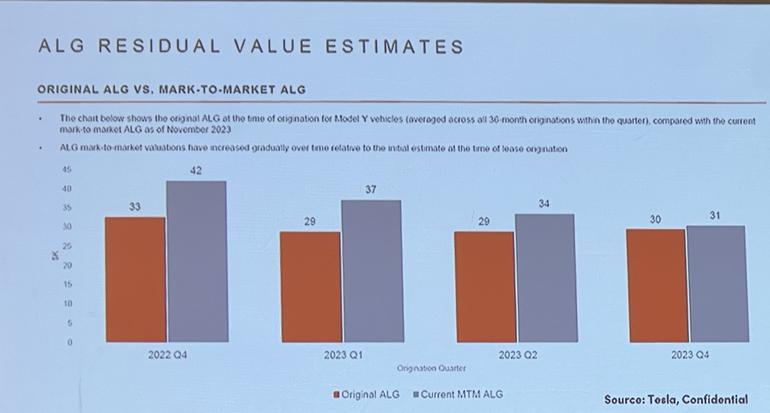
Yuan: SEE CHART These cars are holding their values well above the original estimates. Even in the recent auto price adjustments, we still see the mark to market is still higher than the original ALG. The ones that don’t meet our requirements and are sold into the wholesale channels are always the worst cars, and those are the ones ALG uses (for its data).