

SAN DIEGO–Credit unions here got a primer in how electric vehicles work, what the future of automobiles likely looks like, and why some expectations require adjustment.
Speaking to Origence’s Lending Tech Live 24 event, Chris Gerdes, professor emeritus in mechanical engineering at Stanford University, took his audience along on a ride to the future of automobiles, as well as energy itself.
Gerdes, who led a student team that built “Marty,” the world’s only automated, drifting, electrified DeLorean, is a believer that increasingly in the future electric vehicles (EVs) are going to be a “non-brainer” for consumers.
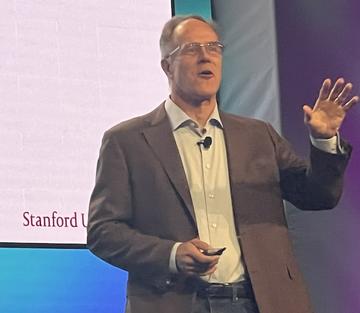
Chris Gerdes speaks at Lending Tech Live
The Basics
Gerdes first offered some basics, walking his audience through how energy flows in a gasoline-powered car vs. an electric vehicle. Two thirds of energy in gasoline is lost when converted to mechanical energy, he said, much of it in the form of heat. The remaining one-third is used to overcome rolling resistance, aerodynamic drag, road grade and acceleration, which an EV must also overcome.
An EV is much more efficient, with about 10% of energy lost in conversion, Gerdes explained. Plus, braking in an EV recaptures energy. And although power plants consume energy and create emissions in generating power, it’s still more efficient than creating carbon-based fuel, he said.
What about a hybrid?
In a hybrid, Gerdes said a little less than 70% of energy is lost.
The best of all worlds, he said, is plug-in hybrids, but it’s also the most complex challenge.
Perspectives on EVs
Three different constituencies have different perspectives on EVs, according to Gerdes, including:
- Government. Gerdes said government sees proven tech to lower C02 emissions and a path towards climate goals.
- Industry. Industry sees lower parts count and simpler construction (but also a need new skills and supply chains)
- Consumers. Consumers like the high torque, smooth acceleration, quiet drive and low maintenance, but are concerned over charging and range.
Declining Interest
Gerdes said there has been declining interest in EVs, with the major concerns including price, charging and operation in cold weather. A recent AAA survey found about 18% of consumers said they are likely to purchase an EV.
Price is a huge issue, Gerdes agreed.
“Many manufacturers looked at what Tesla did and saw a market for expensive electric vehicles where they could make a huge profit,” he said. “The problem was people who were interested had already bought a Tesla.
So, where the affordable electric vehicles? They are in China, Gerdes answered.
“The Chinese government has invested massively” in EVs, and a result has been some vehicles available for less than $10,000, with one available under $5,000, Gerdes said, noting it’s “very doubtful” those vehicles will arrive in the U.S.
But prices are coming down in the U.S. and it’s “moving the merchandise,” Gerdes said, citing a quote in a recent report.
Getting Warmer
And what about the issue of EVs not operating in cold weather? It is an issue, as is the loss of range, Gerdes acknowledged, adding it will likely become much less of an issue in the near future as improvements are made.
In addition, in the near future Gerdes said batteries will be able to charge to about 80% in 14 minutes, which remains a long time compared to refueling at a gas pump.
“For EVs to become a no-brainer solution, people need a place to charge them that’s convenient,” said Gerdes, who is an advocate for solar systems—about a million systems per year are being added—as a means of making EVs more attractive.
A Solar-Powered Conundrum
On the issue of solar energy, Gerdes noted that peak solar production actually occurs at the same time demand decreases (mid-day). The scenario becomes a “problem” known as “curtailment,” because energy needs to be stored or it is “just lost.” California has responded with policies that have led to changes in net metering and, as a result, a recent drop in installations.
When it comes to home charging, Gerdes said many EV owners are finding there isn’t an adequate power transformer or substation that can handle the demand of electric vehicle charging stations installed in homes.
Gerdes noted the infrastructure requirements for mass adoption of EVs could be in the trillions of dollars, according to some estimates.
“Who’s going to pay for all this?” asked Gerdes. “In California, it’s increasingly those without solar systems. In Northern California, the average price of electricity has doubled in recent years.”
‘Premature’ Predictions
Gerdes said he believes despite those challenges, any talk by critics about the “failure” of EVs is off-base and premature.
“EVs are going to be a no-brainer decision for more and more people, but some challenges increase as we add EVs and renewable energy,” he said.
Gerdes said he doubts the market will get to 100% of EVs as the result of “diseconomies of scale,” as solar and electrification move in the opposite direction of affordability. “And the benefits to climate change may not be worth the cost,” he said.
Automation
When it comes to automated driving, sometimes called “self-driving cars,” Gerdes said the benefits include:
- Free up time from driving
- Accessibility
- Lower transportation costs
- Safety
- New vehicle concepts
There are three paths forward with automated vehicles, Gerdes said, and include full self-driving, fully automated when active and robo-taxis.
Gerdes said he has been researching the question, “What if we could use all of a car’s capabilities to automatically avoid a collision?”
“This is what I think automated vehicles can do and a safety benefit they can achieve,” he explained.
The New Question
The question now is whether AI or neural networks make the most sense as the foundation for self-driving cars, with Gerdes admitting he has no idea which technology will win out.
But what he does know, though, is this: “The future looks very different from today. We just have to adjust our expectations around the timing. It’s not going to happen tomorrow.”