

SAN DIEGO–It’s impossible to predict the future, but there are ways to create a “path” for getting there, according to Andrew Busch, who offered some signals every CU leader should be watching.
Busch, the former first chief market intelligence officer for the Commodities Futures Trading Commission who regularly provided briefings to the White House and Congress, as well as the founder of a boutique financial markets and policy research firm, today calls himself an economic futurist, said what’s most often misunderstood about forecasting is that it must have context.
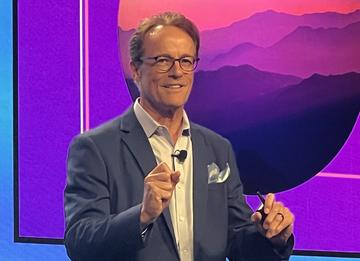
Andrew Busch addresses the meeting
“If you don’t know where you’ve been, you won’t know where you are and you most certainly won’t be able to figure out where you’re going,” Busch told Origence’s Lending Tech Live 24 event.
In his work, Busch said he tries to provide a “future path,” that is, not a prediction of the future but a “path to the future.”
The Present ‘Context’
First, the present “context.”
Busch said the present is very much affected by COVID and the shutdown of global economies followed by an economic boom, especially in the United States where the federal government flooded the market with stimulus and rates were at rock bottom. With services largely shut down, orders for goods surged, and that led to global supply chain issues, he said.
“The Fed kept its foot on the gas through 2022 and now it’s trying to tame the inflation it helped to create,” Busch said, saying the Fed’s moves to raise rates, albeit too late, is “good news.”
Two Points of Interest
For credit unions, two points of interest cited by Busch:
- Used car prices are crashing. “We need them to keep going down,” he said.
- Home prices will not be coming down. There is huge demand for housing, driven in part by immigration, and a lack of inventory as current homeowners sitting on rock-bottom mortgages aren’t moving, he noted. With many seeing pay increases, Busch said high mortgage rates aren’t really the issue—it’s the lack of supply.
What will Fed do this year? Wetting his finger and sticking it in the air, Busch said, “The Fed doesn’t know.” He believes there will “maybe” be one rate cut in 2024.
“The Fed totally screwed up. Inflation was not transitory,” he said. “It’s pernicious. Once it’s in the economy, it’s very hard to get rid of. Now they’ve moved very quickly. But they have no reason to cut rates when you are getting growth, unemployment is low and they’re missing their inflation target.”
The Future
Busch noted the Organization for Economic Co-operation and Development, which includes, a committee of some 2,000 economists, is projecting 2.6% GDP growth for 2024 and 1.8% GDP growth for 2025.
But Busch said there is a “big economic secret” when it comes to that data: “Most economists are awful are predicting the economy. What they are missing is humility, the uncertainly factor,” Busch told the meeting.
Busch offered the “X factors” in forecasting the economy in the graphic below:
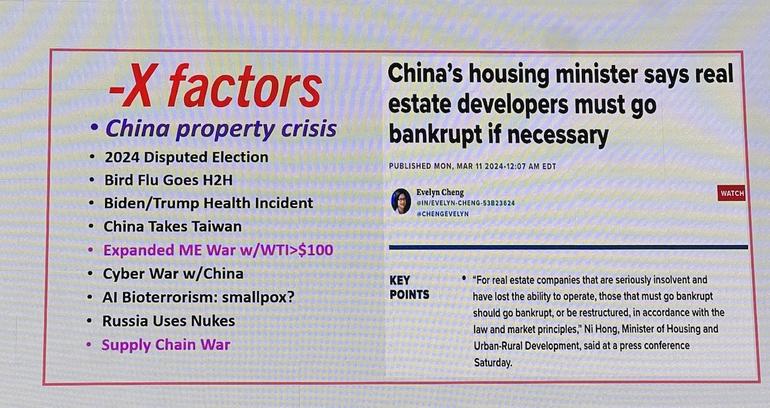
“My biggest worry is China right now,” said Busch. “They have a housing crisis and they are just going to keep pumping out the goods. In communist countries they don’t shut down factories when demand is not there, they keep pumping them out and lower the prices. BYD makes an EV for $15,000 less than Tesla and everyone else.”
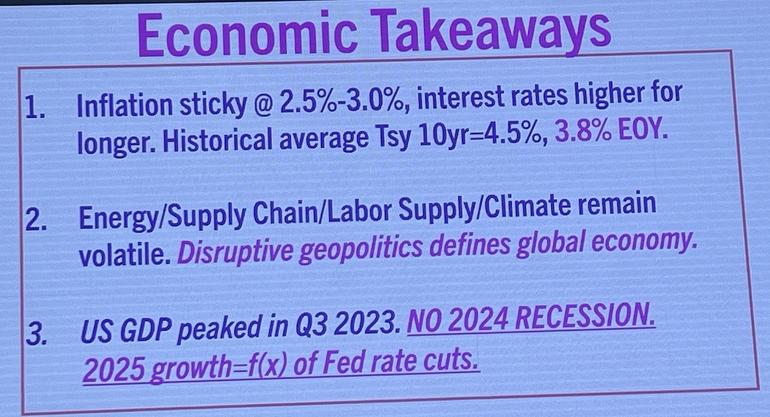
Busch also offered these “economic takeaways” as outlined below:
The Trends
Busch said credit unions should be watching these trends:
- Net Population Growth: The U.S. has seen a 3.8-million-person population increase, driven by immigration. “From economic standpoint, this is fantastic. From a social standpoint, it’s a different discussion. But this creates a lot of economic opportunity.”
- Work from Home is holding steady at 27% but slowly declining.
- Weather Volatility, especially rain, is an increasing issue.
The Crystal Ball
Based on where venture capital is placing its money, Busch said credit unions should pay attention to:
- Climate and weather analytics
- Credit scoring and risk management
- Cybersecurity (AI to be used in attacks)
- Talent acquisition and retention
- Digital Twins (digital representations of anything)
- Digital humans (companies that digitally re-create people, which would allow an employer to “keep” an employee even if they leave with a depository of all their information)