

AURORA, Colo.–The auto sales and financing markets may be in a state of unprecedented flux, but with the exception of consumers, everyone is winning from manufacturers to dealers to lenders, with the biggest winners right now being credit unions, according to one expert.
The same person offered a forecast for what’s ahead in auto lending, including how captive financing companies are likely to respond to the success credit unions are having in one area.
Speaking to the Origence Lending Tech Live meeting here, Thomas King, president, data and analytics division, and chief product officer with J.D. Power shared the chart, below, which he said is often used to illustrate the state of the industry. He called the chart “garbage.”
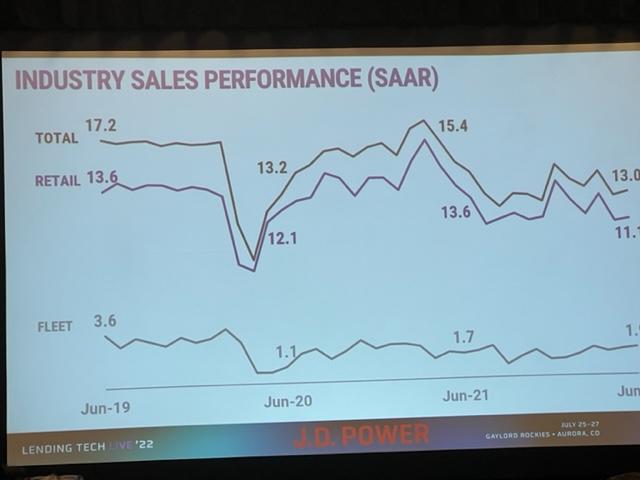
Instead, he said the better way to understand what is taking place is to understand how retail sales are being dictated by available inventory.
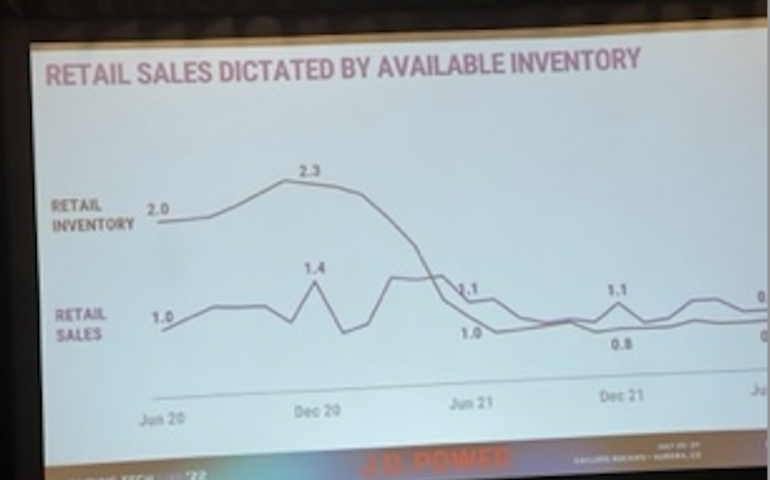
“Every month we’re seeing about a million units, give or take, because that’s what’s being built for sale,” said King. “Ten days is the average time new vehicles are lasting on the lot. Consumer demand is sky high. What do you get? It’s economics 101: Demand exceeding supply has led to record profitability.”
King noted the average vehicle transaction price in 2022 is $44,900, up 34%. As a result, incentives from manufacturers, which had averaged 10% of MSRP in deals, have all but disappeared and are now less than 2% of MSRP.
“We are trading off volume for price,” King said. “The better way to think about the health of the car business is the value of cars purchased.”
King said the transaction price gains have more than offset the volume declines, which he said is great news for manufacturers and dealers, which have seen a 268% increase in gross plus F&I per unit profit to $5,000 per unit. Gross profits for manufacturers was $29 billion in 2021, although those profits have come at the expense of consumers as prices have surged
How Will Inventory Situation Evolve?
So, what is going to happen with production, which will influence inventory, incentives and lending?
King noted that in 2018, 17.3 million cars were built. In 2019, three strikes drove production down to 16.6 million units, and then COVID pushed production down further to 13.3 million units in 2021.
“It was thought that really smart people who have been figuring out supply chains would surely have it figured out by now. But no. We’re still at 70% to 80% of normal levels. When will we get back to normal? It’s hard to predict. COVID continues to play role.”
Even if production does increase, King pointed out that pent-up demand will consume it.
Pent up demand, said King, will consume extra production. Even a recession is unlikely to affect that scenario, he said. As a result, tight inventories are likely to persist, adding that fundamentally, it’s going to be more of the same for the foreseeable future, he added.
OEM Incentives
According to King, the lack of inventory means a lack of incentives for the near term.
“When you haven’t got anything to sell and you have all these customers, you don’t need discounts. Those deals have gone away and the way they’ve gone away is really important,” he told the meeting.
As an example, King pointed to car incentives, finance incentives and lease incentives. The first two have seen big decreases, but the biggest dollar decline has been in lease incentives, he said.
The leasing decline trend has most affected premium compact cars, which have gone from 70% of lease volume in Q2 2019 to 30% in Q2 2022.
Longer Loan Terms
Meanwhile, those ever-higher new vehicle prices have pushed many borrowers into longer terms in order to get their payments down. King said the biggest growth has been in 84-month terms, which have gone from 15% of all auto loans in Q2 2019 to 20% in Q2 2022. That has made dealers “anxious,” because the long-terms are keeping people out of the market. The same is true for people in longer-term leases, he said.
“It’s not a problem today, but it absolutely will be a problem a couple of years from now,” King told the meeting. “Today, it’s fine because everyone is making tons of money, but this is a real headwind for manufacturers, dealers and captive lenders.”
Not surprisingly, he added, subprime borrowers have declined significantly, in large part due to affordability issues and the fact manufacturers aren’t building the inexpensive vehicles that are less profitable when they only have a limited number of chips.
How Does This All Play Out?
What’s ahead? The size of the new vehicle financing market has obviously changed, said King. New vehicle sales are down, but the percentage of vehicles financed has increased even as volume is down slightly. And because the amount financed has been so much larger (25%), the value of loans has grown 17% to $74.8 billion.
Who is Winning/Losing?
As chart below shows, the big winner in auto lending is credit unions, whose share has grown to 25%.
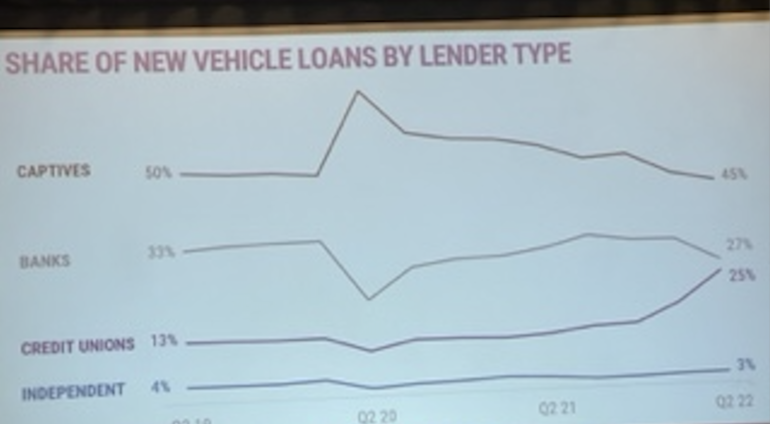
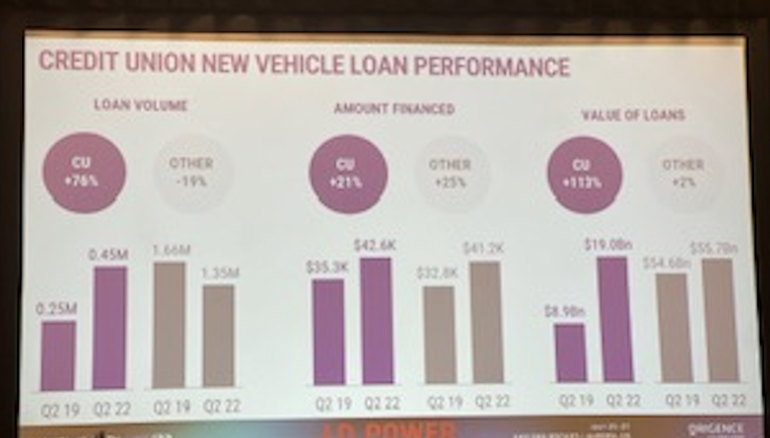
Credit unions are winning due to terms, FICO and rate (thanks to captives’ pulling much of the subvented financing), King said.
The Used Market in Franchised Dealers
The volume of used vehicle sold by franchised dealers has been up 8% as they have sought out new inventory, while the percentage of financing is also up, loan volume has increased, and the amount financed has seen a “really big increase” ($31,400 on average).
Again, credit unions have seen surging share with 32% of market, trailing only banks at 41%
King said he sees no major collapse in used car values anytime soon, in part because the declining number of new vehicles manufactured means fewer used cars in the years ahead
King called it an “unprecedented environment for credit union lending growth,” but he cautioned the inventory situation will eventually improve, OEM incentives will rise, and there will be an increase in offerings of 84-month by the captives, because the lenders see what credit unions are doing.
“The used vehicle values will soften gradually, and we will see a gradual transition to a less favorable environment in 2023,” but it will still be quite strong, said King.