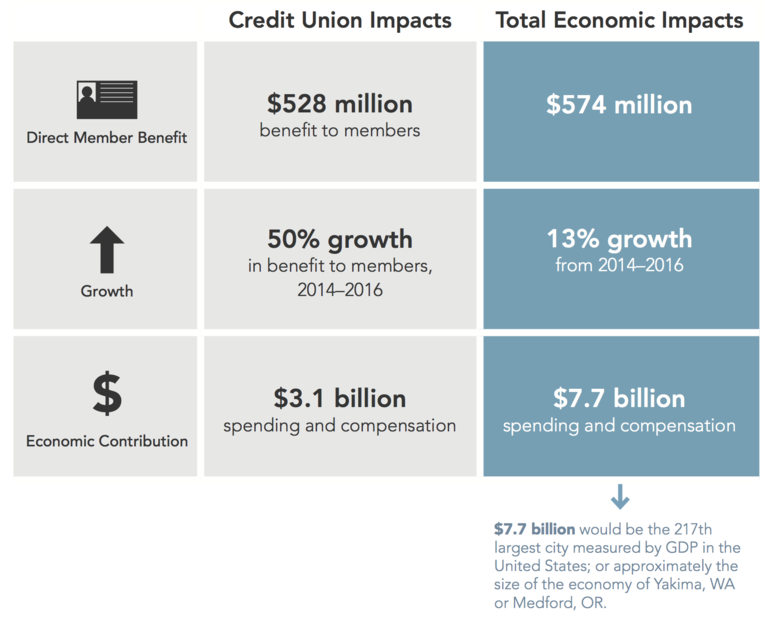
TIGARD, Ore./SEATAC, Wash.–Credit unions in Oregon and Washington created a $7.7-billion economic impact in 2016, according to a new analysis released by the Northwest Credit Union Association.
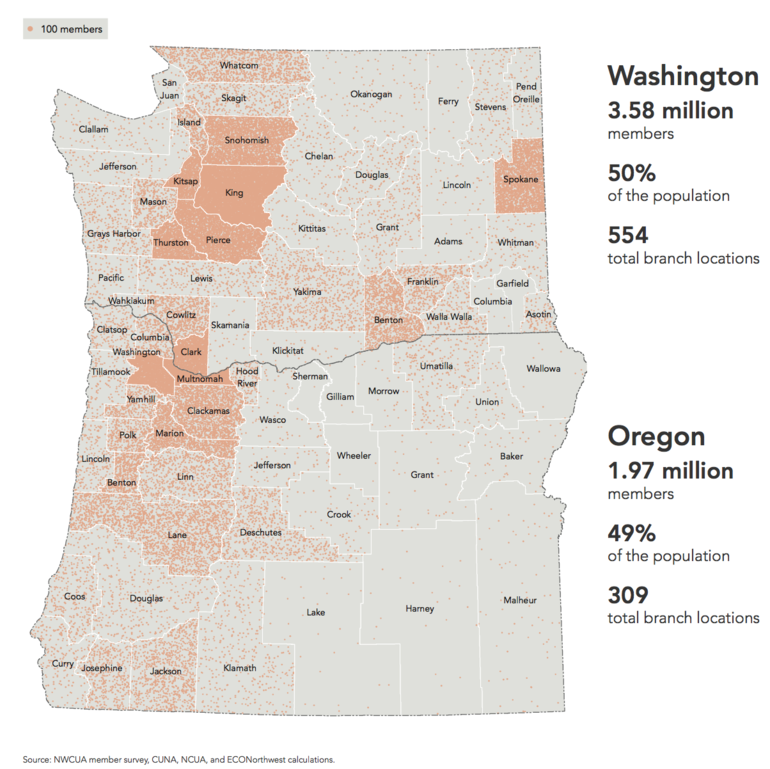
The analysis, performed by ECONorthwest, measured jobs, economic output, and income supported by credit unions in the regional economy. The study also measured the direct benefits that CUs return to their members. The study found that in 2016, the value of benefits to the Northwest’s 5.5 million credit union members was $528 million, which, when spent in local communities generated a total gross economic output—buying power—of $574 million.
According to the NWCUA, to evaluate the economic impacts of credit unions, ECONorthwest used IMPLAN, an input-output model that enables the user to follow expenditures from a company as they flow through the economy. These impacts are comprised of credit union impacts (direct) and indirect (supply chain) and induced (consumer spending) impacts and are calculated to measure economic contributions (output), employee compensation, and jobs.
“Performing a high-level, independent economic analysis documents credit unions’ economic impact on communities, and the financial empowerment they provide to members,” said Troy Stang, NWCUA president and CEO . “This leading-edge study will help elected officials and other community groups understand that credit unions’ not-for-profit, cooperative structure inherently holds them accountable to members. This data makes it clear that consumers must always have access to the cooperative financial services model.”
In addition to the $7.7 billion that Northwest credit unions contributed to the regional economy, credit unions have currently provided 3.46 million loans outstanding to members, totaling $52.3 billion, according to the report.