

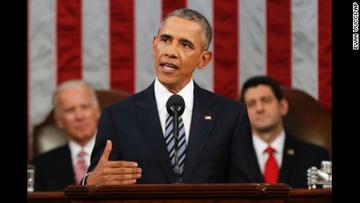
WASHINGTON—Following Barack Obama’s State of the Union address Tuesday, NAFCU applauded the president’s desire to eliminate outdated regulations, and then called for the removal of the MBL cap and outlined how Dodd-Frank is hurting CUs.
“NAFCU and our members appreciate the president’s outlook that we are in a time of extraordinary change,” said NAFCU President and CEO Dan Berger. “NAFCU welcomes the prospect of working with the administration and Congress to move our country’s economy forward, particularly through several key issues that mirror our priorities for 2016—including regulatory relief for credit unions and increased small business lending.”
Berger said that NAFCU welcomes the President’s recognition that a thriving private sector is the lifeblood of the economy.
“Our nation’s credit unions are uniquely qualified to help make this a reality by facilitating access to capital and financial services in communities throughout Main Street America,” stated Berger. “Unfortunately, they are restricted by an arbitrary member business lending cap on credit unions. Lifting this arbitrary lending cap could make more capital available to small businesses and help create valuable jobs.

Dan Berger, NAFCU
“President Obama’s call that we eliminate outdated regulations, as well as his acknowledgment of excessive red tape, echoes our concerns about the overwhelming impact of the compliance burden on credit unions,” continued Berger. “In particular, the impact of rulemaking as a result of the Dodd-Frank Act is evident as the number of credit unions continues to decline, dropping since the second quarter of 2010 by more than 17%—more than 1,280 institutions—96% of which were smaller institutions with assets of less than $100 million.”
Berger added that NAFCU looks forward to working with the administration, Congress and federal regulators on ways to ease Dodd-Frank burdens that were “not intended for the credit union industry, relief from constraints on lending to member small businesses and enactment of national data security standards that ensure all stakeholders are doing all they can to protect consumers’ sensitive personal and financial data.”