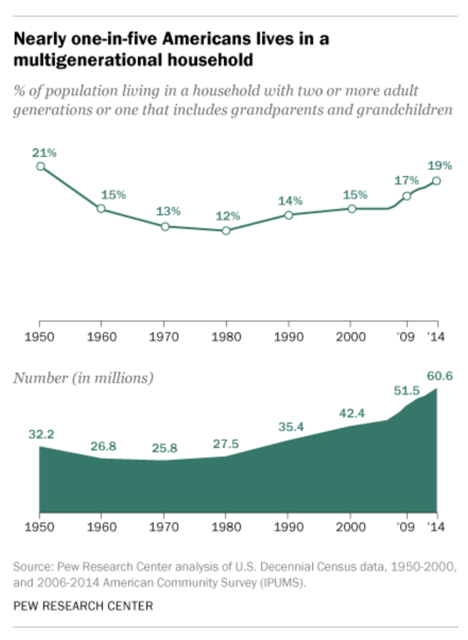
WASHINGTON–The number and share of Americans living in multigenerational family households has continued to rise, even though the Great Recession has largely faded for many people, according to new research.
And that could affect how credit unions market products and services, which products and services are marketed, and when.
According to Pew Research Center, in 2014, a record 60.6 million people, or 19% of the U.S. population, lived with multiple generations under one roof. That figure is up from a low of 12% in 1980, and approaches the record 21% of people living in multi-generational households in 1950, according to Pew’s research of Census data. Multigenerational family living is defined as a household that includes two or more adult generations, or one that includes grandparents and grandchildren. Pew said it is growing among nearly all U.S. racial groups as well as Hispanics, among all age groups and among both men and women.
The Pew Research Center said its analysis of the data shows racial and ethnic diversity in the U.S. population helps explain some of the rise in multigenerational living. The Asian and Hispanic populations overall are growing more rapidly than the white population, and those groups are more likely than whites to live in multigenerational family households, Pew said. Another growth factor is that foreign-born Americans are more likely than the U.S. born to live with multiple generations of family; Asians and Hispanics are more likely than whites to be immigrants.
Pew noted that in recent years, young adults have been the age group most likely to live in multigenerational households (previously, it had been older adults). Among 25- to 29-year-olds in 2014, 31% were residents of such households. Among a broader group of young adults, those ages 18 to 34 living with parents surpassed other living arrangements in 2014 for the first time in more than 130 years.
The research found education levels make a difference, though: Young adults without college degrees now are more likely to live with parents than to be married or cohabiting in their own homes, but those with college degrees are more likely to be living with a spouse or partner in their own homes.
But Pew said it found that even among some other age groups, more than a fifth live with multiple generations under one roof, including Americans ages 55 to 64 (23% in 2014) and 65 and older (21%). The rise in multigenerational living among these older Americans is one reason why fewer now live alone than did in 1990.
For the complete research report click here.